Most website cost articles throw out big price ranges and leave Texas business owners guessing what’s realistic for their situation. You do not just want a number but you need to know what a sensible Texas website budget looks like, what you actually get for that money, and how to avoid “affordable” offers that quietly become very expensive later.
What “affordable” really means for a Texas website?
When you think about affordable web design in Texas, the question is not “How cheap can this be?” It is “What can I safely invest so this site pays for itself and then some?
A useful way to look at affordability is through three lenses:
Risk: How much money, reputation, or opportunity do you stand to lose if the site is slow, confusing, or invisible in search? A basic brochure for a side project carries less risk than the main website for a Houston law firm or Dallas home services brand.
Runway: How long do you plan to keep this version of the site. Many Texas businesses stay on the same platform for 3–5 years, so the real cost is the build plus years of changes, not just the launch invoice.
Return: How many leads, sales, or hours of manual work the website can realistically help you gain or save if it’s built properly.
This is why a $2,500 deal can be more expensive than a $7,000 project. If a cut‑price site loads slowly, ranks poorly, and converts only a fraction of your visitors, the hidden losses in missed inquiries and sales can easily dwarf the savings you made upfront.
Not only that, but Texas brings a few quirks that affect what “affordable” really looks like: competition is intense in major metros like Dallas, Houston, and Austin, so small business websites in Texas often need more serious SEO and content structure than generic templates provide. Many also deal with multiple service areas or bilingual audiences, which adds pages, planning, and cost.
The Texas Web Design Cost landscape in One View
Most professional web designers in Texas work on either an hourly basis or fixed project pricing that is built from an internal hourly rate. Industry analyses put the average web design rate in Texas around the high two‑digit to low three‑digit range per hour, with roughly $90–$110 per hour being common for established agencies.
Those hourly rates translate into typical project bands. For a custom build handled by a Texas web design company:
- Many small business websites fall somewhere between $3,000 and $13,000, depending on complexity and scope.
- Very simple, semi‑template builds can come in under that, while complex ecommerce or multi‑location projects easily land above it.
Rates also shift slightly by city. Austin agencies often sit on the higher end, reflecting its strong tech and startup scene; Houston and Dallas cluster a bit lower overall but still within a similar professional range; San Antonio and smaller markets can trend more budget‑friendly.
Seeing these numbers as a baseline helps frame what affordable web design in Texas means. You are usually not buying a $500 website from a local agency, but it does mean you are choosing where, in a realistic, professional range, your own project should land.
How Website Type and Build approach Shape your Cost?
Two things drive your Texas web design pricing more than anything else. The kind of website you need and how you choose to get it built.
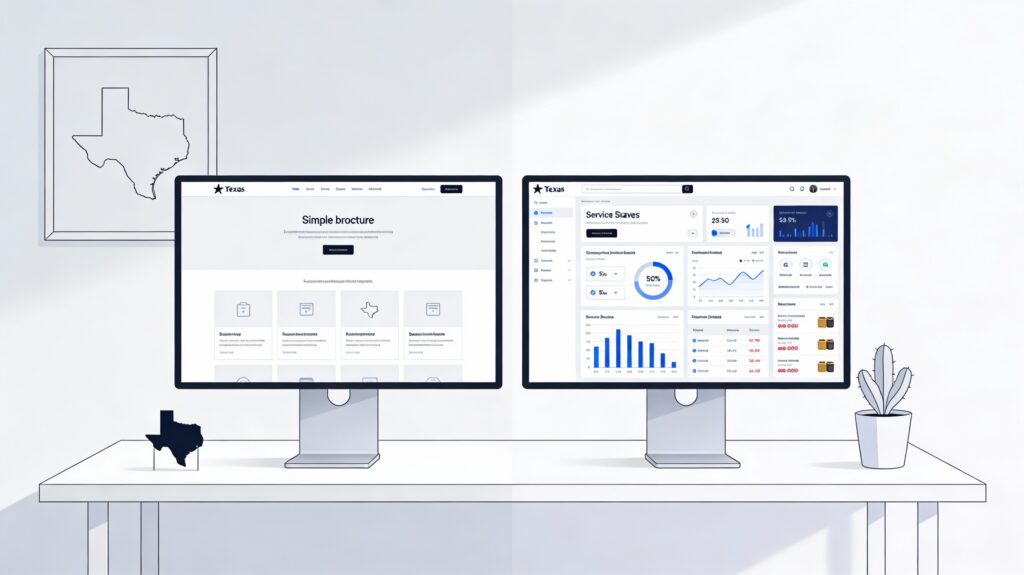
For website types, most small business website projects in Texas fall into one of these buckets:
- A simple brochure or introductory site with a handful of pages that tell people who you are, what you do, and how to contact you.
- A lead‑focused service website with multiple service and location pages, stronger calls to action, and a blog or resources section to support SEO.
- A content‑heavy or authority site often for professional services or B2B, where the structure and depth of information matter as much as the design.
- An ecommerce or booking platformwith product catalogs, carts, payments, or appointment scheduling built in.
Then there is your build approach:
- DIY builders and ultra‑cheap offshore options can get something online but usually with limited control over performance, SEO, and long‑term flexibility.
- Freelancers and very small teams can be a cost‑effective fit for truly simple sites if you are comfortable with more risk and less redundancy.
- A specialized Texas web design agency often costs more upfront but brings process, depth, and support that small businesses rely on as they grow.
Besides that, you have template vs custom. A template‑based site leans heavily on pre‑made layouts and functions, with your logo, colors, and content dropped in. A custom website design in Texas starts from your content structure and user journeys, then shapes layouts, components, and integrations around them, which means more strategy and build time but much more control.
Knowing where you sit on those axes, the type of site and method of build explain a lot of the price difference you see when you collect quotes.
Realistic price bands by website type in Texas
Once you understand the moving parts, you can look at bands with clearer eyes.
For a brochure or simple service website in Texas, handled by a professional but lean provider, you will often see pricing in the lower end of the typical range. That might include:
- A short discovery call or workshop.
- A custom homepage and a small set of inner page templates.
- Implementation on a mainstream CMS, basic mobile responsiveness, and a simple contact form.
- Light on‑page SEO, such as title tags and meta descriptions for core pages.
A growth‑focused small business website in Texas, where the site needs to support local SEO, multiple services or locations, and ongoing content, will usually sit in the middle of the common range. At this point, you should expect:
- A more thorough discovery and planning phase, including sitemap and content planning.
- Thoughtful UX on key pages, clear calls to action, and conversion paths that match your sales process.
- A structure that supports blog content or resources for SEO.
- Clean implementation of tracking and analytics so you can measure performance.
For e-commerce or more complex builds, especially those with custom product logic, membership areas, or deep integrations, the investment often climbs into the upper band or beyond. You are paying for:
- Product and information architecture that makes shopping or booking intuitive.
- Payment, shipping, and tax logic that fits your business and geography.
- Integrations with CRMs, inventory systems, or marketing platforms.
- Additional performance work to keep the site fast under load.
Instead of thinking “How do I get this as cheap as possible?”, think “Given my website type and growth plans, where in these bands does it make sense for me to land?
How City choice shifts What you pay (And what you get)?
Even within Texas, location affects the cost and style of what you get back for your website budget. Austin tends to be the priciest environment, with a concentration of digital and product studios used to working with startups and tech companies. Dallas and Houston both have deep agency ecosystems, with Dallas slightly more skewed toward small and mid‑market brands and Houston carrying a heavier mix of enterprise, energy, and industrial work. San Antonio and other smaller cities tend to offer more budget‑friendly options but with a smaller pool of highly specialized firms.
Those patterns show up in pricing. Where a Dallas web designer might lean toward polished, conversion‑driven marketing sites for local services and small businesses, a Houston web designer is more likely to have experience with complex B2B or enterprise‑level builds that carry higher minimums. If your main decision is between those two cities, there is a deeper discussion of strengths, styles, and budgets in a separate piece comparing Houston vs. Dallas web designers.
The practical takeaway is that you should not pick a city purely for price. You want the mix of cost, expertise, and project fit that matches your business, and sometimes that means looking slightly outside your immediate metro if you need a particular profile or value point.
What to expect at each Texas website Budget Tier?
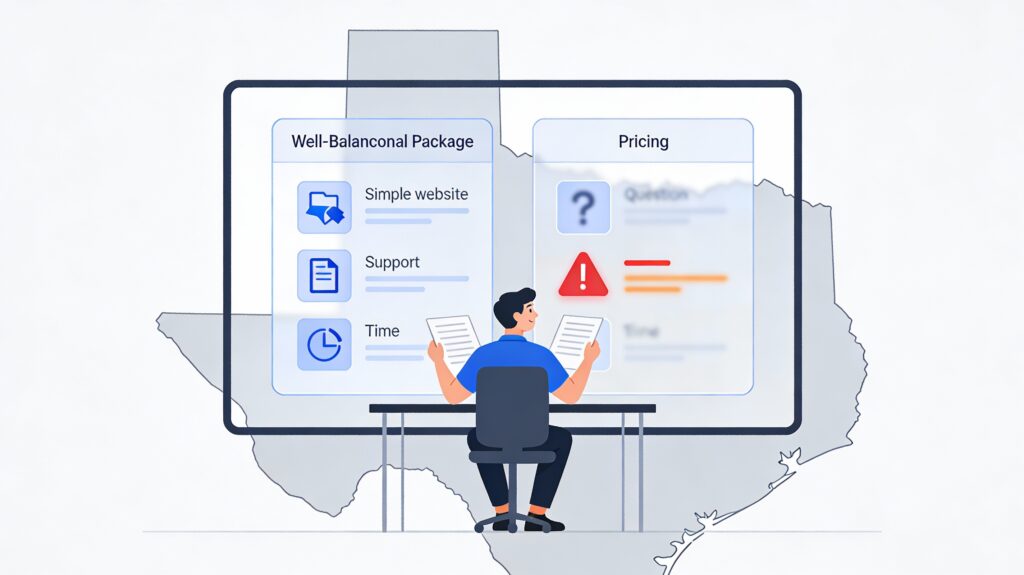
Looking at affordable web design in Texas by budget tier often feels more concrete than talking about abstract ranges.
If your budget is under $3,000, you are usually in one of these situations:
- You are comfortable with a template-driven build and can provide most content and assets yourself.
- You are working with a freelancer or micro‑team with a tight, clearly limited scope.
- You are at an early stage, validating an idea, or need a temporary online presence.
This can be an acceptable choice if the stakes are low, but it is not realistic to expect deep discovery, tailored UX, strong SEO foundations, and robust support at this level.
The $3,000–$7,000range is where a lot of Texas small business websites sit when they are built by professional teams. In this band you can reasonably ask for:
- Structured discovery around your services, audience, and local market.
- A custom homepage and key inner page templates designed around conversions.
- A sensible content structure with on‑page SEO basics and analytics in place.
- Some support and training so your team is not left guessing after launch.
Above $7,000–$15,000+, you are moving into the territory where the website is treated as a core growth asset rather than a digital brochure. This is common for:
- Lead‑heavy, high‑ticket businesses like law firms, medical practices, and specialized B2B services.
- Multi‑location brands that need strong local SEO and carefully planned location structures.
- Ecommerce and complex funnels where the site is the main revenue engine.
At this level, you are paying for deeper research, more robust UX, tailored content strategy, better technical SEO, and performance work that helps the site scale.
Why cheap offers often become expensive?
Many Texas business owners are tempted by “complete website for $500–$1000” or “lifetime deals” they see online. The problem is not just that the designs are basic; it’s that corners are cut in areas that quietly cost you money.
Common patterns in too‑cheap deals include:
- Heavy reliance on bloated page builders and generic templates makes sites slow and hard to optimize.
- Little to no planning around structure or content, so the site fails to rank or convert.
- No clear ownership of your code, content, or hosting environment, making it difficult to switch providers.
- Lack of documentation, training, or support, so every change becomes a chore—or an extra bill.
The long‑term effects can be serious: lost search visibility, high bounce rates, poor lead quality, and the cost of a full rebuild once you finally outgrow the initial shortcut. When you factor in those hidden costs, the cheapest option is often the least affordable.
Scoping smart so your website fits your budget and your Future
The most reliable way to keep your Texas website budget under control is to scope the project intentionally instead of letting it grow in all directions.
A practical move is to separate launch‑critical elements from “phase‑two” improvements. Launch‑critical items might be:
- Clear, well‑structured pages for your main services and locations.
- Strong, visible calls to action that match how people actually contact you.
- Core trust elements like reviews, case studies, and FAQs.
Phase‑two items could include:
- A full content hub or resource library.
- Advanced automations and integrations with CRM or marketing tools.
- More experimental features such as membership areas or online courses.
You can also talk to your web design agency in Texas about putting together a phased roadmap so your initial investment stays within your Texas website budget, with a clear path for how to grow the site as results and revenue improve. That kind of conversation naturally leads into a more detailed quote, which is exactly where an experienced Web Design & Development team can help by mapping budget to realistic outcomes rather than pushing a one‑size package.
When paying more is actually the affordable choice
There are situations where aiming too low on price almost guarantees a higher total cost over the next few years.
If you run a lead‑driven or high‑ticket business for example, a Houston medical practice, a Dallas law firm, or a specialized B2B service even one or two extra clients per month generated by a higher‑performing site can quickly repay the difference between a low‑end and a more serious build.
If you operate across multiple locations or competitive service areas, especially in big metros, the structure and SEO foundation of your site heavily influence whether you show up for important searches. Cutting corners on architecture and content here can mean years of playing catch‑up.
Taken together, these angles let you approach affordable web design in Texas with a clearer head: you see what professionals are actually charging, understand what affects your quote, and know when it makes sense to stretch and when it is smarter to keep things simple and phased.