
When a potential client says, “I checked out your website,” the work of your web design agency in Texas is already on trial. In those few seconds, they are deciding how professional you seem, whether your services feel clear, and if you look like a safe choice to trust with their money. If the agency only focused on visuals, you might have a slick homepage that never really moves anyone to contact you; with the right web design partner, that homepage quietly does the early sales work for you day after day.
Start With Your Business, not their Portfolio

Before you even open a single agency website, sit down and write what your website actually needs to do in the next 12–24 months.
- Do you need more booked calls from Houston and Dallas?
- Do you want to reduce back‑and‑forth by letting customers self‑serve information?
- Are you planning to launch a new service line in Texas later this year?
Turn those thoughts into a short, practical list:
- Primary goal (e.g., “20% more qualified leads from organic search”)
- Key actions you want visitors to take (call, book, buy, apply, request quote)
- Non‑negotiables (integrate with your CRM, handle multiple locations, online payments, bilingual content, etc.)
When you approach agencies with this clarity, it becomes obvious who is just selling “a nice website” and who is thinking in terms of funnels, retention, and lifetime value.
Shortlisting Texas Agencies With Real Filters
There are hundreds of agencies and freelancers across Texas, Austin boutiques, Dallas studios, Houston full‑service shops, and smaller teams spread across secondary cities. Many of them will look similar at first glance.
Instead of starting with price or logos, use filters that actually matter:
Texas market familiarity: Have they worked with local service businesses, B2B firms, or ecommerce brands that sell into Texas? Do they understand how people search and compare options in your space?
Specialization: Some are great at brochure sites, others at conversion‑heavy lead gen, others at complex web apps. You want one that already operates in your “type” of project, not one that you’re learning on your dime.
Size and involvement: A five-person studio can provide you with more direct access to senior personnel; a larger agency may have more processes and capacity. Decide what you’re comfortable with.
When you skim their site, look for signs of real thinking:
- Do they talk about research, user journeys, and testing?
- Or is everything about “stunning designs” and “beautiful websites” with no mention of results?
That alone will eliminate a surprising number of candidates.
Reading Portfolios like a Strategist, not a Casual Visitor
Most businesses look at portfolios the same way: “This looks nice; this doesn’t.” That is how bad decisions happen.
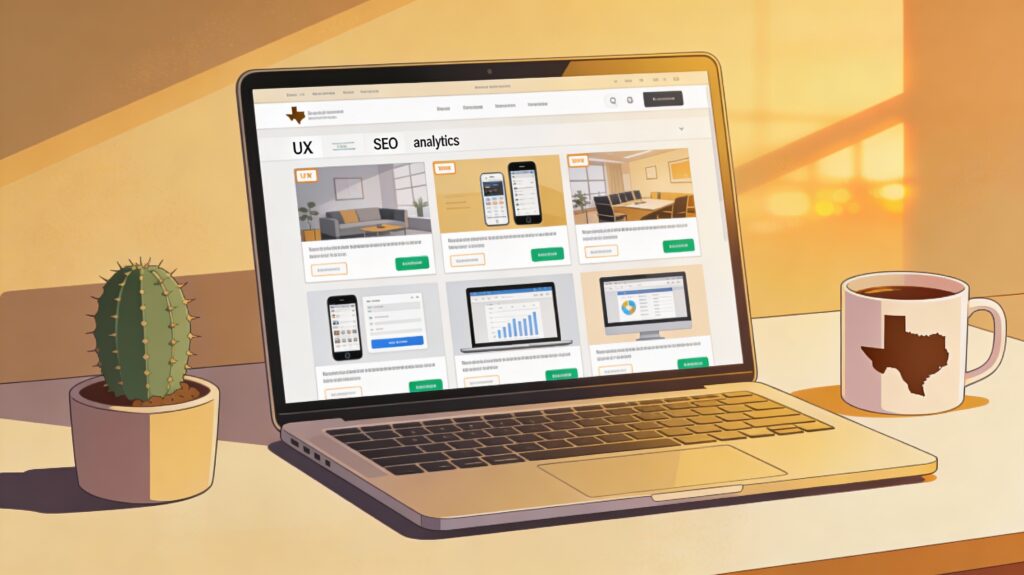
When you open an agency’s case study, ask yourself:
- If this were my business, would this layout actually make it easy to take the next step?
- Is it obvious what the main call to action is, or do you have to hunt for it?
- How does the site feel on mobile? Are buttons reachable with one thumb, is text legible and does it load quickly?
Look for small, telling details:
- Service pages with clear sections, FAQs, and supporting content (rather than one long, vague paragraph).
- Use of headings and internal links that suggest someone thought about search and content structure.
- Evidence of custom layouts: sections that clearly respond to a specific business need, not generic theme blocks repeated across every project.
If every site in their portfolio looks like minor variations of the same theme, you are probably looking at a “template first” shop, even if they avoid using that word.
Questions that reveal how they actually work
The most valuable part of your evaluation is not the proposal. It is the conversation. The way an agency talks about the work will tell you more than any PDF.
Ask very direct questions:
- Walk me through your process from first call to launch.
- Who will I speak with weekly, and who actually designs and codes the site?
- How do you decide what goes on the homepage vs deeper pages?
- How do you handle revisions and feedback if we disagree on a direction?
You are listening for structure and calm clarity, not rehearsed buzzwords. A mature team will talk about:
- Discovery: learning about your customers, competitors, and internal constraints.
- Strategy: defining the sitemap, key user journeys, content priorities, and SEO foundations.
- Design and UX: wireframes first, then UI, with space for review and testing.
- Development: clean builds, responsive behavior, performance, accessibility.
- Launch and aftercare: testing, analytics, training, and ongoing support.
If everything is vague. We just collaborate closely,” we’re flexible, we’ll figure it out together”, you may be dealing with a team that improvises every project. That usually shows up later as delays, confusion, and a site that drifts away from your original goals.
Understanding Pricing and Proposals in a Texas Context
Rates across Texas can vary depending on city, experience, and complexity, but there are a few patterns you will see over and over. You will typically encounter:
- Flat‑fee project pricing for a defined scope
- Hourly or day‑rate pricing for ongoing support
- Retainers that blend web, SEO, and marketing services
When you receive a proposal, ignore the total for a moment and look at how it is built:
- Are strategy, UX, design, development, content support, and QA clearly broken out?
- Do they specify number of pages, templates, integrations, and rounds of revisions?
- Is there a line for on‑page SEO, analytics setup, or training so your team can manage the site?
A “cheap” proposal often looks thin on detail. You see a single line like “Website design and development” with a price and little else. That usually means:
- Limited or no discovery
- Minimal thinking about content
- Shortcuts like pre‑built themes with light reskinning
- Little to no testing or optimization
A more serious proposal will feel almost like a checklist: you can see where the time goes and how each stage ties back to outcomes. If you want to go deeper into what “affordable but realistic” ranges look like in practice, this is exactly the kind of discussion covered in a blog on what to expect to pay for web design in Texas.
Red Flags that Should Make You Pause
There are a few patterns that consistently lead to bad experiences, regardless of whether the agency is in Dallas, Houston, or a smaller Texas city:
Ownership is unclear: If the contract doesn’t spell out who owns the design files, code, and content, you risk being locked into them for every future change.
No mention of content: If they assume you will “just provide everything” without helping you plan or shape the content, the project will either stall or launch with weak copy.
No talk of analytics or measurement: A site without proper tracking, goals, and basic reporting is flying blind.
Guaranteed rankings or unrealistic promises: Anyone promising specific SEO rankings on a schedule for a brand‑new site is being careless or misleading.
Pressure to move quickly without questions: Good agencies ask a lot of questions. If someone is ready to take payment after a 20‑minute call, that is a warning sign.
Trust your gut here. If you feel rushed or talked down to, that dynamic will not improve during a multi‑month project.
When a Custom Website Makes More Sense Than a Template
Templates and DIY builders have their place. If you are testing a new idea or just need a placeholder online, they can be a useful bridge. But for an established Texas business with real revenue on the line, the limits show up fast.
Signs you are outgrowing templates:
- You need to support several locations or service areas with dedicated pages and tailored content.
- Your sales process is more complex than a single “Contact us” form, and you need multiple paths for different kinds of prospects.
- You keep fighting the theme to make small layout changes or new sections.
- Your site has become slow and cluttered because of stacked plugins and page‑builder elements.
A thoughtfully built custom site lets your agency shape structure, content, and design around how your customers actually make decisions. It is not just about “looking different,”it is about reducing friction at each step from first visit to signed deal. For a deeper look at why custom builds matter, especially for growing businesses in Texas, this is explored more fully in content focused on custom vs template‑based website design.
How To Run a Fair, Low‑Drama Selection Process?
Once you have a shortlist of two to four agencies, set up a simple, fair process to choose one:
- Share the same brief with everyone
- Outline your goals, rough budget range, timeline, and must‑have features.
- Include a few sites you like and, importantly, why you like them.
2. Ask each agency for a short call before they quote
- See how they react to constraints.
- Notice whether they challenge your assumptions respectfully or just agree with everything
3. Compare more than price
- Evaluate communication style and how clearly they explain trade‑offs.
- Weigh their understanding of your space, not just their generic capabilities
4. Check references or reviews
- quick conversation with a past client can tell you how they behave when something goes wrong, not just when everything runs smoothly.
5. Decide how this fits into a longer relationship
- Are you looking for a one‑off project or an ongoing partner for design, development, and optimization?
- Does their model support both?
Connecting this Decision To The Rest Of Your Digital Strategy
Choosing the right agency is not an isolated choice. It will connect to:
- -How much you end up paying for web design and ongoing improvements over the next few years (a topic explored in more detail in a separate blog about affordable web design in Texas).
- Whether you later need a full custom rebuild because you started with something that was too limited.
- How easily you can layer on SEO, paid campaigns, content, and automation over time.
For readers who are still comparing cities and talent pools, a separate post comparing Houston and Dallas web designers can help frame where to look and what to expect from each market. All of these pieces together form a small but solid decision‑making system, one that helps Texas businesses choose web agencies with their eyes open, not just their fingers crossed.