
SEO retainers typically ask for a six to twelve-month commitment before a single ranking has visibly moved. That’s a long stretch to be locked into the wrong approach, and it’s exactly why the questions to ask an SEO agency before signing a contract matter more than the pitch deck sitting in front of you.
The list below covers who actually does the work, how progress gets measured, who keeps the accounts and content if you leave, and what triggers a cancellation clause. Each question comes with what a strong answer sounds like and what should make you pause, along with a look at what SEO work actually looks like once you’re a client so you know what to compare the agency’s answers against. Read through it before the first call, not after the contract is already on your desk.
Why You Should Interview an SEO Agency Before Signing
Google’s own guidance for site owners considering outside SEO help puts it plainly. Hiring the wrong SEO can damage a site’s visibility and reputation, and that risk is exactly why an interview matters before any contract gets signed. It’s a chance to see how an agency actually thinks instead of relying on what it claims to have done for other clients.
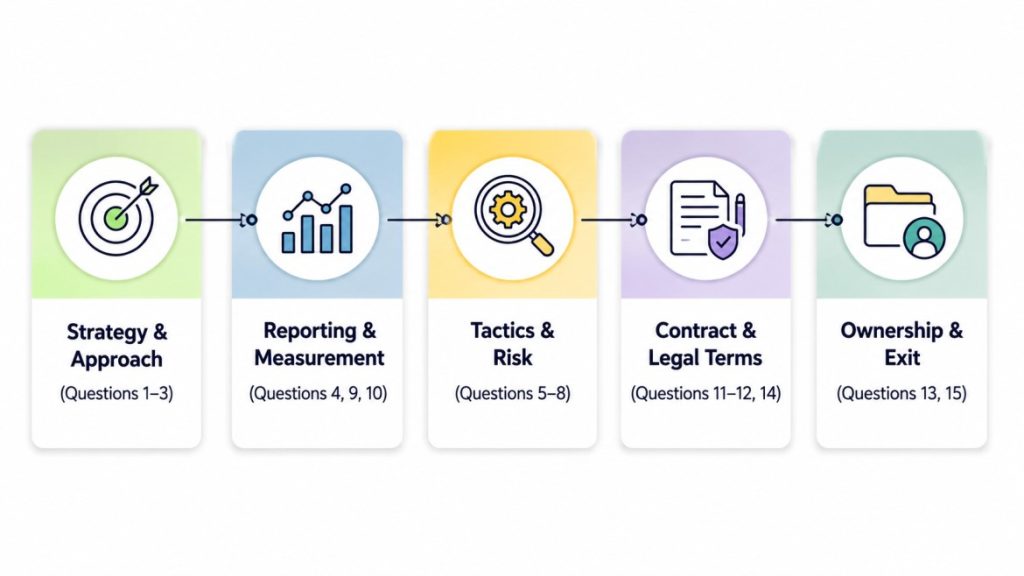
An interview also surfaces mismatches early. An agency built for fast-growing SaaS companies might not fit a multi-location home services business, and one comfortable with six-month retainers may not suit a founder who wants monthly flexibility. If you’re still weighing whether hiring outside help makes sense for your business at all, settle that question first, since the answer depends on how much time and in-house expertise you already have.
None of this needs a legal background or deep SEO knowledge, just direct questions, a willingness to press past a confident tone, and notes you can check against the actual contract later.
The Questions to Ask an SEO Agency Before You Sign
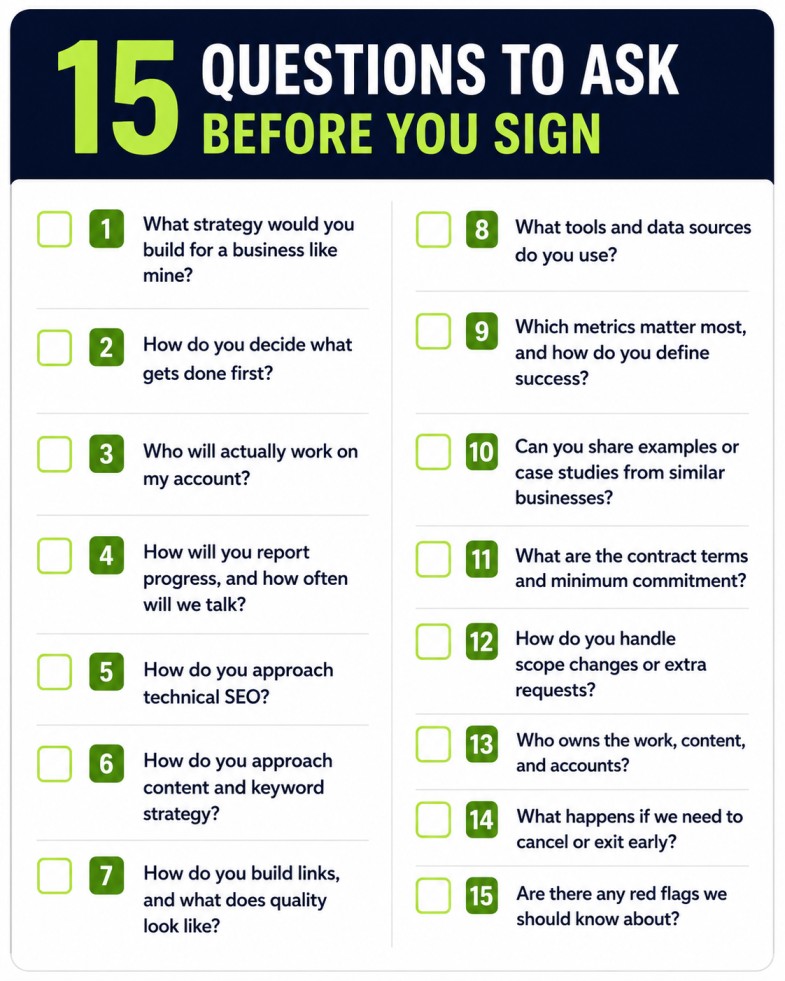
1. What strategy would you build for a business like mine, and how did you get there?
The specificity of the answer matters more than the confidence behind it. You want to hear something anchored to your actual site, your competitors, and your industry, with a clear sense of how the agency prioritized what it found rather than reused a template from the last client. If the answer stays vague once you push on what they’d change first, ask what data it’s actually based on.
2. How do you decide what gets done first?
SEO covers technical fixes, content, and link building, and no agency handles all three simultaneously. A solid answer walks through a prioritization logic, usually starting with anything blocking crawling or indexing before moving into content and authority work. If every task sounds equally urgent, or the plan leads with content volume regardless of what’s actually wrong with the site, that’s a plan built for a pitch, not for your site.
3. Who will actually work on my account?
The person on the sales call is rarely the person doing the work. Ask who handles strategy, who writes the content, who builds the links, and whether any part of it gets outsourced without telling you. You’re looking for named roles and a real sense of the team, not a description of the agency’s overall size. If they dodge the specifics, ask to meet whoever will actually be on your account before you sign anything.
4. How will you report progress, and how often will we talk?
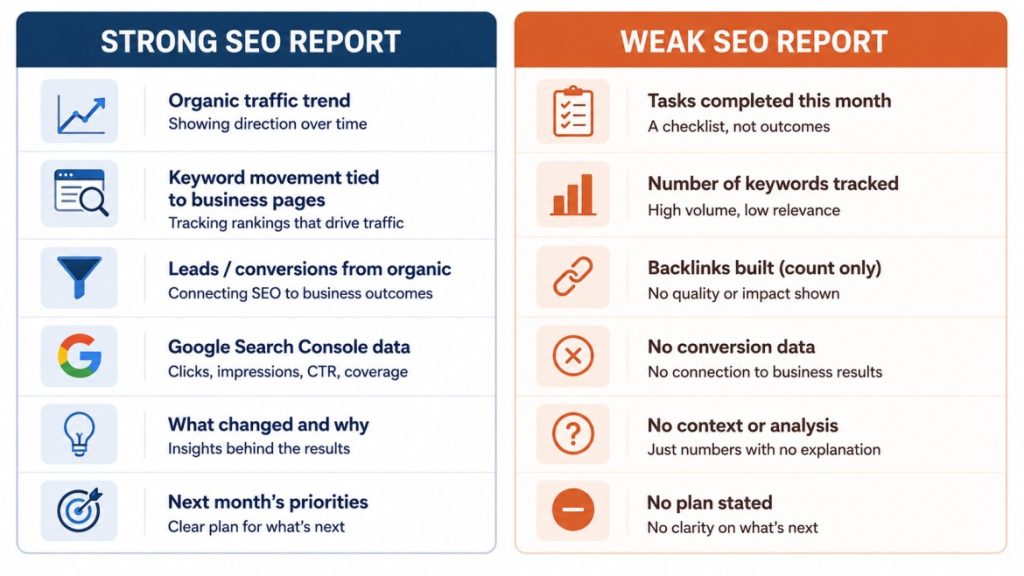
Monthly and biweekly reporting both work fine, as long as the cadence matches how involved you want to stay. Ask to see a sample report before signing anything. A useful one connects the work to outcomes, traffic, conversions, and rankings that matter to your business, rather than a checklist of finished tasks. If the sample is full of vanity metrics with no context attached, that’s roughly what reporting will look like once you’re paying for it.
5. How do you approach technical SEO?
Technical SEO is what makes the rest of the work possible, since search engines have to be able to crawl, index, and actually understand your site first. Listen for concrete specifics, site speed, crawlability, structured data, mobile usability, ideally tied to a real example from past work. An agency that can only speak about this in vague terms probably hasn’t had to fix it under pressure.
6. How do you approach content and keyword strategy?
Good content strategy starts with what your buyers are actually asking, not just which keywords have the highest volume. Ask how topics get chosen, who writes the content, and how it connects to conversions rather than traffic for its own sake. If the answer is mostly about word count or publishing frequency, that’s a production schedule, not a strategy.
7. How do you build links, and what won’t you do?
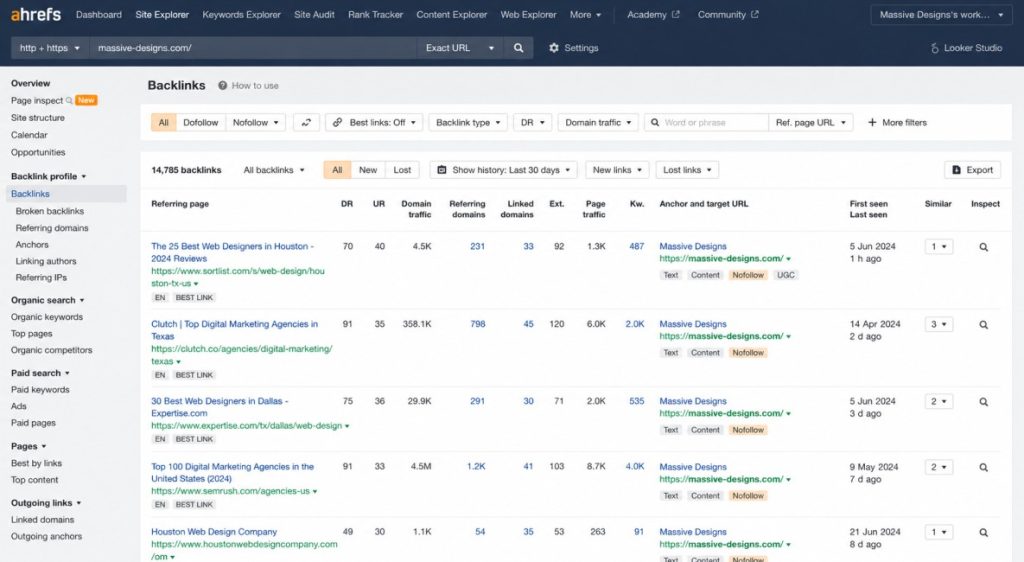
Link building is where careless SEO tends to do the most damage. A good answer talks about earning links through digital PR, partnerships, or content genuinely worth citing, and can explain how a site gets vetted before a link is pursued on it. A promised number of backlinks per month, regardless of where they come from, is a shortcut worth questioning. Paid link schemes and low-quality guest post networks can violate Google’s spam policies, and your site carries that risk, not the agency’s.
8. How are you adjusting for AI Overviews and AI-driven search?
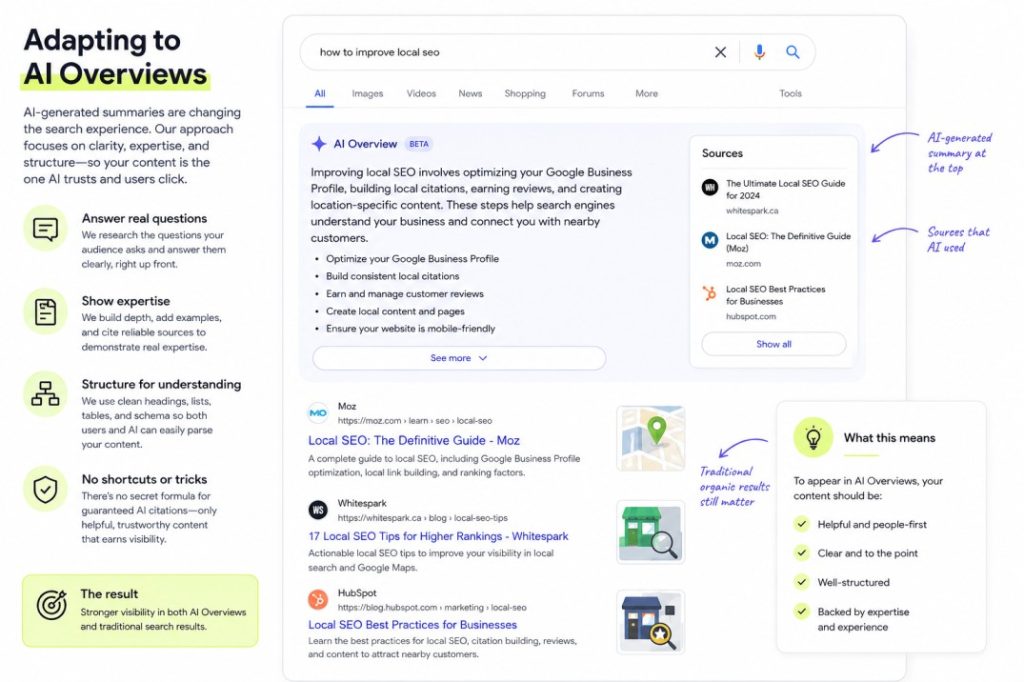
Search results now include AI-generated summaries alongside the usual list of links, and a competent agency should be able to describe how that’s changing content and structure without pretending it has a shortcut. The stronger answers come back to clarity, direct answers to real questions, and demonstrated expertise, the same fundamentals that support traditional rankings anyway. A claimed secret technique for guaranteed AI citation is worth walking away from, since nothing like that actually exists.
9. What will you measure beyond rankings?
Rankings alone don’t pay the bills. Look for an agency that ties performance to qualified leads, conversion rate, or revenue wherever that data is available, and that can explain how it’ll actually get access to it. If the conversation never moves past keyword position and organic traffic, ask directly how they’d know the work was worth what you’re paying.
10. What happens if traffic or rankings drop?
Rankings move, and a Google core update can shift traffic even when an agency is doing everything right. What matters is how they’d diagnose a drop, whether it traces to an algorithm change, a technical issue, or a competitor pulling ahead, and what they’d actually do next. Blaming Google with no plan to investigate is one concern. Claiming it’s never happened at all is another, since that usually points to limited experience rather than a flawless record.
11. Will you guarantee results?
No agency controls Google’s algorithm, so no agency can guarantee a specific ranking, a point Google’s own guidance for businesses makes directly. What a solid agency offers instead is a realistic range and timeline shaped by your competition and your site’s current condition. A flat guarantee of rankings, traffic, or leads is one of the more reliable warning signs in the industry, whatever confidence it’s delivered with.
12. How long is the contract, and how do we end it?
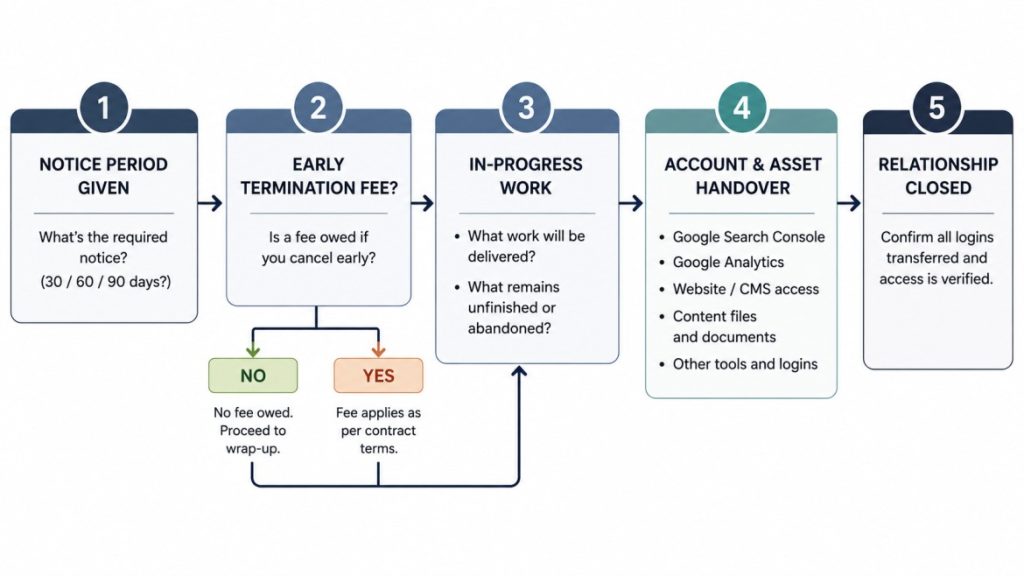
Contract length varies by agency, and month-to-month, six-month, and twelve-month terms are all common depending on scope. The exit process matters more than the start date. Ask about notice periods, whether an early termination fee applies, and what happens to work already in progress if you leave mid-contract. However an agency handles this question during the sales process is usually how it’ll handle it later.
13. Who owns the content, accounts, and data if we leave?
This is as much a contract question as an SEO one. Get it in writing that you keep ownership of your website, your Search Console and Analytics accounts, your content, and any tracking setup no matter who ends the relationship. Google’s hiring guidance specifically recommends granting read-only Search Console access up front rather than full control. An agency that wants to hold onto your accounts, or won’t hand over login access after termination, is a serious problem to flag before signing, not something to sort out later.
14. What’s included in the price, and what isn’t?
SEO pricing swings widely by market, competition, and scope, and there’s no single average that applies across every business. What you want is clarity on exactly what the retainer covers and what counts as extra, additional content, paid tools, work outside the agreed scope. Ask for a written breakdown of deliverables tied to the price rather than a flat monthly figure. Vague scope is usually where budgets quietly grow after the ink is dry.
15. Can I talk to a current or recent client?
References are one of the few checks that happen outside the agency’s control. Ask for at least one client in a similar industry or of similar size, and ask that client directly about communication, responsiveness, and whether results actually matched what was promised. An agency that can’t produce a single reference, or points only to testimonials on its own website, hasn’t given you much to check against.
How to Compare Agencies After the Calls
Once you’ve gone through these questions with two or three agencies, the differences are usually easier to see side by side than they were in any single call. Write down each agency’s answer to the same question in the same place, especially for strategy, ownership, and contract terms, so you’re comparing actual answers rather than impressions. Pay attention to which agency answered specifically and which one talked around the question. For a sense of what broader service categories usually include when SEO gets bundled with web design or paid ads, an overview of typical agency service offerings is a useful reference point before that final comparison.
What Belongs in the Contract
A verbal agreement about scope is less reliable once the contract is signed, so please put the following in writing rather than relying on assumptions. It helps to know what a typical SEO engagement covers before comparing it to what’s actually written in the proposal in front of you.
- Deliverables specific enough that you’d notice if something stopped happening
- Reporting frequency and the exact KPIs tracked, not just “regular updates”
- Contract length, renewal terms, and required cancellation notice
- Payment terms and what counts as work outside the agreed scope
- Ownership of accounts, content, and data
- What access you keep to Search Console, Analytics, your website, and your Google Business Profile if local SEO is part of the engagement
None of this replaces legal advice. A contract with meaningful financial commitment is worth an attorney’s review before you sign, especially if the terms differ from what was discussed on the call.
SEO Agency Red Flags Worth Pausing On
Some warning signs show up before a single question gets asked. Guaranteed first-place rankings, a claimed “special relationship” with Google, and promises of thousands of backlinks are exactly what Google warns businesses to watch for, since no outside company controls how Google ranks a site. Vague explanations of the actual work, reluctance to name who’s on your account, and pressure to sign quickly deserve the same skepticism.
If you believe you were genuinely misled by an SEO provider, the Federal Trade Commission handles complaints about deceptive business practices in the United States, and a complaint can be filed directly through the FTC’s website.
A solid agency won’t flinch at these questions. The uncomfortable ones are usually the clearest gauge of how it’ll actually behave once the contract is signed.
A Quick Gut Check Before You Sign
Before signing, you should be able to answer these without checking your notes.
- Do you know exactly what work happens each month?
- Do you know how success will be measured and how often you’ll hear about it?
- Do you know who owns your accounts and content if the relationship ends?
- Do you know the notice period for cancellation and whether there’s an early termination fee?
If any of these come back uncertain, get one more call in before you sign.