Google confirmed nothing about the weekend of July 18 and 19, 2026, and that gap between what the trackers showed and what Google said is the story of 2026 so far. Rankings moved across fourteen independent tracking tools that weekend, chatter spread through SEO forums by Monday, and the Search Status Dashboard stayed clean. Six months into the year, that pattern has repeated often enough to stop being news on its own.
This guide tracks every confirmed and unconfirmed volatility event from December 2025 through the July 18-19 weekend, explains what separates a broad algorithm shift from a site-specific problem, and lays out the diagnostic steps worth taking before touching a single page.
Understanding Google Search Ranking Volatility Today
Ranking volatility describes measurable movement in where pages appear for tracked keywords over a short window. Small day-to-day shifts happen constantly. Meaningful volatility looks like high churn in top positions, the kind that lights up tools like Semrush Sensor, AccuRanker, or Sistrix across many unrelated sites at once.
Google describes core updates as broad improvements across multiple ranking systems, adjustments to how content usefulness, relevance, and satisfaction get evaluated rather than a single switch. Smaller, unannounced tweaks run continuously between the named updates, which is a large part of why 2026 has felt unsettled even during the quieter stretches.
Volatility also shows up indirectly. A page can hold its position and still lose clicks when AI Overviews or other generative features absorb attention higher in the results. That redistribution does not register as a ranking drop, but it shows up in traffic, which is why Search Console’s click and impression data matters as much as position tracking.
The 2026 Timeline: From December Through the July 18-19 Weekend
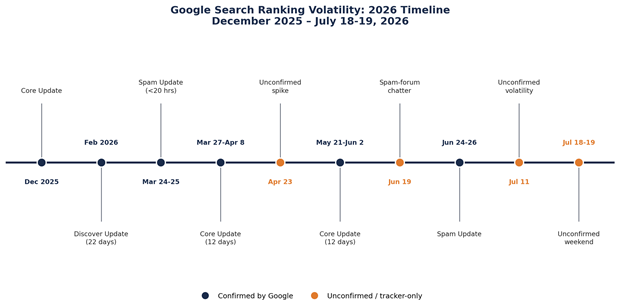
Figure 1: Confirmed and unconfirmed Google search volatility events, December 2025 through July 18-19, 2026.
December 2025 core update. The first of the current run, producing noticeable movement heading into the new year.
February 2026 Discover update. A 22-day rollout focused on Discover and other personalized surfaces, Google’s first update explicitly labeled Discover-only.
March 24-25 spam update. The fastest spam rollout on record at the time, completing in under 20 hours.
March 27-April 8 core update. The first broad core update of 2026, roughly 12 days. SE Ranking data showed 79.5 percent of top-3 URLs changing position, compared with 66.8 percent during the December update, and about 24.1 percent of top-10 pages dropping out of the top 100 entirely.
April 23 spike. Fresh volatility across Semrush Sensor, Advanced Web Rankings, and Sistrix roughly two weeks after the March update officially closed, with no new confirmation from Google.
May 21-June 2 core update. The second broad core update of the year, running just under 12 days. Semrush Sensor peaked at 7.0 out of 10, and the rollout moved in three distinct bursts rather than one smooth curve: a spike over the May 23 weekend, a sharper one on May 30, and a final burst on the June 2 completion day. Practitioners generally described it as more forceful than March, despite March’s higher churn numbers.
June 19 spam-forum chatter. Search Engine Roundtable flagged unusual movement concentrated in black-hat and spam-adjacent forums rather than the broader white-hat SEO community, an uneven pattern that does not match a typical confirmed core update.
June 24-26 spam update. Rolled out globally within about 48 hours. Google described it only as a normal spam update and, when asked directly, said it does not target link spam or the site reputation abuse policy. Some analysts have connected the timing to Google’s May 15 spam policy expansion covering manipulation of AI Overviews and AI Mode results, though Google has not confirmed that link.
Early July volatility. Trackers registered elevated movement again in the first half of July, with no official acknowledgment from Google.
July 18-19 weekend. A blip on Saturday, July 18 that intensified into Sunday, July 19, visible across fourteen independent tools including AccuRanker, Algoroo, Semrush Sensor, Sistrix, and Wincher. As of July 21, the Search Status Dashboard shows no confirmed incident for that window. Some SEOs reported the early-July movement partially reversing within the same week, a reminder that reactive changes made in response to a short-lived swing can end up solving a problem that fixed itself.
Why 2026 Search Feels Unsettled
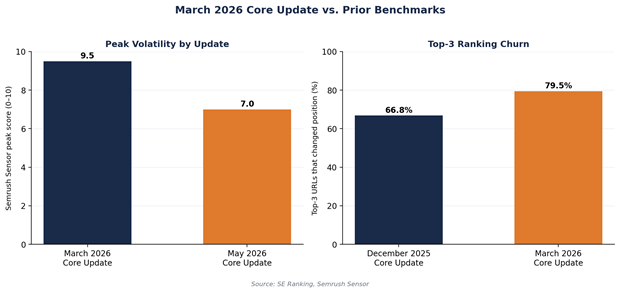
Figure 2: Peak Semrush Sensor scores and top-3 ranking churn across recent core updates.
Several forces are stacking on top of each other. Google is running more ranking systems against more content than before, and the machine learning models used to interpret intent keep evolving in between named updates. AI Overviews and AI Mode add another layer, since Google is actively testing how these features affect satisfaction, which can move traffic without moving positions.
User behavior is shifting alongside the algorithm. Expectations around depth, format, and freshness change as people spend more time in forums, social platforms, and AI-generated answers, so content that satisfied a query a year ago can lose ground to something more current or more experience-rich without anything about the original page changing.
Google’s May 2026 expansion of its spam policies, which extended coverage to manipulation of AI Overview and AI Mode results, adds a compliance dimension that did not exist at the start of the year. Combined with the pace of updates- roughly six weeks between the March and May core updates and about three weeks between the May core update and the June spam update- sites now have less recovery time between events than they did in 2025.
Spotting the Difference: Volatility vs. Site-Specific Issues
Broad volatility touches many unrelated queries and sites at the same time. If your losses line up with tracker spikes and cut across templates or intent categories rather than concentrating in one area, a system-wide recalibration is the more likely explanation.
Site-specific problems tend to look narrower: drops concentrated on one page type, technical crawl or indexing gaps, information that has gone stale, or weak E-E-A-T signals that become more visible once ranking systems reweight. Traffic loss without a matching position loss usually points to AI Overviews or another rich feature satisfying the query above the organic results rather than an actual ranking penalty.
Compare winners and losers within your own site before assuming either explanation. Clear structure, recent updates, and strong sourcing tend to separate the pages that hold steady from the ones that do not.
Monitoring Tools and Data Interpretation
No single tool tells the full story, and the July 18-19 weekend is a good example why. Fourteen independent trackers, including AccuRanker, Algoroo, AWR, CognitiveSEO, DataForSEO, Mangools, Mozcast, Semrush Sensor, Serpstat, SimilarWeb, Sistrix, Wincher, Wireboard, and Zutrix, registered the movement, and the readings varied across all of them.
Pair tracker data with your own numbers:
- Google Search Console for impressions, clicks, and position trends, read over 28- or 90-day windows rather than single days
- Google Analytics for what happens after the click
- Segmented tracking by device, location, and query intent
When a spike shows up without an official Google note, treat it as an unconfirmed signal rather than a new algorithm. The Search Status Dashboard remains the only authoritative record of confirmed rollouts and incidents.
Step-by-Step Diagnosis When Your Rankings Shift
Resist the urge to overhaul anything immediately. Start by segmenting affected pages by template, content type, or primary intent, then work through:
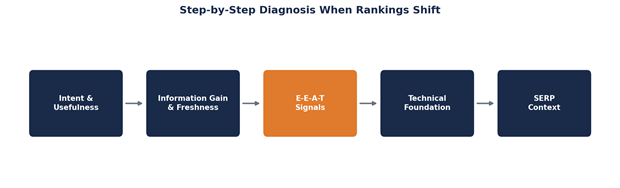
Figure 3: The five-point diagnostic sequence to run before making any content changes.
- Intent and usefulness. Does the page still match what searchers expect in depth, format, and perspective?
- Information gain and freshness. Does it add something original, or restate what already ranks?
- E-E-A-T signals. Is experience, expertise, authoritativeness, and trustworthiness visible through sourcing, named authorship, and real-world detail, especially on pages touching health, finance, or safety?
- Technical foundation. Crawlability, page experience, structured data, and rendering.
- SERP context. Are AI Overviews or other features absorbing clicks even where positions have not moved?
Look at what is outranking you in the same volatile queries for patterns in structure or depth, without copying it outright. Fix the pages where user value is genuinely weak before touching anything else.
For sites without the internal bandwidth to run this kind of audit themselves, a structured technical SEO audit can separate an algorithmic shift from an underlying site issue faster than guesswork.
Practical Steps to Strengthen Resilience
Sites that ride out volatility with less damage tend to share habits:
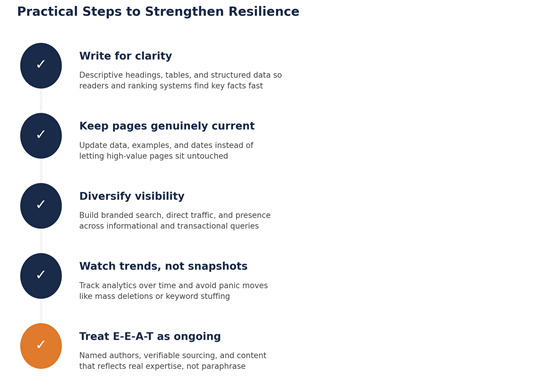
Figure 4: Five habits that separate sites that recover quickly from those that don’t.
- They write for clarity and extractability, using descriptive headings, tables, and structured data so both readers and ranking systems can find the key facts quickly
- They keep important pages genuinely current, updating data, examples, and dates rather than letting them sit untouched for a year
- They build visibility beyond organic search, through branded search, direct traffic, and a presence across informational and transactional queries
- They watch their own analytics trends over time instead of reacting to daily rank snapshots, and they avoid panic moves like mass deletions or keyword stuffing during volatile stretches
- They treat E-E-A-T as a standing practice rather than a one-time checklist, with named authors, verifiable sourcing, and content that reflects real expertise rather than paraphrased summaries
Much of this depends on the site itself being easy to use. Site architecture and UX improvements matter more as ranking systems increasingly reward pages that are simple to parse, navigate, and interact with, on top of whatever the content says.
Looking Ahead
Seven confirmed or widely tracked volatility events between December 2025 and the July 18-19 weekend is not an anomaly anymore, it is the operating rhythm of search in 2026. The gap between named updates keeps shrinking, and the unconfirmed spikes in between have become as disruptive as the confirmed ones.
Sites built on genuine expertise, clear sourcing, and solid technical health tend to recover faster, and sometimes gain ground, once each round of reweighting settles. Sites relying on thin or scaled content keep facing steeper drops each time Google tightens the standard.
The practical answer has not changed since March: diagnose before reacting, prioritize the pages that genuinely serve the searcher, and give the data a full week or more to settle before drawing conclusions. Consistency across updates matters more than perfection during any single one.