
A business owner signs an SEO retainer expecting something akin to a subscription, paying monthly and watching the traffic graph climb. What actually shows up over the next six months looks more like a slow renovation, technical repairs, new pages, a running list of decisions about what gets fixed first, and reports that don’t always explain why any of it matters. That gap between the expectation and the reality is where most agency relationships either earn trust or quietly fall apart.
Making sense of what an SEO agency actually does starts with a distinction most sales pages skip right past. It is the difference between what an agency does and what a client actually gets handed. One is a list of activities. The other is a deliverable. Mix the two up and it becomes almost impossible to tell real work from a retainer that’s just running on autopilot.
Activities Are Not the Same as Deliverables

An activity happens on the agency’s side of the fence. A deliverable is what crosses over to the client. Running a technical audit is an activity. Handing over a ranked list of crawl errors, broken internal links, and indexing problems, with a rough timeline for fixing each one, is a deliverable. The first happens whether or not anyone writes it down. The second is proof it happened at all.
A lot of SEO retainers are built almost entirely out of activities that never turn into anything a client can actually see. Someone genuinely spent six hours on keyword research last month. Someone genuinely reviewed three competitor sites. None of it shows up anywhere the client can look, so from where they’re sitting, nothing happened. It’s rarely dishonesty. It’s more often a habit of doing the work and forgetting that someone outside the process needs to see it too, and that habit is probably the single biggest reason clients lose confidence in SEO even when the underlying work was fine.
One habit is worth building into any agency relationship. For every activity on a proposal, ask what actually gets delivered and when. An agency that fumbles that question about its own pitch tends to fumble it for the next twelve months too.
Before Anything Gets Built
Real SEO work starts with looking, not doing. A technical crawl turns up indexing problems, broken links, duplicate pages, and the page speed issues search engines genuinely weigh. A gap analysis lines up what a business already ranks for against what its buyers are actually typing into Google, working off real search intent rather than a spreadsheet of search volumes. Competitor research isn’t about copying whoever sits at the top. It’s figuring out why they’re there and what a page would actually need to beat them.
What should come out of that phase is a document, not a conversation. Specific pages. Specific problems. Some sense of what gets fixed first. If an agency can’t hand over something like that, either the audit wasn’t thorough or nobody bothered writing it down, and both are worth asking about directly.
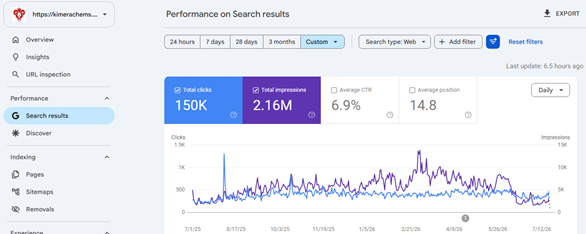
A multi-month ecommerce SEO engagement we ran shows how much this first phase decides everything that follows. Depending on what the audit turns up, the first few months might go entirely toward fixing a broken product catalog, or entirely toward filling content gaps nobody had noticed. No two starting points look the same, which is exactly why the generic month-one package so many agencies sell tends to underdeliver.
Strategy and Implementation Are Different Jobs
SEO work gets talked about as one thing when it’s really two, doing very different jobs. Strategy is the thinking about which pages matter most, which keywords are actually tied to revenue, how the site’s structure should change, and what the next couple of months of content need to cover. Implementation is everything that happens after those decisions get made: writing and publishing pages, fixing broken redirects, wiring up schema markup, threading internal links through the site, earning mentions from other relevant sites.
A client reading a proposal should be able to tell which line is strategy and which is implementation, because the two take different kinds of people and very different amounts of time. Someone cranking out four blog posts a month is doing implementation. Someone deciding which four topics are even worth writing, and why, is doing strategy. Agencies strong at only one of these tend to either produce a lot of content that never ranks, or a strategy document that looks sharp on paper and never turns into anything published.
Internal linking is a decent example of where the two meet. Deciding which pages should be passing authority to which other pages is a strategic call, tied to what the business actually wants to rank for. Going through the site and placing those links is implementation, and it’s tedious enough work that it’s often the first thing dropped once the strategy conversations eat up the month’s hours.
How Technical, Content, Authority, and Measurement Fit Together
Most agencies split their own work into four buckets, i.e., technical health, content, authority (links and citations), and measurement. This is roughly the same structure behind the SEO services we run for clients across Texas, and treated as four separate checklists; none of the four does much on its own. Great content sitting on a slow, badly structured site still underperforms. A technically flawless site with thin content has nothing worth ranking in the first place. Authority pointed at a page that doesn’t actually answer the question just helps someone leave faster. And measurement without the other three is a dashboard nobody looks at twice.
A single team tends to outperform four vendors working in isolation, mostly because these four things keep talking to each other. A page that isn’t getting indexed changes what the content team should prioritize next. A gap in the content, questions buyers keep asking that the site never answers, changes where the authority-building work should point. And measurement is what actually tells everyone whether last month’s calls mattered, which resets the whole priority list for the month after.
How Agencies Decide What to Work on First
Every site has more possible fixes and content ideas than any monthly budget will cover, so figuring out what happens first is its own piece of work, not something that sorts itself out automatically. One way to weigh it: how much a change is likely to move things, against how much effort it actually takes. A broken redirect on a page already ranking near the top of page one is usually a quick fix with a real payoff, so it jumps the line. A brand-new content cluster aimed at a competitive keyword with no existing authority behind it takes longer to pay off, so it gets scheduled instead of rushed.
How close something sits to revenue matters just as much as how hard it is. A page one click from a quote request usually beats a general awareness article in the queue, even when the awareness piece would take less time to write. This is also where a client’s own knowledge should carry real weight. An agency that never asks which services or products actually bring in money is prioritizing off guesswork, and that gap tends to surface later as effort spent on pages nobody was ever going to buy from.
Why Deliverables Look Different by Business Type
A local plumber, a national ecommerce brand, and a B2B software company are not buying the same version of SEO, even when they’re paying roughly the same monthly rate.
For a contractor working across several cities in the Dallas-Fort Worth Metroplex, the deliverables that matter are map pack visibility and call volume out of specific neighborhoods, not a generic keyword ranking report. How local SEO actually extends beyond a Google Business Profile goes deeper into what that looks like in practice, from citation accuracy to how service-area pages get built.
An ecommerce store needs something else entirely: product and category architecture, structured data on every listing, site speed that holds up at scale, and content built around wherever a shopper actually sits in the buying decision. Technical debt piles up faster here too, since every new product means new pages, so audits happen more often and implementation never really stops.
A B2B or service business selling to other companies tends to need longer-form content that answers specific buyer questions, case studies, and a site built around a sales cycle that can run for months. Good content strategy here looks less like a blog calendar and more like a library someone can actually use while they’re still deciding whether to fill out a form.
None of this means one type of business gets shortchanged. It means the same budget buys a different mix of work depending on what actually moves that business forward, and a proposal that reads identically across wildly different clients is worth a second look.
What a Reporting Deliverable Should Actually Contain
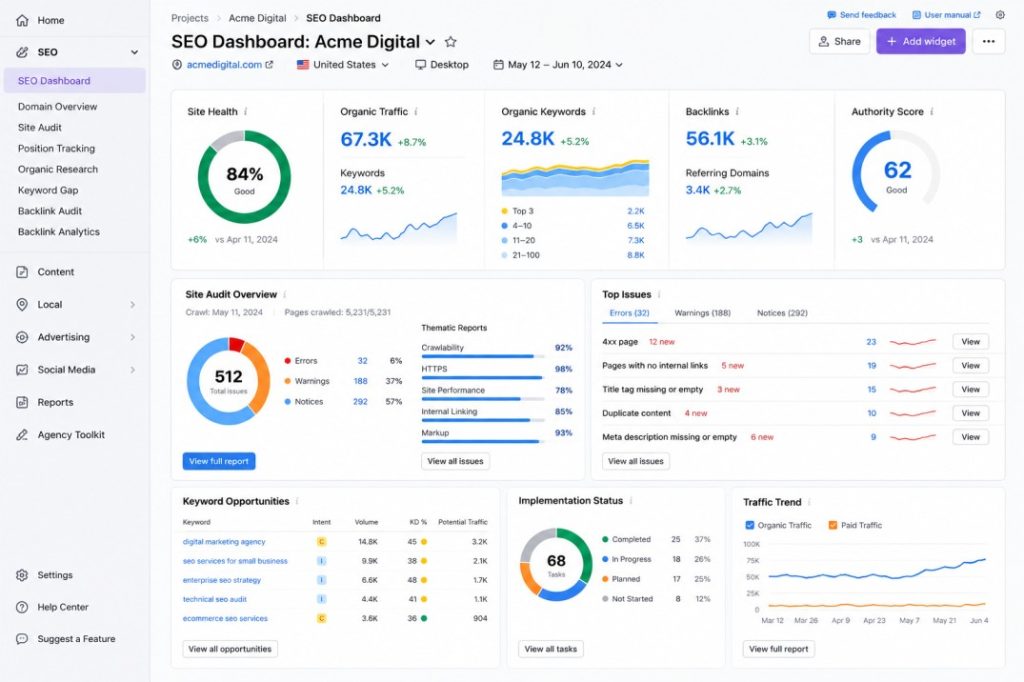
Most SEO reports lean almost entirely on lagging indicators, rankings, total organic traffic, the kind of numbers that confirm something happened weeks after it did. A report built only around those leaves a client with no way to tell whether this month’s work is going to matter until it’s already too late to act on it. Better reporting pairs those lagging numbers with leading ones: whether newly published pages are actually getting indexed, whether impressions for a target query start climbing in Search Console before rankings catch up, whether click-through rate shifts on a page once its title tag gets rewritten.
That last one is worth sitting with, because it’s diagnostic in a way the others aren’t. Impressions rising while clicks stay flat almost always points to a title tag or meta description problem, not a content problem, and that’s a much faster fix than a low ranking on its own. A report that can say “this page needs a different headline” instead of just “this page needs work” is doing real analysis. A line going up or down on a chart is not.
Cadence should shift with the phase of the work too. Early on, while technical fixes and audit follow-through dominate, reporting should track specific fixes and their measurable effect, pages moving from unindexed to indexed, that kind of thing. Later, once content and authority work carry more of the weight, the report should be built around which pages are gaining or losing visibility and why, since that’s the signal actually driving next month’s priorities.
What an SEO Agency Can Influence, and What It Cannot Control
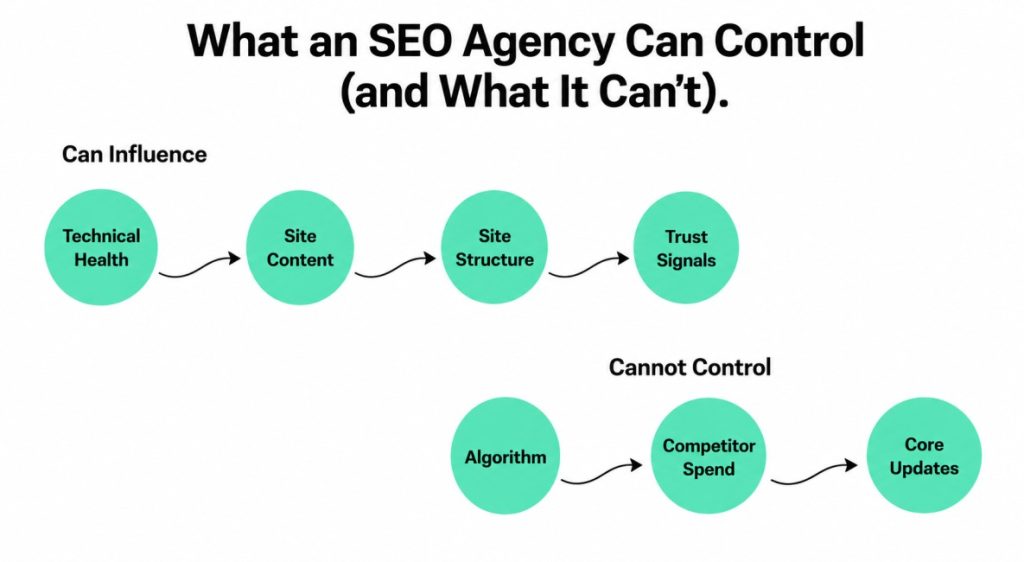
An agency can influence a site’s technical health, how clear and useful its content is, how the site is structured, and the signals that tell a search engine a page is worth trusting. What no agency controls is the algorithm itself, how much a competitor decides to spend chasing the same keywords, or when a broad core update rolls out and reshuffles the results for reasons that have nothing to do with anything the agency did that month. Judging an engagement off one rough month is a weak way to measure whether the work is actually working.
There’s also a harder edge worth being direct about. Google has said plainly that its spam policies apply across all of Search now, including the AI-written summaries sitting above the regular results. Link schemes, cloaking, thin AI-generated pages built purely to game rankings, none of it gets treated differently depending on which part of the results page it’s aimed at. An agency running any of that is building on ground that tends to give way the moment Google’s detection catches up. Reading that documentation directly, rather than taking an agency’s word for what counts as manipulation, is a reasonable thing for any business to do before signing anything.
How the Work Changes After the First Few Months
The first month or two of a new engagement is usually the busiest for technical and structural fixes, since that’s where the audit findings get worked through. Months three through six tend to shift toward content and the internal linking that supports it, while the technical side settles into monitoring instead of active repair.
After that, the work should start following the data more than the original audit. Pages stuck on page two get pulled forward for improvement, using roughly the same impact-versus-effort thinking that shaped the first month’s fixes. Content that isn’t earning impressions gets revisited or folded into something else instead of sitting there untouched out of habit. This is usually where a reactive agency and a proactive one start to look different: one waits to be asked what’s next, the other already knows from last month’s numbers.
For anyone weighing whether this kind of ongoing spend actually makes sense for their budget, rather than what the day-to-day work involves, whether an SEO retainer is actually worth the cost goes into that decision in more detail.