AI logo generators have moved fast. Tools like Looka, Canva’s Logo Maker, and Adobe Express now produce results in minutes that would have taken a junior designer half a day to mock up in 2018. The outputs look credible at a glance. The pricing is nearly frictionless. And the speed is genuinely impressive.
So why does the conversation about custom logos versus AI tools keep circling back to the same unresolved tension? Because the comparison most business owners are making is the wrong one. The real question is not whether an AI tool can create something that looks like a logo. It clearly can. The question is whether what it produces can do the job a logo actually needs to do over the life of a growing business.
That distinction matters more in competitive markets than it does in simple ones. And Texas business markets, whether you are operating in the DFW commercial corridor, building a professional services firm in Houston, or growing a trade company out of Fort Worth or North Richland Hills, are not simple markets.
What AI Logo Generators Actually Produce
Understanding what you get from an AI logo tool requires understanding how these tools work rather than just what they output.
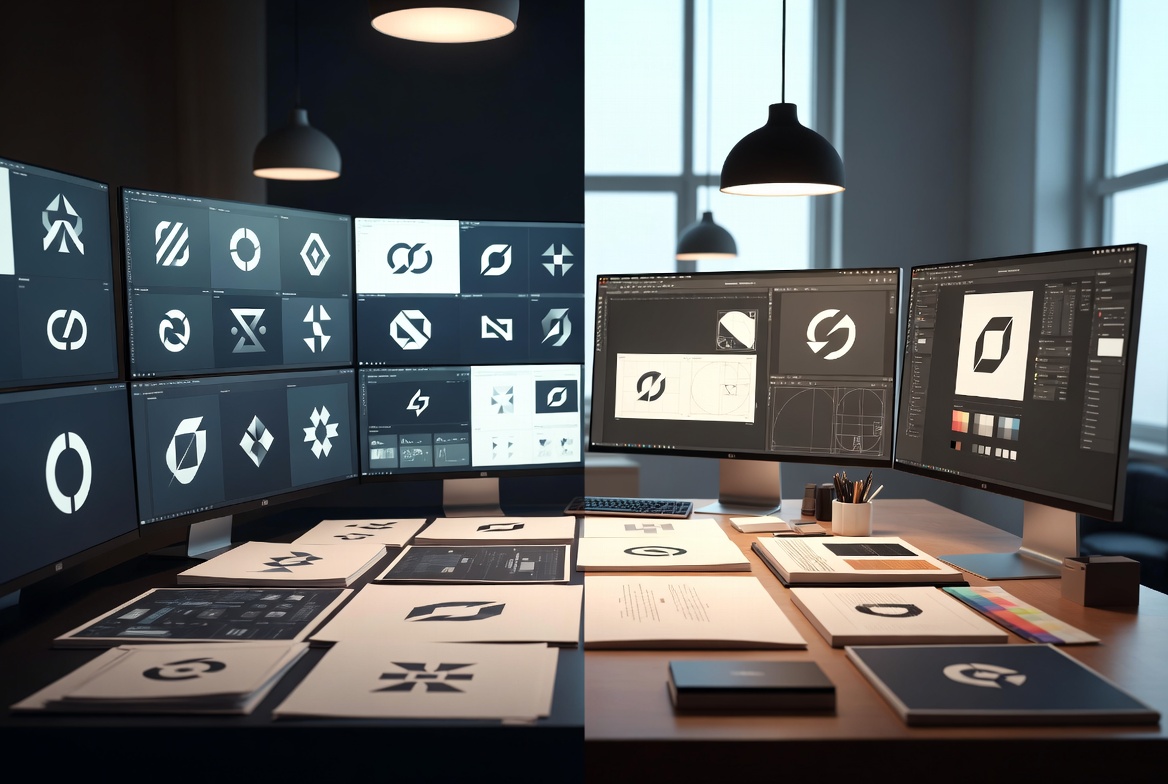
Most AI logo generators, Looka, Canva, Tailor Brands, Wix Logo Maker, and similar platforms, operate on a combination of pre-built icon libraries and rule-based design logic. You input your business name, industry, and some style preferences. The algorithm selects from a pool of available icons, applies your color and font inputs, and generates multiple variations. You choose one, adjust it, and download.
The critical mechanical reality here: those icons come from shared libraries. Every user of the same tool has access to the same icon pool. Businesses in your category and your city are drawing from the same source. Testing confirms this pattern — companies in overlapping industries regularly receive logo suggestions built around the same core icon, sometimes with only color or font treatment differentiating them.
This matters for reasons that go beyond aesthetics. The U.S. Patent and Trademark Office requires that a trademark be ‘distinctively yours.’ A logo built from a shared commercial icon library carries real risk when you attempt to trademark it, particularly if a competitor in your space has used the same base icon in a prior registration. That is not a hypothetical concern for a growing Texas business. It is a legal exposure that has no equivalent in custom logo design.
Where AI Logos Work and Where They Break Down

There is a clear and defensible use case for AI logo tools, and pretending there is not would be analytically dishonest.
If you are in the earliest stage of a business, testing a concept before committing resources, generating a placeholder identity for an MVP, or operating at a revenue level where a $50 Canva subscription makes legitimate sense, an AI-generated logo is not catastrophically wrong. It gives you something to put on a business card, a basic website, or a social profile while you validate whether the business idea has traction.
The problem is not where AI logos start. It is where they stop.
An AI-generated logo is typically a single mark, often with limited file variants, no brand system behind it, and no strategic rationale for the design choices made. When you scale from a startup into a recognized local business, several things happen that the logo needs to survive: print reproduction in varying sizes, co-branding on partner materials, signage, vehicle wraps, merchandise, RFP submissions, and professional presentations. A logo that was built for a web header starts to fail the moment it needs to work at 2 inches wide on a business card or at 10 feet on a trade show banner.
A custom logo design built by a professional studio solves this before the problem appears. Vector files are native to the process. Variants, horizontal, stacked, icon-only, and reversed for dark backgrounds, are part of the deliverable. The mark is designed to work at every scale from the beginning, not retrofitted afterward.
The Brand System Gap: What No AI Tool Delivers
Even the best AI logo generator produces a logo. What a professional branding engagement produces is a brand system.
For Texas businesses competing in markets where professional credibility matters, including B2B services in Dallas, construction and contracting in Fort Worth and Arlington, professional practices in Houston and Plano, and healthcare or legal services across the state, the difference is not cosmetic. A brand system gives you:
- A primary logo and all required variants with documented use guidelines
- A color palette with specific hex, CMYK, and Pantone values for print accuracy
- Typography standards that carry your brand voice across proposals, presentations, and client materials
- Clear spacing rules and misuse guidelines that prevent the brand from degrading over time
- Digital asset files formatted for web, social, and print without needing a designer on call
That system is what allows a brand to remain consistent when three different people are creating materials for the same company at the same time. Without it, inconsistency accumulates. Colors drift. Fonts get swapped. The logo gets stretched to fit a template. The cumulative effect is a brand that looks like multiple different companies depending on which touchpoint a client encounters first.
This is especially visible in professional services, where clients are evaluating trust signals before they evaluate qualifications. A Dallas law firm or a Houston consulting practice with inconsistent brand materials signals operational inconsistency in the mind of a prospective client, whether that interpretation is consciously made or not. The relationship between brand consistency and perceived credibility is well-established and not subtle.
Cost: The Comparison That Gets Framed Wrong
The framing most people use when comparing AI logos to custom design treats cost as a straightforward variable: AI logo tools cost $0 to $100. Professional logo design in Texas from a reputable agency typically starts in the $500 to $2,000+ range depending on scope.
That framing makes AI tools look like an obvious choice for cost-conscious businesses. But it compares the wrong things.
The relevant comparison is not what a logo costs to produce. It is what it costs to replace, and what it costs the business between now and replacement. A business that launches on a Canva logo, builds early brand recognition in the local market, and then realizes at year two or three that the logo cannot scale into print, cannot be trademarked, and looks amateur next to the competition it now wants to outcompete, faces a full rebrand at that point. That rebrand carries costs the original logo budget avoided: reproduction across all existing materials, updating the website, reprinting collateral, and, most expensively, the brand recognition reset that comes with a visual identity change.
Professional logo design done once, done correctly, with full file delivery and a brand system behind it, avoids that compounding cost entirely. For a Texas business with serious growth plans, that is not a premium. It is a risk management decision.
The Trademark Consideration Most Business Owners Skip
As Texas businesses grow, many eventually want to protect their brand legally. Trademark registration through the USPTO is the primary mechanism. And it is where AI-generated logos run into a structural problem that most tools do not disclose clearly in their marketing.
Trademark registration requires that your logo be sufficiently distinctive to qualify for protection. Generic or commonly used icons drawn from shared commercial libraries frequently fail this test, either because they lack distinctiveness or because prior registrations using similar base elements already exist in your industry class.
A custom logo designed from original artwork does not carry this risk. The design is yours. The originality is demonstrable. The trademark filing proceeds on a solid foundation. For a Texas business planning a trademark at any point in its future, that structural difference in where the design originates is not a minor technical detail. It is the whole ballgame.
What to Look for in a Professional Logo Design Company in Texas
If the comparison above leads to a decision to invest in professional logo design, the question becomes how to evaluate who to work with. A few markers separate strong branding work from average agency output:
- Strategic discovery before any design work. A reputable studio will ask about your market, your competitors, your target client, and your positioning before sketching anything. If a logo is proposed without those conversations, the design is decoration, not strategy.
- Full vector file delivery as standard: not optional, not a premium upsell. SVG, EPS, AI, and PDF files should come with every professional logo engagement.
- Complete variant set: horizontal, stacked, icon-only, and reversed versions allow the logo to function in every context it will actually encounter.
- Brand system depth: color standards, typography specifications, and basic usage guidelines separate a standalone logo from a deployable brand identity.
- Portfolio evidence in your category: a studio that has worked with businesses similar to yours in the Texas market brings competitive context that generalist designers cannot replicate.
The professional branding and logo design services in Texas built around these principles produce logos that are not just visually strong today but structurally capable of representing the business accurately as it grows. That distinction is where the real value of custom design lives, not in the aesthetic preference between AI and human-made, but in the business utility of what the work delivers over time.
For Texas businesses thinking about what branding actually needs to accomplish, whether that is converting proposals to contracts, establishing credibility in new markets, or building the consistent visual presence that referrals and repeat business depend on, the gap between a shared-library icon and a purpose-built identity is not a design opinion. It is a business decision with measurable consequences.