Texas has more than 3.3 million small businesses, according to the U.S. Small Business Administration, which means the competition for local search visibility is not abstract. In Dallas-Fort Worth, Houston, Austin, and San Antonio, two businesses offering nearly identical services can land in very different positions on Google, and the gap often comes down to one thing: which one has more credible, locally relevant links pointing to its site.
Link building has a reputation problem. The phrase conjures up paid guest posts, spammy directories, and link schemes that Google dismantled years ago. The reality in 2026 is simpler and more interesting than that. The tactics that consistently move local rankings are not technical shortcuts. They are the digital equivalent of showing up, contributing to the community, and becoming the kind of business that other credible sources naturally reference.
This guide walks through the specific approaches that work for Texas businesses, why each one carries weight with search engines, and how a well-executed content marketing strategy Texas creates the conditions where links accumulate rather than having to be manually chased.
Why Local Links Hit Differently Than Generic Backlinks
A backlink from a nationally known publication with a domain authority of 85 sounds impressive. For a plumbing company in Fort Worth, though, a link from the Fort Worth Chamber of Commerce website, the Fort Worth Star-Telegram, or a locally trusted home improvement blog may carry more ranking weight for the searches that actually drive calls.
Search engines do not just count links. They evaluate relevance signals. A link from a source that is geographically connected to your business area and topically adjacent to your industry tells Google something specific: this business is part of this place and this industry. That specificity is harder to manufacture than a generic high-DA link, and it is also harder for competitors to replicate quickly.
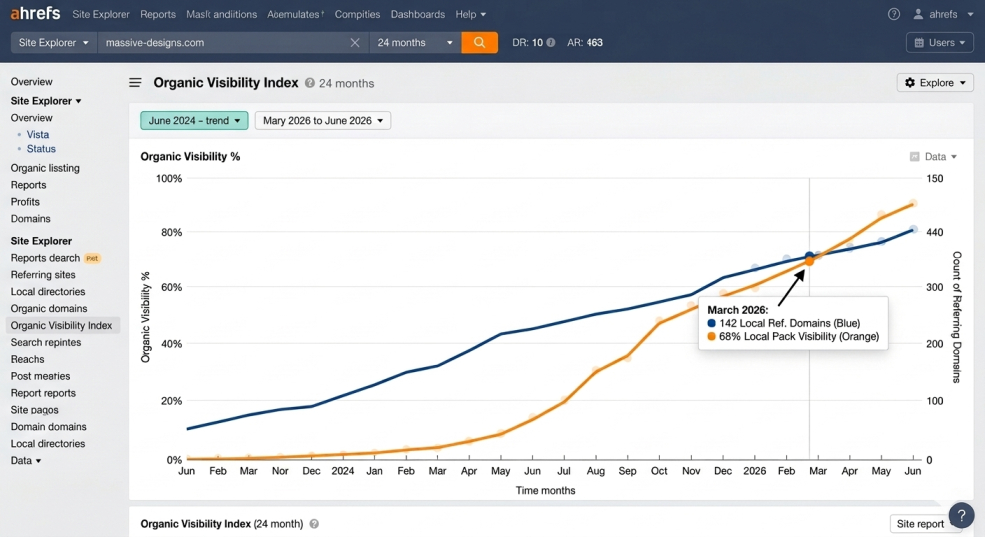
According to Whitespark’s Local Search Ranking Factors research, local links remain among the top three ranking contributors for Google Local Pack visibility. That data has stayed consistent across multiple years and survey iterations, which means this is not a trend. It is a structural feature of how local search works.
Tactic 1: Texas Chamber Memberships Are Not Just Networking Tools
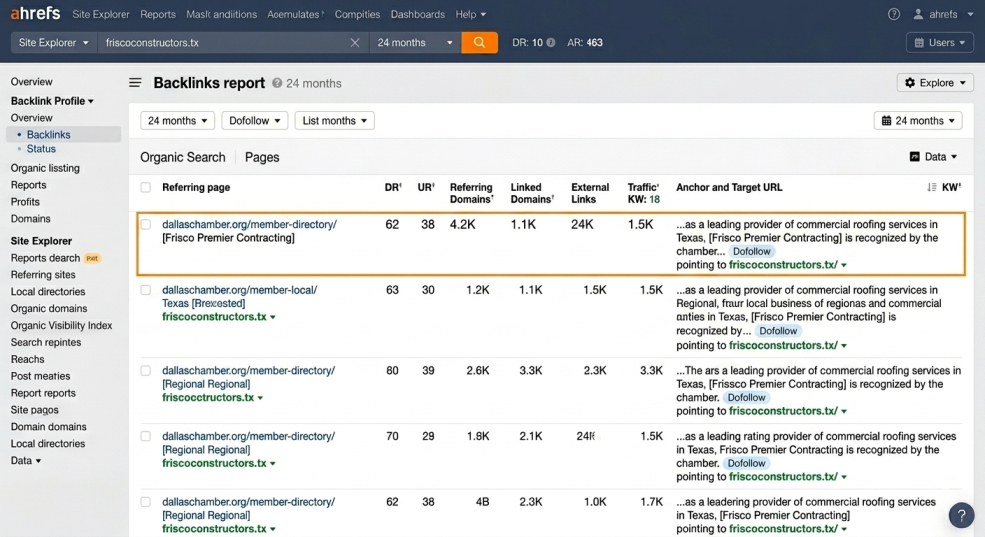
Every significant Texas city and most mid-size towns have active chamber of commerce organizations. The Greater Dallas Chamber, the Greater Houston Partnership, the Austin Chamber of Commerce, the San Antonio Chamber of Commerce, and hundreds of regional bodies like the North Richland Hills Chamber of Commerce and the Plano Chamber all maintain business directories on their websites.
Getting listed in those directories is not complicated. Membership fees are real, but they are also reasonable when weighed against the SEO value of a government-adjacent, regionally authoritative backlink. The domain authority of chamber websites across Texas typically ranges between 40 and 65, which is solid for local authority building. More importantly, these sites have been indexed and trusted by search engines for years.
The underused opportunity here is not just the directory listing. Chambers regularly publish member spotlights, business news, and event coverage. A contractor company in Frisco that sponsors a chamber networking event will almost always receive a mention and a link on the chamber’s event recap page. A marketing agency that speaks at a chamber luncheon gets written up in the meeting notes. These secondary links from chamber activity often outperform the basic directory listing because they appear in editorial content on the same trusted domain.
Action point: If you’re operating in DFW, join at minimum the relevant city chamber and one regional business association. Then actually show up. Sponsorship, speaking opportunities, and volunteer committee work each create natural linking occasions that are otherwise unavailable.
Tactic 2: Texas Media Coverage is More Accessible Than Most Businesses Realize
Local journalism in Texas is not dead. The Austin American-Statesman, Houston Chronicle, Dallas Morning News, Fort Worth Star-Telegram, San Antonio Express-News, and a dense ecosystem of city-specific business publications (including the Dallas Business Journal and Houston Business Journal) actively cover local business stories.
What most business owners miss is that these outlets do not require a PR firm on retainer. They need interesting, timely stories. A North Texas contractor who completes the first net-zero residential renovation project in their city has a local story. An Austin fintech startup that hires fifty local employees during an economic contraction has a local story. A Plano digital agency that launches a free resource for local nonprofits has a local story.
The pattern worth studying is the story angle rather than the press release. Journalists are pitched self-promotional copy all day. They respond to local relevance, human specificity, and connection to topics their audience cares about. When your business does something genuinely interesting, the outreach is not asking for a favor. It is offering the journalist something their readers want.
A single mention in the Houston Chronicle or Dallas Morning News delivers a backlink that most link-building campaigns cannot buy at any price because these outlets do not sell editorial coverage. That restriction is exactly what makes the link valuable
Tactic 3: University and College Partnerships
Texas hosts flagship research institutions including UT Austin, Texas A&M, Texas Tech, Rice University, University of Houston, and TCU, as well as a wide network of community colleges. Links from .edu domains carry disproportionate trust signals, and they are more accessible than they appear.
Local businesses that offer internship programs are frequently listed on university career services and business school websites. A company that partners with UT Dallas on a research project, a Fort Worth law firm that provides a scholarship through TCU’s law school, or a marketing agency that participates in a UT Austin career fair may find their link appearing on a university subdomain within weeks of formalizing the relationship.
The investment required is typically a modest scholarship amount, a structured internship, or a guest speaking commitment. The return includes a .edu backlink, legitimate community credentials, and a recruitment pipeline, none of which belong to the SEO budget in isolation but which contribute to it directly.
Tactic 4: Hyperlocal Content That Earns Citations Naturally
Most competing link-building guides skip this because it requires actual work rather than outreach. But for Texas businesses with a genuine local presence, it is one of the most durable sources of inbound links available.
The mechanism is straightforward: create content that is specific enough and useful enough that local sources reference it without being asked. A roofing company in San Antonio that publishes a detailed guide on hail damage standards by Texas county, complete with insurance claim context, becomes a natural citation target for local news coverage of hailstorms. A CPA in Austin that publishes the clearest available breakdown of Texas franchise tax rules becomes the reference point for local business blogs and forums.
This kind of content works because it solves a specific problem for a specific audience, and that specificity makes it uniquely citable. Generic content can be found anywhere. Authoritative, locally specific content lives in a short supply.
The approach connects directly to what a sound SEO content strategy should be accomplishing at the MOFU stage of the funnel: building authority through genuine usefulness rather than chasing metrics.
Tactic 5: Local Business Partnerships and Cross-Referrals
Texas business culture places a premium on relationships. The convention of reciprocal referrals between complementary service businesses, common in industries like real estate, mortgage, title, and home services, creates a natural infrastructure for link building when it extends to the web.
A Keller-based general contractor who consistently refers clients to a local architect creates the conditions for a genuine partnership. When that relationship is documented on both websites (as a preferred partner, a vendor, or a referral source), both businesses receive contextually relevant links from a trusted local entity.
This approach scales across industry categories. A Southlake financial advisor and a Dallas estate attorney who serve overlapping client bases. A Houston photography studio and a Houston wedding venue. A Dallas digital marketing agency and a North Texas branding firm. In each case, the link is editorially justified because the relationship is real and the referral context is genuine.
Google’s quality guidelines do not penalize reciprocal links when they reflect actual business relationships. The line is between manufactured link exchanges and genuine editorial references, and the distinction is visible in context, anchor text, and the coherence of the surrounding content.
Tactic 6: Sponsoring Local Events and Community Organizations
Texas has a dense calendar of industry events, community festivals, nonprofit fundraisers, and civic organizations. Each of these creates a linking opportunity for businesses willing to put their name behind something local.
Event sponsorships typically result in a sponsor page listing on the event website, often with a link. Annual festivals like the State Fair of Texas, Austin City Limits Music Festival, and hundreds of local events generate sponsor pages with links that persist for months. Charity golf tournaments, local youth sports league sponsorships, and nonprofit gala sponsorships follow the same pattern.
The key is choosing organizations and events that have functional websites, maintain their sponsor pages for at least a year, and have some topical or geographic connection to your business audience. A commercial HVAC company sponsoring a local construction industry association event earns a more relevant link than the same company sponsoring an unrelated arts festival, even if the latter has a slightly higher domain authority.
Tactic 7: Claiming and Enriching Your Local Citation Profile
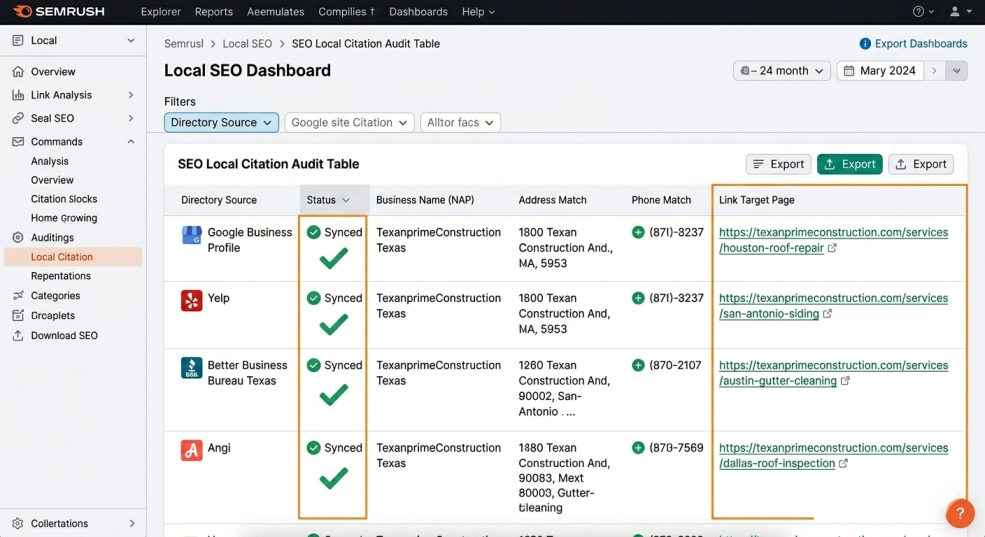
Before pursuing new links, most Texas businesses have an immediate opportunity to improve their existing citation infrastructure. Inconsistent business name, address, and phone information across local directories actively harms local rankings by creating conflicting location signals.
Priority citation sources for Texas businesses include Google Business Profile, Bing Places, Yelp, BBB, Angi (for home services), Houzz (for design and construction), Avvo (for legal), Healthgrades (for medical), and the Texas Secretary of State business registry. Beyond these, industry-specific directories in construction, legal, medical, financial services, and technology each add relevant topical context.
The goal is not just quantity. Each citation source should have consistent NAP data, a complete business description, accurate categories, and, where possible, links back to specific service pages rather than just the homepage. A link pointing directly to a web design and development service page carries more topical relevance than a homepage link for most service businesses.
How Content and Link Building Work Together
Link building and content strategy are not separate activities. The content a Texas business publishes determines what is linkable. An agency that publishes thoughtful, specific, researched guides creates assets that other sites want to reference. One that publishes thin promotional posts creates nothing worth linking to.
The content formats that tend to earn the most unsolicited local links fall into a few categories: original research or data specific to Texas markets, comprehensive how-to guides that answer questions local audiences actually have, case studies that document real outcomes for Texas clients, and tools or resources that local organizations want to share with their audiences.
According to Ahrefs’ link building research, content that earns natural backlinks typically falls into one of three categories: it is useful (solves a real problem), it is unique (covers something not already covered), or it is original (presents data or perspectives that do not exist elsewhere). Texas-specific content hits all three criteria when it is executed with genuine depth.
A North Texas business that commissions a study on remote work patterns in the DFW metro, or publishes an annual report on small business growth in Tarrant County, creates something that local media, local organizations, and other local businesses will naturally reference. That is the content side of link earning rather than link begging.
What to Avoid: Link Tactics That Hurt Texas Businesses
There are practices that appear to be shortcuts but consistently backfire. Paid links from foreign link farms. Fake press release syndication networks that exist only for link placement. Thin guest posts on sites with no real audience. Private blog networks. These practices have been a focus of Google’s spam detection systems for years, and the penalties, when they land, are significant.
The simpler test is this: would the link make sense if search engines did not exist? If a link to a Dallas marketing agency appears on a website about cryptocurrency wallets with no editorial connection, it fails the test regardless of the domain authority. If it appears in a Dallas Business Journal article about DFW digital marketing trends, it passes.
The practical implication is that the most sustainable link building for Texas businesses is also the most defensible. Real relationships, real editorial placements, real community involvement, and real content that earns references organically. These do not generate hundreds of links per month, but they generate the kind that hold their value and compound over time.
Putting a Texas Link Building Program Together
A realistic link acquisition program for a Texas SMB typically operates on a 90-day cycle with defined targets. The first month focuses on audit and citation cleanup: identifying existing NAP inconsistencies, claiming unclaimed profiles, and cataloging current link sources. The second month initiates outreach: chamber membership, partnership conversations, event sponsorship identification, and media pitch development. The third month shifts toward content: identifying the one or two hyperlocal content pieces that are most worth developing given the business’s industry and audience.
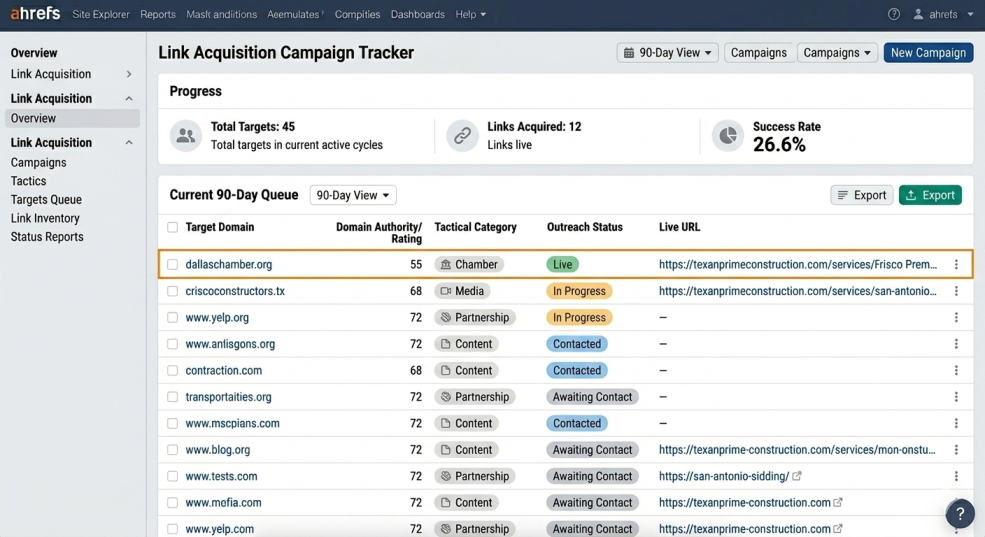
After 90 days, the focus shifts to tracking and iteration. Which citation sources drove the most referral traffic? Which content pieces generated unsolicited mentions? And which outreach channels produced actual responses? These patterns inform the next cycle rather than starting from scratch.
For businesses working with a digital marketing agency in Texas on this kind of program, the internal resource requirement is manageable. The business provides access to relationships, local knowledge, and subject-matter expertise. The agency handles research, outreach sequencing, content production, and tracking. The combination is more effective than either party operating alone.
The Bottom Line on Local Links
There is no algorithm that rewards the appearance of authority without the substance. A Texas business that is genuinely embedded in its community, producing content that local audiences find useful, and maintaining consistent local citation information across the web will accumulate links as a byproduct of operating well.
The link building tactics outlined here are not separate from running a credible local business. They are the digital expression of it. Chambers, press coverage, university partnerships, local content, community sponsorships, and cross-referral networks are all things that benefit businesses in their own right. The search authority they produce is a byproduct rather than the primary goal, and that framing is what separates sustainable local SEO from campaigns that erode the moment Google updates its spam filters.
Texas businesses have a structural advantage in local link building that national brands cannot replicate: genuine local identity. Using it consistently and strategically is what separates the ones that rank from the ones that keep wondering why they don’t.