
Kimera Chems came to us in June 2025 with a large catalogue, a functioning storefront, and organic traffic that had stopped moving. The site averaged roughly 150 organic visits a day. It was not a content problem in the way most people assume; there was plenty of content. It was a foundation problem: Google was spending its crawl budget on pages that could never rank, product pages were competing with blog posts for the same queries, and mobile pages were taking nineteen seconds to render their main content.
Three months of technical remediation, metadata rebuilding across more than 150 pages, and structured content production took average daily organic traffic past 450 — a gain of more than 200%.
The more interesting part of this project is what happened next. As the business moved towards a compliance-led, researcher-first model — including gating the product catalogue behind account registration — the commercial SEO playbook that produced the first result stopped being the right playbook for the second. The engagement is now rebuilding the site around a Research Hub architecture, where authoritative educational content, not product pages, becomes the primary entry point from search.
This case study covers both halves: what we fixed, why we fixed it in that order, what the data showed, and where our reasoning had to change.
How we measured, and what we can and cannot claim
Before the numbers, the caveats. Any agency case study without this section is asking you to take its arithmetic on faith.
Data sources. Google Search Console (clicks, impressions, average CTR, average position), Google Analytics 4 (sessions and engagement), Google PageSpeed Insights and Lighthouse (lab performance data), Screaming Frog SEO Spider (crawl), and Semrush and Ahrefs (keyword, competitor, and backlink data). Third-party estimates from Semrush and Ahrefs are modelled figures and are treated here as directional, not authoritative — only Search Console and GA4 report what actually happened on the property.
Attribution. Technical fixes, metadata rewrites, content publishing, and link acquisition ran in parallel, which is normal in a real engagement and inconvenient for clean attribution. We can show what we changed and what happened afterward. We cannot isolate a single lever and assign it a percentage of the gain, and we do not attempt to. Where we believe one change carried disproportionate weight, we say so and explain the reasoning rather than presenting it as measurement.
Comparability. Search demand in this category is seasonal and competitive conditions shift. Growth figures compare like-for-like reporting windows in Search Console, and the underlying screenshots are reproduced here so you can read the same data we read.
Typicality. These are one client’s results, on one site, in one market. They are not a forecast for another business.
The starting point: June 2025
The initial assessment was deliberately unglamorous. Before proposing anything, we wanted to know what Google could actually see, what it was choosing to ignore, and why.
Kimera Chems runs a WordPress and WooCommerce storefront across eight product categories — peptides, selective modulators, nootropics, aminos, analytical reagents, chemical supplies, discounted compounds, and multi-compound systems — supported by a blog and a public Certificates of Analysis section. The COA library matters more than it first appears. In a category where buyers evaluate supplier credibility before anything else, third-party purity documentation is a trust asset most competitors either bury or omit. It was sitting on the site, largely unleveraged in search.
What the audit found was a decade’s worth of accumulated technical debt layered under a site that looked, from the front end, perfectly healthy.
Mobile performance was the headline problem.
Table 1. Core Web Vitals and supporting lab metrics, mobile — June 2025
| Metric | June 2025 (mobile) | Google’s “good” threshold | Assessment |
| First Contentful Paint | 7.2 s | Under 1.8 s | Poor |
| Largest Contentful Paint | 19.2 s | Under 2.5 s | Critical |
| Total Blocking Time | 410 ms | Under 200 ms | Needs work |
| Cumulative Layout Shift | 0.174 | Under 0.1 | Needs work |
| Speed Index | 10.6 s | Under 3.4 s | Slow |
Table 2. The same metrics on desktop — June 2025
| Metric | June 2025 (desktop) | Google’s “good” threshold | Assessment |
| First Contentful Paint | 1.3 s | Under 1.8 s | Good |
| Largest Contentful Paint | 1.5 s | Under 2.5 s | Good |
| Total Blocking Time | 330 ms | Under 200 ms | Slightly high |
| Cumulative Layout Shift | 0.002 | Under 0.1 | Good |
| Speed Index | 2.5 s | Under 3.4 s | Good |
The gap between the two tables is the finding. Desktop was fine. Mobile was not — a 19.2-second Largest Contentful Paint against a 2.5-second target, which is not a tuning issue but a rendering failure. Because Google indexes with a mobile crawler, the desktop numbers were largely decorative. The mobile column described the experience Google was evaluating, and the one most researchers on a phone were actually getting.
Two technical points are worth being precise about, since they are routinely muddled in agency reporting.
These are lab figures, not field data. PageSpeed Insights runs a simulated environment. Google’s page experience signals are drawn from the Chrome User Experience Report — real users, 75th percentile, rolling 28-day window. Lab data is a diagnostic that tells you where the problem is; it is not what you are graded on. We tracked both and treated field data as the source of truth.
Total Blocking Time is a proxy, not a Core Web Vital. The responsiveness metric has been Interaction to Next Paint since March 2024, and INP can only be measured from real interactions. TBT correlates with it closely enough to be useful in the lab, which is why 410 ms mattered: it pointed at main-thread work from render-blocking JavaScript and CSS that would surface as sluggish menus, filters, and add-to-cart behaviour for real users. Diagnosing that kind of rendering problem sits on the boundary between SEO and build quality, which is why our SEO work and our web development team run the remediation together rather than handing tickets back and forth.
Google was crawling the wrong site.
The Search Console index coverage report explained why publishing more content would not have worked on its own.
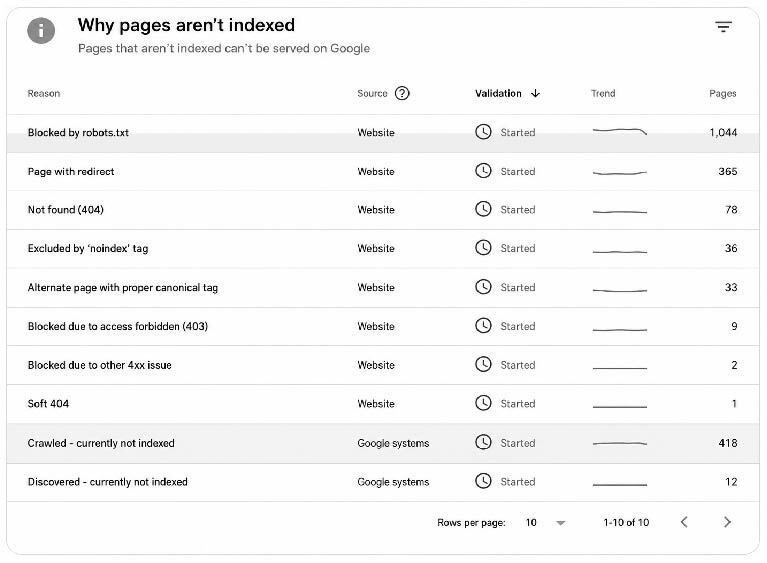
Figure 1. Google Search Console page indexing report, June 2025 — 1,976 URLs sitting outside the index.
Table 3. Index coverage at the start of the engagement
| Reason pages were not indexed | Pages |
| Blocked by robots.txt | 1,044 |
| Crawled – currently not indexed | 418 |
| Page with redirect | 346 |
| Not found (404) | 78 |
| Excluded by noindex tag | 36 |
| Alternate page with proper canonical tag | 30 |
| Discovered – currently not indexed | 12 |
| Other (403, soft 404, and similar) | 12 |
| Total | 1,976 |
That is 1,976 URLs outside the index. The number is large, but the number by itself is not the insight — and this is where a lot of audits go wrong.
Not all of these are defects. On a WooCommerce site, a substantial share of “blocked by robots.txt” is deliberate: cart, checkout, account, add-to-cart parameters, and faceted filter combinations that should never be crawled. Some “page with redirect” entries are the correct residue of past slug changes. The audit’s real job was separating intentional exclusions from accidental ones, and the accidental ones told the story.
418 pages crawled and then rejected. Google spent budget fetching these and declined to index them. On a catalogue of this shape, that pattern almost always means thin or near-duplicate pages — product entries differentiated only by size or variant, and blog posts too similar to one another to justify separate index entries.
346 redirects and 78 broken URLs were still being discovered, which meant internal links and sitemaps were still pointing at addresses that no longer existed.
Twelve pages discovered but never crawled, a classic symptom of a crawl budget being consumed elsewhere.
Combined with a weak internal linking structure, the practical effect was that Kimera Chems’ best commercial pages were competing for Google’s attention against roughly two thousand URLs that were never going to earn a click.
The rest of the audit
Screaming Frog and manual review surfaced the supporting problems: duplicate and missing title tags and meta descriptions across the homepage, category, and product templates; inconsistent heading hierarchy; unoptimised images; missing and malformed structured data; orphaned pages; redirect chains; and keyword cannibalisation, where several blog posts and product pages targeted the same query and split their own signals.
We prioritised a single question — what is currently preventing the site from ranking, as opposed to what would make it rank better? Those are different projects, and doing the second before the first wastes money.
That put the order at crawl and indexation hygiene, then mobile rendering, then metadata, then content, then authority. Fixing the mobile LCP before cleaning up the index would have produced a fast site that Google still could not read properly. Publishing new articles before resolving cannibalisation would have added competitors to an existing internal fight.
The alternative we considered and rejected was a full replatform. It was tempting: a clean rebuild would have solved the rendering problem outright. We advised against it because a migration mid-engagement would have reset the site’s existing equity and pushed measurable results out by months for a business that needed traffic now. It is the same calculation we walk clients through when they ask what a new build is really worth — the launch invoice is rarely the expensive part. Remediating in place was slower to plan and considerably less risky.
The backlink profile: cleanup as risk reduction, not as a growth tactic
The backlink audit, run across Semrush and Ahrefs, found what a lot of established e-commerce domains carry — a residue of automated link building predating our engagement. Referring domains included link-network properties such as seoflox.io, exlinko.org, rank-fast.agency, and prolinkbox.com, with the usual signatures: no topical relevance, artificial anchor text distribution, and near-identical placement patterns across unrelated sites.
We compiled a disavow file and submitted it through Search Console.
We want to be straightforward about how we think about this, because it is frequently oversold. Google’s systems ignore most spam links without help, and the disavow tool is positioned as a remedy for site owners with a manual action or a genuine reason to believe they are at risk — not as a routine growth lever. We do not attribute any of the traffic gain to the disavow. We did it because the profile carried a pattern that could plausibly attract scrutiny, and because a clean baseline made the subsequent link acquisition work measurable. It was insurance, not strategy.
What did become strategy was the replacement: editorial placements, digital PR, and contextual links from publications with genuine topical adjacency to laboratory research and scientific supply, acquired slowly. In a category where credibility is the product, a small number of defensible links is worth more than volume — and volume is exactly what created the problem we had just spent time cleaning up.
Competitive analysis: reading the market before writing for it
With the technical picture clear, we mapped the competitive set in Semrush and Ahrefs to understand where organic demand in this category actually sits.
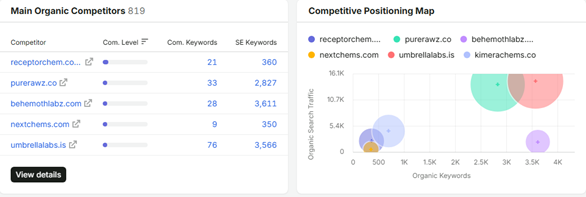
Five direct suppliers dominated the shared keyword space. The positioning map was the useful artefact: it showed competitors clustered at organic keyword counts several multiples above Kimera Chems’ at the time, on comparable traffic tiers. The gap was not authority — several of those domains were not notably stronger. The gap was coverage. They ranked for more things because they had published more pages addressing more queries, and their internal structures let those pages support one another.
That reframed the opportunity. This was not a market where we needed to outrank an entrenched leader on a handful of head terms. It was a market where the addressable keyword footprint was far larger than the one being served, and where a supplier with better technical foundations and better-organised content could take share across the long tail.
Keyword research and the metadata rebuild
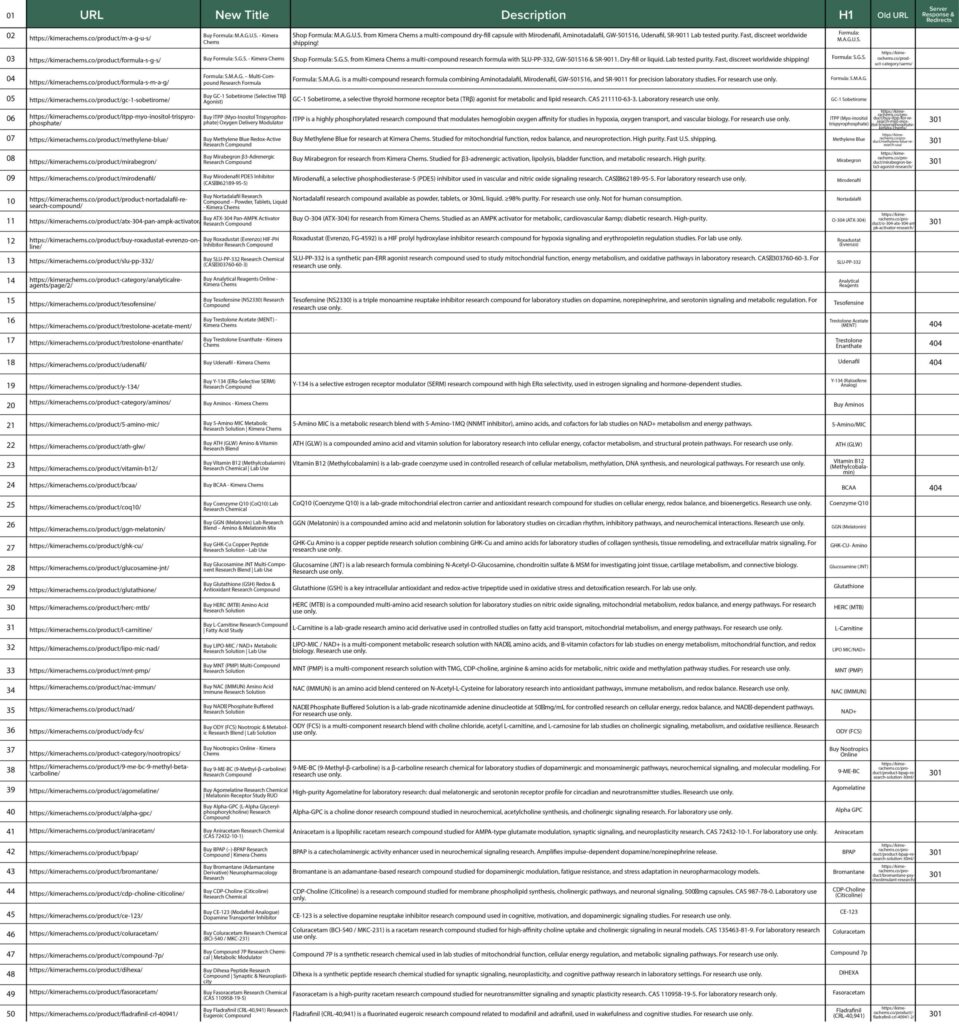
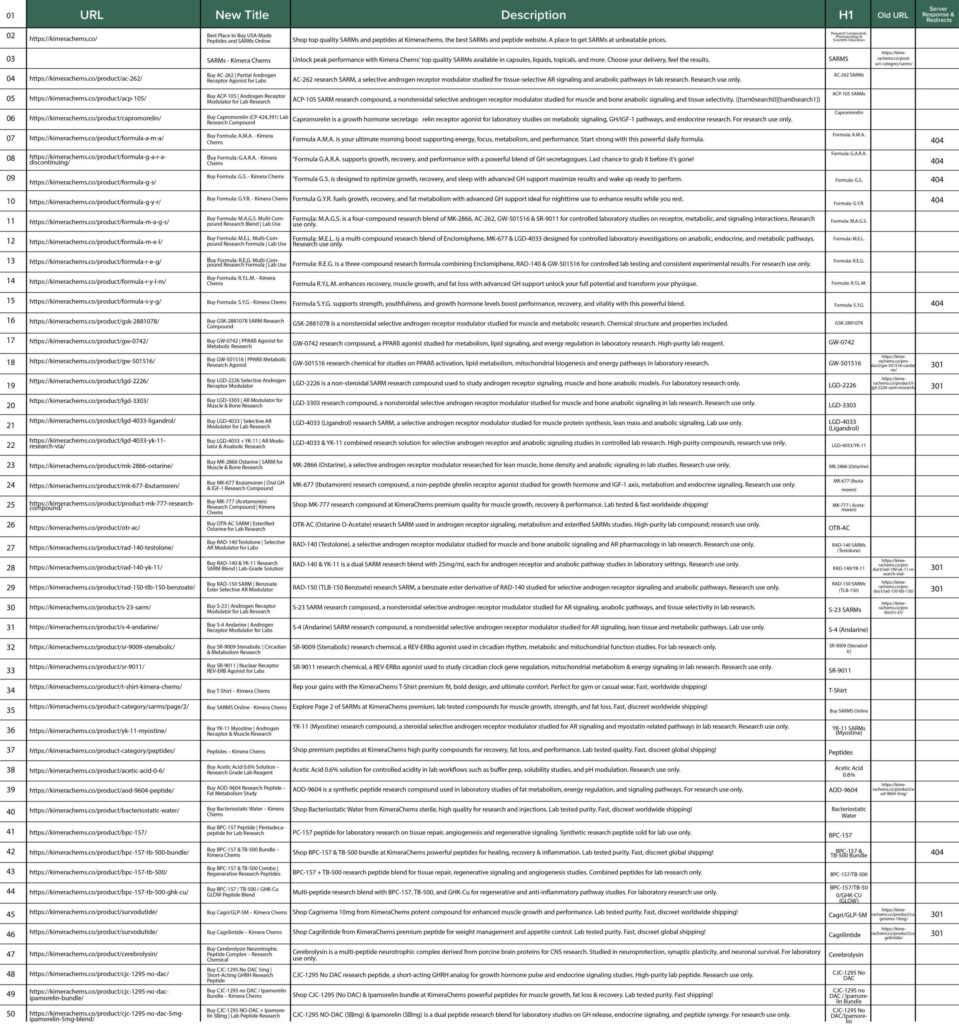
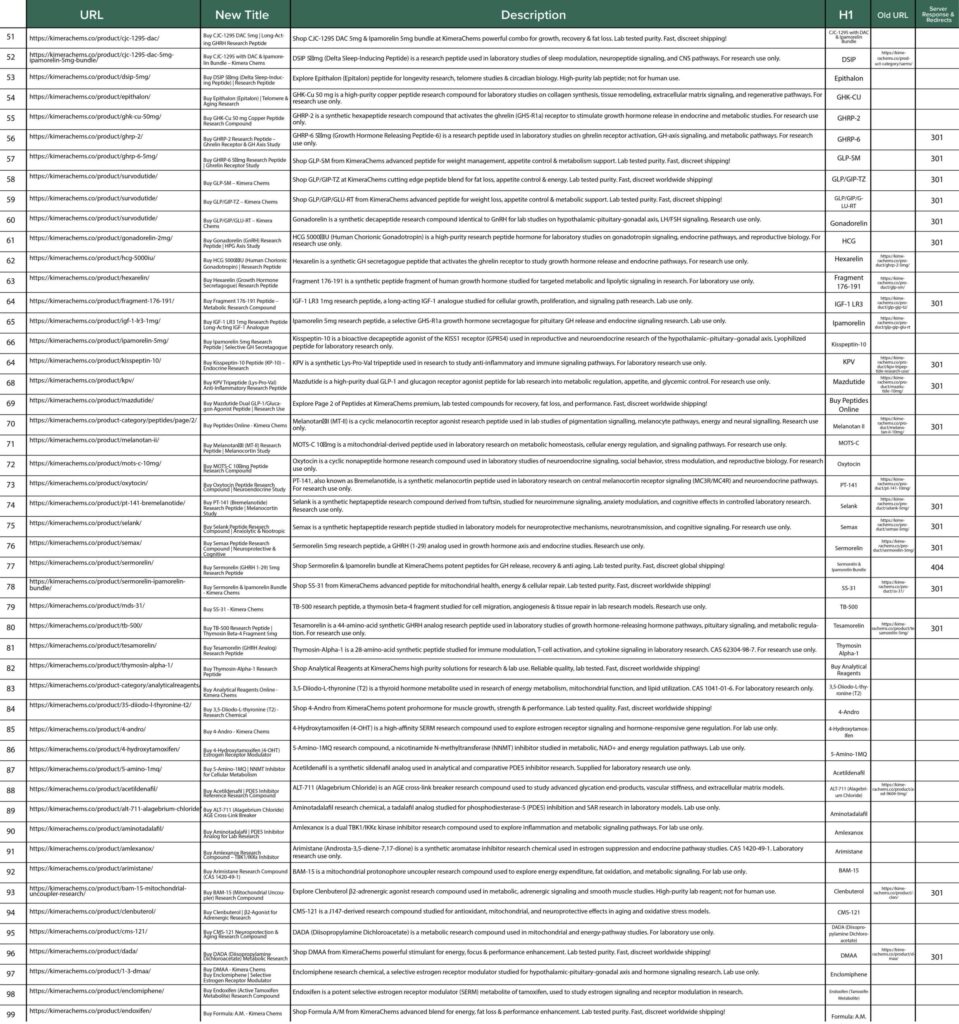
At this stage of the business, Kimera Chems was a straightforward e-commerce operation, so the keyword strategy prioritised commercial and transactional intent: category-level terms, compound-specific product queries, comparison and specification searches, and long-tail purchase-intent variations, validated against Search Console’s existing impression data rather than tool estimates alone.
The Search Console data was the more valuable input. Impressions on queries the site had never targeted showed where Google already considered the domain marginally relevant — the cheapest ranking gains available, because they require improvement rather than establishment.
We then rewrote SEO titles and meta descriptions across more than 150 pages: homepage, category pages, collection pages, and the commercial product set. Each page was assigned one primary query and written to earn a click from a search result rather than to satisfy a checklist. In a category where buyers are risk-averse and comparison-shopping, the description does real work — surfacing COA verification, purity documentation, and shipping specifics is what separates a click from a scroll-past.
Metadata is unfashionable work. It is also, on a catalogue site with 150+ commercially relevant pages and no consistent title conventions, one of the highest-leverage interventions available: it touches every page’s relevance signal and its click-through rate at the same time, and it ships in weeks rather than quarters.
Content: built to support the catalogue, not to fill a calendar
The content programme that followed was designed around the same principle. Every article was commissioned against a specific query cluster with a defined relationship to a commercial page — compound overviews, comparison pieces, laboratory application notes, storage and handling guidance, safety documentation, and identification and property references. This is the model behind our content marketing work generally: publishing against demonstrated search demand rather than an editorial calendar invented in a meeting.
Each piece linked deliberately into the relevant category and product pages. That internal linking was not decoration; it was the mechanism. It gave Google a path from newly earned informational relevance to the commercial pages that needed it, and it gave researchers arriving from an informational query somewhere sensible to go next.
Results: the first three months
By September 2025, roughly three months into remediation, the compounding effect of the technical fixes, metadata rebuild, and content programme was visible in Search Console.
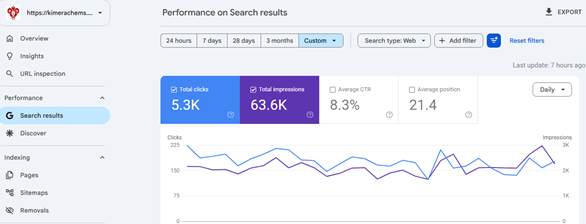
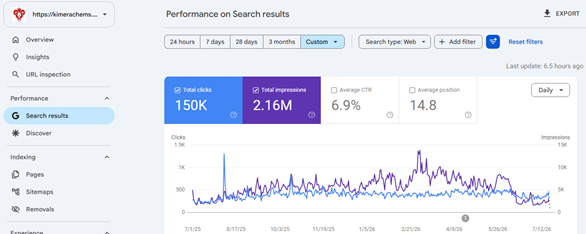
Figure 4. Search Console performance reported July 2026: 150K clicks, 2.16M impressions, 6.9% average CTR, 14.8 average position.
Average daily organic traffic moved from approximately 150 visits per day in June 2025 to more than 450 per day from September 2025 — an increase of more than 200% within the first three months of the engagement.
Three observations about that data, because the raw numbers understate one thing and overstate another.
The impression growth is the leading indicator. Clicks are the outcome; impressions are the evidence that the site’s eligible surface expanded. A site cannot earn clicks on queries it never appears for, and a large impression increase alongside an improving average position is what genuine visibility expansion looks like, as distinct from a temporary ranking bounce on terms already held.
Average position improving from 21.4 to 14.8 matters more than it sounds. That is movement from the back of page two into the lower half of page one across the aggregate. Aggregate position blends thousands of queries, so it moves slowly and grudgingly; a shift of that size across an entire property reflects broad improvement rather than a handful of wins.
Average CTR fell from 8.3% to 6.9%, and that is expected. When a site starts appearing for a far wider set of queries — including informational and long-tail searches where it ranks in lower positions — the denominator grows faster than the numerator and the blended rate drops. Reading that as a decline in performance would be a mistake: clicks and impressions both rose substantially over the same period. We flag it because a case study that reports only the metrics that flatter the work is not a case study.
What we will not do is attribute the growth to one intervention. Our reading, based on sequence and timing, is that fixing indexation and mobile rendering removed the ceiling, and that metadata plus content filled the space that opened up. That is a judgement informed by the data, not a measurement of it.
Where the strategy had to change
Around this point, the project stopped being a straightforward SEO engagement.
Kimera Chems made a business decision to move toward a stricter compliance posture and a researcher-first model. The most consequential change from a search perspective: the product catalogue now sits behind account registration. Browsing requires logging in or creating an account.
For an SEO strategy built on commercial and transactional intent, that changes the arithmetic completely. Gated commercial pages cannot do the acquisition work they were optimised to do. The first phase of this engagement had been spent making product and category pages rank, and the business — for sound compliance reasons — had just moved them behind a door.
The honest read is that a portion of the phase-one commercial optimisation has a reduced role in the current architecture. We would rather state that plainly than quietly reframe it. It was still the right work at the time: it produced the traffic growth, and the technical remediation underneath it benefits every page on the domain regardless of what sits behind the login.
But the acquisition layer had to be rebuilt on ground that could stay open. That ground is editorial.
The Research Hub: what we are building now
The current phase — in progress, not complete, and reported here as work underway rather than as a result — restructures the site around a research-first information architecture.
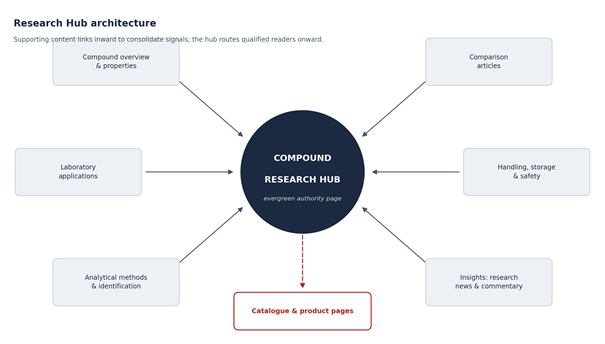
The model is hub and cluster. Rather than a flat sprawl of individually competing pages, each significant compound becomes a comprehensive authority page covering properties, identification, research context, laboratory handling, and analytical considerations, with the site’s COA and testing documentation woven in as primary evidence. Supporting articles cluster around each hub and link inward, consolidating signals instead of splitting them. It is the same topic cluster approach we use in competitive markets elsewhere, applied to a subject where the entities are unusually well defined.
Several things make this the right structure for this specific site rather than a generic best practice.
It matches how the entities are actually organised. Search engines increasingly resolve queries against entities — specific compounds, with specific identifiers and relationships — rather than keyword strings. A compound-centric architecture mirrors the underlying reality of the subject matter, which makes the site legible to systems that work that way.
It resolves cannibalisation structurally. The audit found multiple pages competing for the same query. Consolidating into designated hubs eliminates the internal competition at the architectural level rather than treating each collision individually.
It survives the compliance constraint. Educational research content can remain fully open and indexable in a way that gated commercial pages cannot. It also happens to be the honest form of this supplier’s advantage, which is third-party verification and documentation.
It builds a defensible surface for AI-mediated search. Comprehensive, well-structured, evidently sourced reference pages are the kind of content generative search systems cite, not merely the kind traditional engines rank. Semrush’s AI visibility tracking currently shows the domain with a small number of cited pages and mentions — an early footprint, and one we are treating as a metric to grow deliberately rather than a happy accident.
The existing blog is being restructured in parallel into an Insights section covering industry developments, research methodology, laboratory education, and analytical techniques: timely content that feeds the evergreen hubs rather than competing with them.
The consolidation and migration work
This is the least visible and most dangerous part of the project. Consolidating content means removing and redirecting URLs that currently earn traffic, and done carelessly it destroys the equity the first year of work produced.
The process: every existing article reviewed and scored; overlapping pieces identified and mapped to their destination hub; a complete redirect specification written before anything moves; internal links updated to point at final destinations rather than through redirect chains; and post-migration monitoring in Search Console against pre-migration baselines for each affected URL.
We are deliberately staging this rather than executing it in a single release. A phased migration is slower, and it lets us verify that consolidated hubs hold or improve on their predecessors’ performance before the next batch moves.
Where the domain stands today
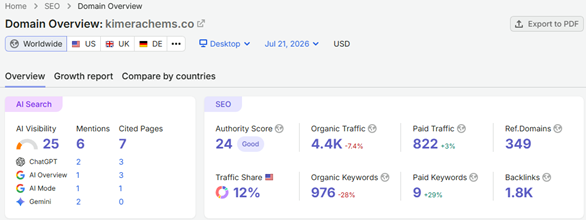
Semrush’s July 2026 domain overview shows an Authority Score of 24, approximately 976 organic keywords, 349 referring domains, and around 1.8K total backlinks, with organic traffic up 74% and organic keyword count up 22% against its comparison period. Semrush figures are estimates and we present them as such — the Search Console data above is the measured record. What the third-party view adds is the shape of the profile: keyword coverage and referring domains growing together, which is the pattern you want, rather than traffic growth resting on a narrow set of terms.
What we would do differently
Establish the field-data baseline earlier. We had thorough lab performance data from day one. Full Chrome UX Report field data across the important page templates would have let us demonstrate real-user improvement, not just Lighthouse improvement, in the first reporting cycle.
Ask the strategic question sooner. The compliance direction and the catalogue gating changed the SEO strategy substantially. Some of the commercial-intent work carried out in months two and three would have been sequenced differently, or scoped smaller, had we understood earlier where the business model was heading. The lesson is not “do less SEO” — it is that an SEO roadmap is only as durable as the commercial roadmap beneath it, and that is a conversation to have at kickoff and revisit every quarter.
Instrument the internal linking from the start. We improved internal linking throughout the engagement, but we did not baseline it in a way that lets us demonstrate the change cleanly. On the hub migration we are tracking it explicitly.
What other businesses can take from this
Diagnose the ceiling before buying more content. Nearly 2,000 URLs sat outside the index. Publishing into that situation adds cost without adding visibility. Find out what is preventing performance before investing in improving it.
Check the mobile column. A site can be genuinely fast on desktop and effectively broken on mobile. Google indexes with a mobile crawler, and it is not unusual for the two profiles to differ this dramatically.
Not every “error” is an error. Index coverage reports are full of exclusions working exactly as intended. The skill is in the triage, not in the total.
Treat toxic-link cleanup as hygiene. It protects a baseline. It rarely produces growth, and anyone selling it as a growth service should be asked to show their measurement.
Metadata is not a small job on a catalogue site. More than 150 pages of deliberate title and description work touches relevance and click-through rate simultaneously, and it ships in weeks.
Architecture beats volume. Kimera Chems’ competitors were not stronger domains. They covered more ground and organised it better. Structure is what turns a content library into topical authority.
The engagement continues
Current priorities are launching the Research Hub architecture, migrating existing content into topical clusters in staged batches, continuing the educational publishing programme, expanding authority through selective editorial link acquisition, and monitoring performance against baseline in Search Console, Google Analytics 4, Ahrefs, and Semrush.
The first three months of this project demonstrated something fairly ordinary: a technically sound site with well-targeted pages outperforms a technically compromised one, and the gains arrive within a quarter when the foundation work is properly sequenced. The current phase is the more ambitious one — turning a product catalogue into a reference resource that researchers use whether or not they are buying that day, and doing it without spending the equity the first phase built.
We will update this case study as the Research Hub phase produces measurable results, including the ones that do not go the way we expect.
Massive Designs is a web design, development, and digital marketing agency based in North Richland Hills, Texas, working with clients across Texas and beyond. You can see more of our client work, read about how we approach search, or talk to us about what a diagnostic pass would surface on your own site.