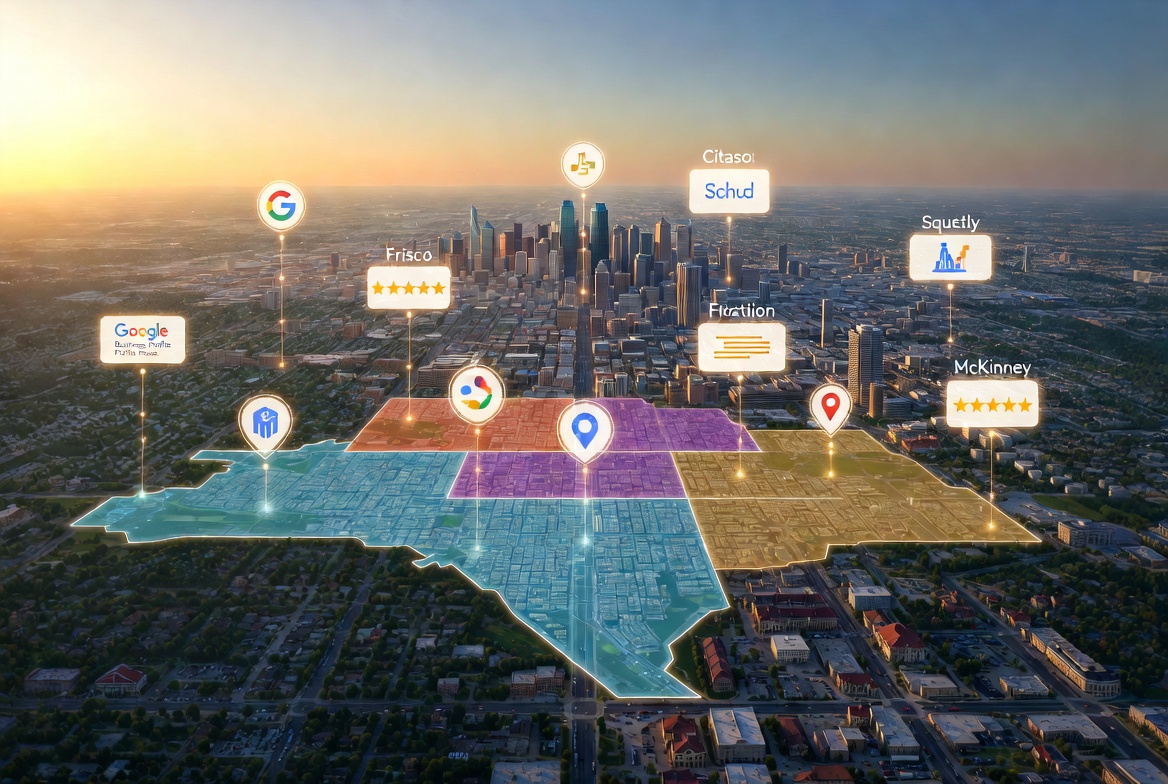
The DFW metroplex spans over 9,000 square miles, crosses four major counties, and contains more than 40 incorporated municipalities. Yet the overwhelming majority of SEO guides targeting this region treat it as a single market, ‘optimize for Dallas-Fort Worth’, as if a plumbing company in Prosper and a law firm in downtown Dallas face identical ranking conditions.
They don’t. Not even close.
Search competition density, buyer demographics, local citation ecosystems, and the industry clusters that dominate each city’s commercial landscape vary so significantly across DFW that a strategy tuned for Frisco can actively underperform in Fort Worth, and vice versa. What follows is a city-by-city breakdown of the ranking factors that actually move the needle in North Texas’s distinct markets — not a generic local SEO checklist, but a geographic framework for understanding why the same tactics produce different results depending on which DFW city you’re targeting.
Why DFW Is Not One SEO Market
The assumption that ‘DFW’ represents a unified search market is reinforced by how digital marketing agencies typically talk about the region: one service area, one strategy, one set of tactics. The problem with that framing becomes obvious when you compare what it takes to rank in, say, McKinney versus Irving.
McKinney is a Collin County city with a distinct historic downtown district, a fast-growing suburban residential base, and a commercial landscape still developing its density. Irving is a Dallas County city with one of the highest concentrations of corporate headquarters in the state, sitting at the intersection of multiple major highways and within proximity bias range of Dallas proper. The buyer profile, competition density, citation ecosystem, and content expectations are completely different, not somewhat different, completely different.
Four structural factors shape why DFW city-level SEO diverges so significantly:
- County citation ecosystems: Dallas County, Tarrant County, Collin County, and Denton County each have their own chamber of commerce directories, business associations, and regional publication networks that carry different geographic authority signals
- Competition density inheritance: Older, more established cities (Dallas, Fort Worth, Garland) have years of accumulated GBP listings, review volume, and citation histories — newer high-growth cities (Frisco, Prosper, Allen) have thinner competitive landscapes but are filling rapidly
- Industry cluster bias: Each city’s dominant commercial sector shapes what categories face the hardest search competition and what buyer intent patterns look like
- Proximity signal mechanics: How close a business sits to Dallas or Fort Worth proper affects how Google calculates geographic relevance for service-area businesses and multi-location queries.
Understanding these regional nuances is essential; for example, we’ve previously analyzed how these factors specifically impact local SEO in Plano compared to its neighboring cities.
DFW City SEO Landscape: At a Glance
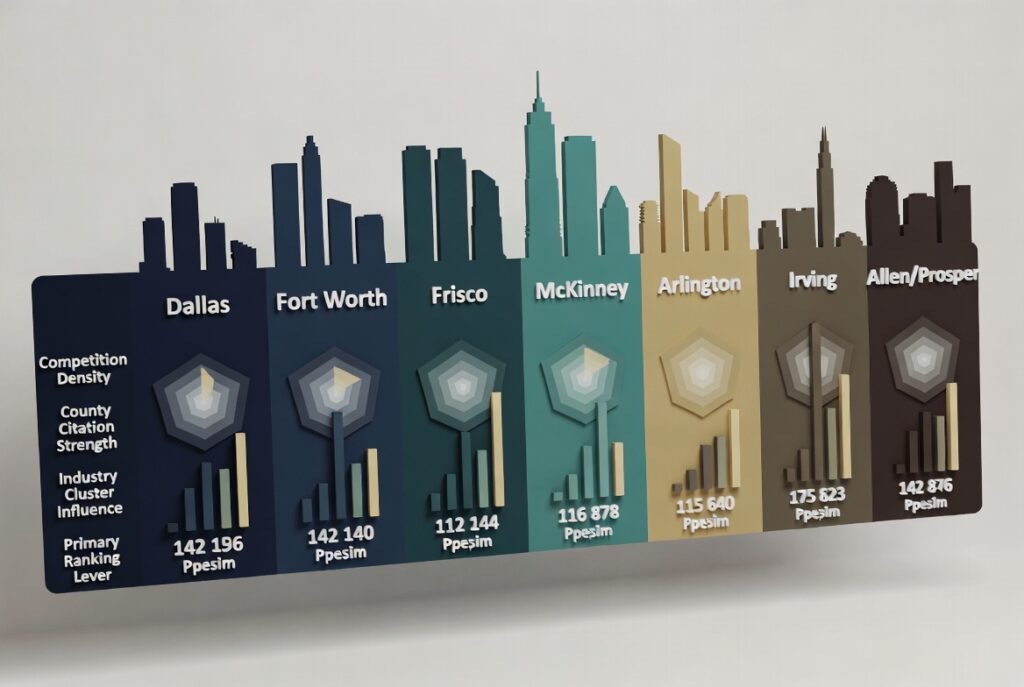
| City | Competition Density | County Citation Ecosystem | Dominant Industry Cluster | Primary Ranking Lever |
| Dallas | Very High | Dallas County | Enterprise B2B, Finance, Healthcare | Neighborhood-level landing pages |
| Fort Worth | High | Tarrant County | Industrial, Logistics, Healthcare | GBP category precision + reviews |
| Frisco | Medium-High | Collin County | Healthcare, Luxury Real Estate, Corp HQ | Content depth + schema markup |
| McKinney | Medium | Collin County | Professional Services, Retail | Hyper-local content + citations |
| Arlington | High | Tarrant County | Entertainment, Healthcare, Retail | Intent-specific landing pages |
| Irving | High | Dallas County | Corporate/Financial, B2B Tech | GBP + proximity targeting to Dallas |
| Richardson | Medium-High | Dallas County | Telecom, Tech, B2B | Content authority + technical SEO |
| Denton | Medium | Denton County | University-adjacent, Arts/Culture | Review velocity + local citations |
| Garland | Medium-Low | Dallas County | Manufacturing, Auto Services | Citation consistency + GBP optimization |
| NRH/Keller/Southlake | Low-Medium | Tarrant County | Family Services, Luxury Retail | Affluent-intent content + reviews |
| Carrollton | Medium | Dallas/Denton County | Food, Professional Services | Local citations + content layering |
| Allen/Prosper | Low-Medium | Collin County | Emerging Retail, Healthcare | Opportunity gap: early mover advantage |
Dallas: Volume, Neighborhoods, and B2B Complexity

Dallas presents the most complex local SEO environment in North Texas. With 1.3 million residents, dozens of distinct commercial neighborhoods, and decades of accumulated GBP competition across virtually every service category, ranking in Dallas requires geographic precision that city-level targeting cannot provide.
The biggest strategic error Dallas businesses make is targeting ‘Dallas, TX’ as a keyword modifier and stopping there. Deep Ellum has a completely different search culture than Uptown. Las Colinas attracts B2B queries with corporate-account intent. Bishop Arts draws neighborhood-specific consumer searches. Highland Park triggers premium-tier service expectations. Each of these micro-markets rewards businesses with dedicated location-specific content built around the neighborhood’s actual commercial character, not cosmetically local pages that simply swap a neighborhood name into a service page template.
For B2B businesses in the Dallas Tech Center or Legacy West corridor, the critical SEO factor is authority depth, not citation breadth. Enterprise buyers in these districts evaluate vendor credibility partially through the quality and depth of online content. A business ranking in these corridors needs to demonstrate subject-matter expertise across multiple content assets, not just a well-optimized homepage.
Primary Dallas Ranking Levers
- Neighborhood-level landing pages with genuine local context, not templated ‘service + neighborhood’ pages
- Dallas Business Journal, Dallas Chamber of Commerce, and North Texas Commission citations for local authority
- Review volume from verifiable Dallas-area customers — Google cross-references proximity between reviewer location and business address
- Technical site performance: Dallas’s mobile-first searcher base has one of the lowest page-abandonment thresholds in Texas
Fort Worth: Distinct Identity, Different Competitive Dynamics
Fort Worth is persistently underestimated in DFW SEO strategy. Businesses that build a Dallas-centric strategy and assume it transfers to Fort Worth discover, usually too late, that Fort Worth has its own distinct commercial identity, and Google recognizes it.
Fort Worth’s economy clusters around industrial and logistics services, healthcare (Texas Health Resources, Cook Children’s), cultural and entertainment venues (the Cultural District, Stockyards, Sundance Square), and a substantial defense and aerospace presence anchored by Lockheed Martin and NAS Fort Worth JRB. Each of these sectors has distinct buyer intent patterns that generic service-category keywords completely miss.
Critically, Fort Worth’s competition density, while high, is lower than Dallas in most service categories. This means that businesses that execute local SEO DFW strategies correctly in Fort Worth often achieve map pack visibility faster than they would attempting comparable tactics in Dallas. The search competition ‘ceiling’ in Fort Worth is lower, and the floor for getting there is achievable without the content volume required in Dallas.
Primary Fort Worth Ranking Levers
- GBP category precision: Fort Worth’s industrial and healthcare clusters reward exact-category matching over broad service descriptions
- Tarrant County-specific citations: Fort Worth Chamber, Tarrant Regional Water District suppliers, Cook Children’s and Texas Health vendor networks
- Review velocity from Tarrant County customers: proximity-matched reviews carry stronger geographic signals in Tarrant County than in the Dallas market
- Local content referencing Fort Worth landmarks and districts — Sundance Square, TCU, the Stockyards, Cultural District — signals genuine local relevance versus SEO-motivated geographic mention
Frisco: Healthcare, Corporate Corridors, and the Content Depth Requirement
Frisco has transformed more rapidly than any other DFW city over the past decade. The arrival of Toyota North America’s US headquarters, several major healthcare systems, and a high concentration of technology companies has created a commercial search landscape with sophisticated buyers and rising content expectations.
The distinguishing feature of Frisco’s local SEO environment is the content depth requirement. Frisco buyers, particularly in healthcare, professional services, and corporate-adjacent B2B categories, conduct more research before contacting a vendor than buyers in most other DFW cities. Pages that present information at the surface level lose to pages that answer the full set of questions a Frisco-area buyer asks before making a decision.
The opportunity gap in Frisco is significant for businesses willing to invest in content infrastructure. Despite rapid commercial growth, many Frisco businesses are relatively young and lack the citation history and review volume that older Dallas and Fort Worth competitors have accumulated over years. A business entering Frisco’s search landscape today with strong content, complete schema markup, and an active review acquisition process can achieve visibility faster than the same strategy would produce in a more saturated market.
Primary Frisco Ranking Levers
- Schema markup implementation: LocalBusiness, MedicalBusiness, and Service schema are underused in Frisco — closing that gap is a relatively low-effort ranking advantage
- Collin County citations: Frisco Chamber of Commerce, Collin County business directory, and healthcare-specific Collin County platforms
- Content that answers Frisco-buyer research questions thoroughly — longer, more detailed service pages outperform short pages significantly in this market
- GBP attribute completeness: Frisco’s healthcare buyers specifically look for appointment availability, insurance acceptance, and service-specific attributes before clicking through
McKinney: History, Growth, and Neighborhood-Level Search Behavior
McKinney occupies an unusual position in North Texas SEO: it combines an established historic downtown with rapid new residential and commercial development expanding outward in multiple directions. These two environments have genuinely different search cultures.
The historic square and downtown district drive tourism and experience-oriented searches, attracting intent signals that favor locally-rooted, character-driven content. The newer development corridors toward Highway 380 and into Allen attract residential service searches with suburban intent patterns. Businesses serving both need two distinct content strategies, one grounded in McKinney’s community identity, one targeting the practical service needs of a growing suburban base.
McKinney’s overall competition density sits at the mid-level: lower than Frisco or Irving, but rising as development continues. The businesses that locked in strong GBP positioning and citation coverage in McKinney two or three years ago hold visible advantages today. New entrants face a steeper climb than they would have in 2022 but still encounter less resistance than they would in Dallas.
Primary McKinney Ranking Levers
- Content rooted in McKinney’s community identity — historic district, local events, community anchors — builds trust signals that outlast generic service content
- McKinney Chamber of Commerce citation and local business association membership carry meaningful local authority in Collin County
- Review acquisition tied to specific McKinney neighborhoods: reviews mentioning ‘near downtown McKinney’ or specific corridor names signal geographic precision
Arlington: Entertainment Corridors and Dual Intent Markets
Arlington presents a genuinely bifurcated local SEO challenge. The entertainment corridor around Globe Life Field, AT&T Stadium, and the Esports Stadium drives high-volume, event-driven search traffic that is fundamentally different from the residential service searches that dominate most of Arlington’s broader commercial landscape.
Businesses in the entertainment corridor compete for intent signals that are tied to events — pre-game restaurant searches, parking and transportation queries, sports-adjacent hospitality — which require a different content and GBP strategy than businesses targeting Arlington’s general residential population.
Away from the entertainment corridor, Arlington functions more like a traditional Tarrant County suburban market. The residential base generates consistent service-category search demand across healthcare, home services, automotive, and professional services. Competition density in most non-entertainment categories is manageable, and the Tarrant County citation ecosystem applies with similar weight as in Fort Worth.
Richardson: The Telecom Corridor and B2B Technical Audiences
Richardson’s identity as a technology hub, anchored by the historic Telecom Corridor along US-75, shapes its local SEO environment in ways that don’t apply to other DFW cities. B2B technology companies and professional services businesses in Richardson face a uniquely sophisticated buyer audience that evaluates content authority before engaging with a vendor.
Technical accuracy in content matters in Richardson. A B2B technology buyer searching in this market reads service pages critically and notices shallow content immediately. The advantage for businesses that invest in genuinely authoritative, technically precise content in Richardson is that most competitors don’t, they use the same generic service descriptions that work for less demanding audiences.
On the technical SEO side, Richardson rewards Core Web Vitals investment. The technology-heavy user base accesses content from high-performance devices with low tolerance for subpar mobile experiences.
Denton: University Influence and the Review Velocity Advantage
Denton’s character as a university city, home to both the University of North Texas and Texas Woman’s University, creates a local search environment with younger-skewing demographics, higher mobile search rates, and a stronger emphasis on social proof signals than most DFW markets.
Review velocity matters more in Denton than competition density data alone would suggest. A newer business with consistent, recent reviews often outranks established competitors in Denton’s map pack because the demographic mix here weights recency signals heavily. A review strategy that produces a steady stream of current reviews, rather than a large historical volume, performs better in this market.
Denton’s arts and culture sector generates search categories that are essentially uncontested compared to DFW norms. Local music, art, and experience-adjacent businesses face thin GBP competition and can achieve top-three map pack visibility with relatively modest optimization investment.
Allen and Prosper: The Early-Mover Opportunity Window
Allen and Prosper represent the most significant current opportunity in North Texas local SEO, not because they are easy markets, but because they are filling faster than businesses are optimizing for them.

Both cities are Collin County municipalities experiencing rapid commercial growth alongside large residential expansion. The critical dynamic: search demand is rising sharply as new residents arrive and seek local service providers, but the pool of GBP listings, citation coverage, and local content depth has not yet caught up to demand.
A business that establishes strong GBP optimization, consistent Collin County citations, and a content foundation in Allen or Prosper today will hold advantages over later entrants that are genuinely difficult to displace. Search ranking in these markets rewards first-mover investment in a way that saturated markets like Dallas and Irving simply don’t.
North Richland Hills, Keller, and Southlake: Affluent Tarrant County Submarkets
These adjacent Tarrant County cities share an important characteristic: they serve some of the highest-income residential demographics in North Texas. Southlake in particular attracts a buyer profile that responds to premium-tier positioning, values brand signals, and performs detailed research before engaging a service provider.
In these markets, review quality matters as much as review volume. A handful of detailed, specific reviews from verified Southlake or Keller customers carries more weight than a large volume of generic five-star reviews. Content that speaks to the specific priorities of affluent families, premium materials, experienced professionals, and responsive communication performs markedly better than generic service content.
For businesses in professional services, luxury home services, and specialized healthcare, these submarkets offer a distinct advantage: competition density is low enough that basic execution of local SEO fundamentals can achieve map pack visibility, but the buyer quality when that visibility converts is significantly higher than most DFW markets.
The County Citation Dimension: The Step Most DFW Businesses Skip
Across every North Texas city, one of the most consistently underused ranking levers is county-specific citation building. Most businesses prioritize national directories, Yelp, Yellow Pages, Angi, HomeAdvisor, and treat local citation building as a lower priority.
The problem with that approach is geographic signal quality. National directories tell Google that your business exists. County-specific citations tell Google where your business specifically operates within a competitive regional market.
In practice, this means:
- Dallas County businesses should appear in the Dallas Regional Chamber, Dallas Business Journal business directory, and North Texas Commission member listings
- Tarrant County businesses should target Fort Worth Chamber, Tarrant County Business Connection, and industry-specific Tarrant County platforms
- Collin County businesses should prioritize Frisco Chamber, McKinney Chamber, Allen/Prosper business associations, and Collin County regional directories
- Denton County businesses should cover the Denton Chamber of Commerce, DCTA business resources, and university-adjacent business listings
The less saturated these local directories are with direct competitors, the more differentiation each citation produces. In Allen and Prosper especially, Collin County-specific citations face so little competition that a single accurate listing can function as a primary local authority signal.
Applying This Framework: Starting from Where You Are
The city-by-city framework above is not designed to be executed all at once. The practical starting point is always the same: understand your competitive position within your specific city before applying tactics borrowed from a different market.
Three diagnostic questions clarify where to start:
- What does your current GBP listing say about your geographic service area — and does it match the city-specific expectations described above?
- Which county citation ecosystem applies to your location, and how complete is your presence in that ecosystem’s highest-authority directories?
- Does your existing content reflect the specific buyer intent patterns of your city, or does it target a generic ‘DFW business owner’ that does not accurately describe your actual customer?
SEO in North Texas rewards specificity at every level. The businesses that rank consistently across DFW cities are those that treat each city as the distinct market it actually is, not as a uniform region where one strategy applies everywhere from Denton to Mansfield.
Massive Designs provides SEO services for businesses across North Texas, with particular experience in the DFW metroplex’s multi-city competitive landscape. If you’re unsure how your current strategy maps to the specific ranking conditions of your city, a site and GBP audit will show you exactly where you stand.