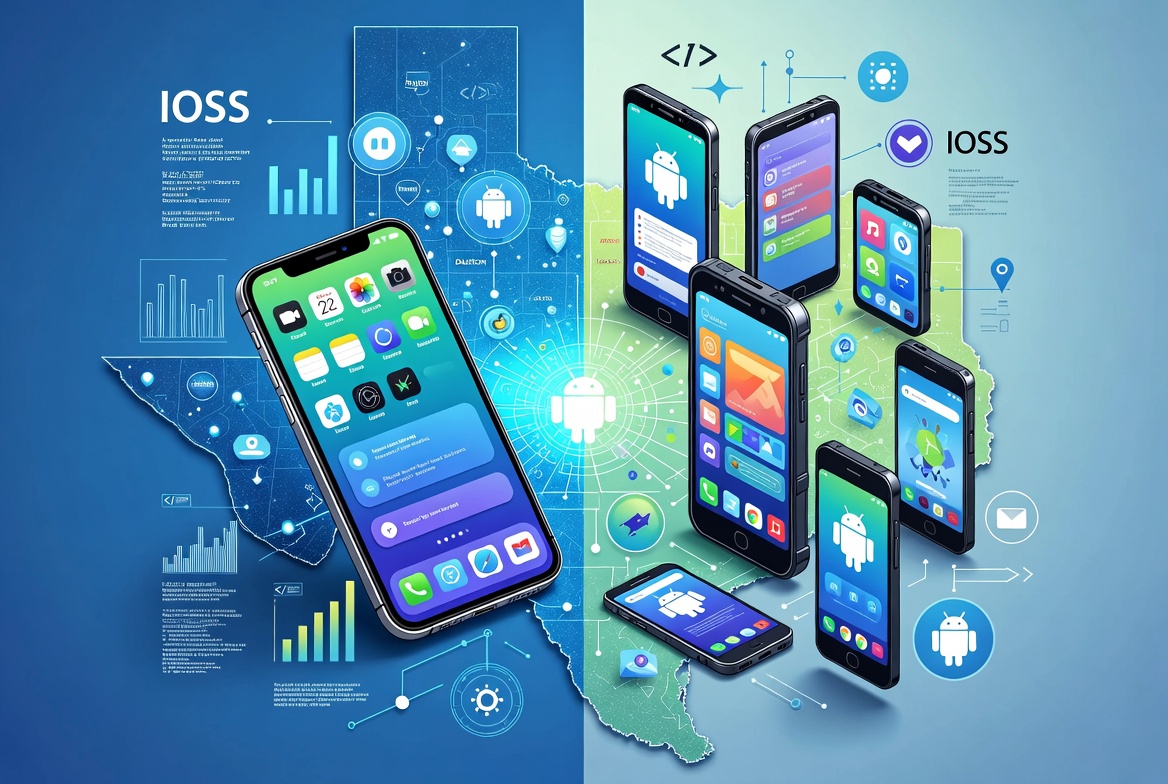
Most Texas startup founders default to iOS without examining the assumption. It feels like the ‘right’ answer, Apple users are engaged, App Store revenue is strong, and the product looks premium on a retina display. But that reasoning, taken alone, is incomplete. The right platform decision depends on three things that have nothing to do with which phone you personally prefer: who your users are, how they will pay, and where your business is most likely to generate its first real revenue.
Texas makes this decision more nuanced than most markets. The demographics across Austin, Houston, DFW, and San Antonio pull in different directions. A consumer-facing app for Austin tech professionals and a field-operations tool for Houston energy workers exist in different smartphone ecosystems and building for the wrong one delays product-market fit and burns budget.
This guide doesn’t tell you that iOS is always right or that Android is the safe default. It gives you the data and the frameworks to make the call correctly for your specific business.
Texas Market Data: Who Is Actually Holding What Phone

Nationally, iOS holds approximately 57% of US smartphone market share heading into 2026, a proportion that has been relatively stable for three years. But market share averages obscure the geographic and demographic variation that matters for Texas founders.
Austin’s technology and startup community skews strongly toward iOS, in a pattern that mirrors San Francisco and New York more than it mirrors the broader state. The professional services, fintech, and B2B SaaS founders building products for Austin’s tech-adjacent consumer base are operating in an effectively iOS-dominant market.
Houston presents a different picture. The energy sector’s field workforce, engineers, technicians, and operators working in the Permian Basin and along the Gulf Coast, tends toward Android, particularly for ruggedised and mid-range devices that survive industrial environments. A mobile app development texas project targeting Houston field workers is talking to a very different device ecosystem than one targeting Austin’s healthcare tech users.
DFW sits closer to the national split, with consumer-facing apps seeing mixed usage and enterprise / B2B tools skewing toward iOS where the professional user base resembles larger corporate environments.
| Practical Implication: Before committing to a platform, survey 20–30 of your target users about their primary device. This 30-minute exercise outperforms any market share statistic for informing a launch platform decision. |
The Revenue Reality: Where the Money Is in 2026
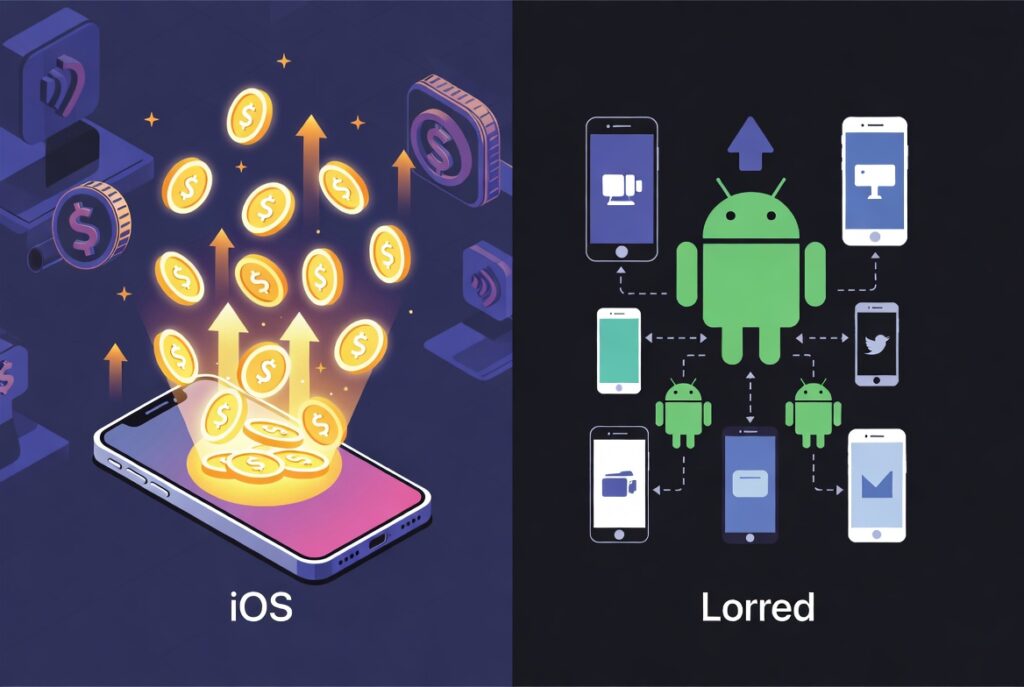
Revenue data consistently favours iOS for consumer-facing subscription apps. iOS users spend approximately 2–2.5× more on in-app purchases than Android users on a per-user basis, a ratio that has held steady across 2024 and 2025 data. The App Store’s friction-low payment experience and the higher average income of iPhone owners both contribute to this.
For subscription-first Texas startups, SaaS tools, premium consumer apps, and professional platforms, this revenue differential is a compelling argument for iOS as the first-launch platform. The validation data comes faster, and the early revenue per user is stronger.
The equation flips in specific scenarios. Ad-supported models benefit from Android’s larger addressable volume. B2B internal tools where the company pays per seat rather than individual users often find Android’s enterprise device management flexibility more practical. Volume-driven models, high-frequency, low-cost transactions at scale — frequently find Android’s reach more relevant than iOS’s revenue-per-user premium.
| Business Model | Favours iOS? | Reason |
| Subscription / SaaS | Yes — strongly | 2–2.5× revenue per user, lower churn on subscription |
| Ad-supported / freemium | Depends — often Android | Volume matters more than per-user spend |
| B2B internal tool | Depends on device fleet | Enterprise Android MDM sometimes more practical |
| E-commerce (consumer) | Yes — for checkout conversion | Apple Pay reduces friction significantly |
| Field-service / operations | Often Android | Rugged device availability, wider price range |
Development Cost and Timeline: Texas Market Rates by Platform
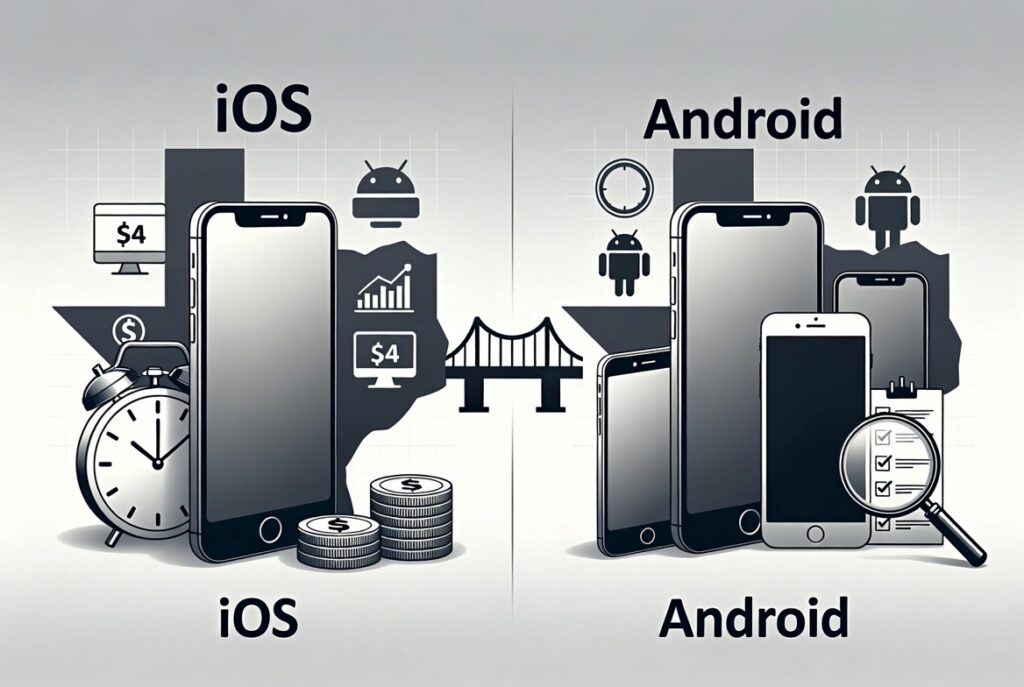
A common misconception is that Android development is meaningfully cheaper than iOS. At Texas developer rates, the upfront labour cost difference is minor. The real difference is where the time, and therefore the budget, gets spent.
iOS development benefits from a smaller device testing matrix. Apple’s controlled hardware lineup means your QA engineer is testing against a manageable set of screen sizes and OS versions. Android’s fragmentation across thousands of device configurations adds 15–25% to testing cycles, which accumulates into meaningful cost on larger projects.
Austin carries a 10–15% developer rate premium over DFW and Houston due to density of tech talent and competition for senior engineers. A senior mobile developer in Austin typically bills at $120–$175 per hour; equivalent talent in Dallas or Houston runs $105–$155.
Cross-platform frameworks, Flutter and React Native, offer a third path that deserves serious consideration for mobile app development texas projects on constrained budgets. A single codebase that deploys to both platforms reduces initial build cost by 30–50% compared to two separate native builds. The trade-offs are real: native-only features require platform-specific code, performance ceilings exist for animation-heavy experiences, and UI fidelity to platform conventions requires extra care. For most startup MVPs, however, these trade-offs are acceptable and a cross-platform MVP that validates product-market fit on both platforms simultaneously is often the best allocation of early capital.
Our team’s overview of mobile app development modern realities & expectations, covers the scoping and build process in detail, including how cross-platform decisions affect long-term maintenance costs.
Texas Industry Verticals: The Platform Decision by Sector
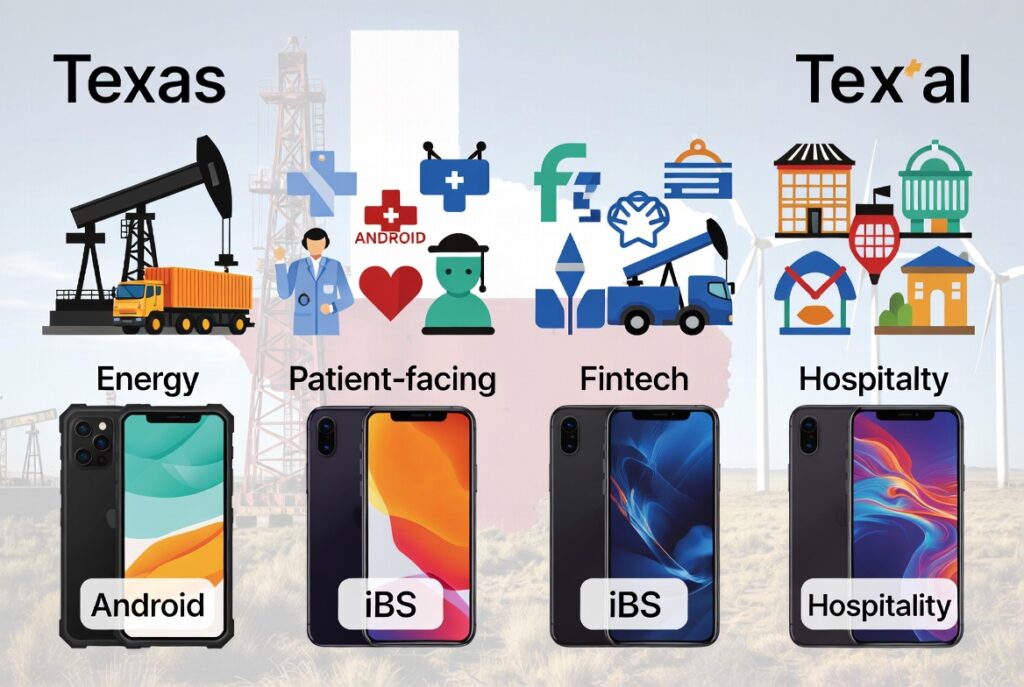
The most reliable way to make this decision is to start with your industry vertical and work backwards to the platform. Texas’s economic landscape creates clear patterns.
| Texas Industry | Primary Market | Platform Recommendation | Primary Driver |
| Energy / logistics / construction | Houston, Midland, DFW field ops | Android-first | Rugged device availability, MDM in field environments |
| Healthcare / medspa / dental | Austin, Dallas, Houston | iOS-first | Patient demographic skews iPhone, HIPAA MDM mature on iOS |
| Fintech / legaltech / professional services | DFW, Austin | iOS-first | High-income professional user base, subscription model fit |
| Retail / hospitality (customer-facing) | Statewide | iOS-first | Texas consumer iOS majority, Apple Pay conversion |
| Retail / hospitality (staff-facing) | Statewide | Android-first | Rugged POS-adjacent devices, cost per device at scale |
| Construction project management | DFW, Houston, San Antonio | Both (cross-platform) | Mixed office/field user base requires both ecosystems |
What Texas Investors Expect to See
Texas’s venture and angel capital ecosystem, concentrated in Austin’s Capital Factory, DFW’s Perot Jain network, and Houston’s energy-adjacent tech investors, does have platform preferences that are worth accounting for in your launch strategy.
An iOS MVP reads as a validation signal to most early-stage Texas investors. The reasoning is partly practical (iOS users being more willing to pay validates the monetisation thesis) and partly aesthetic (iOS apps typically look more polished in a demo environment). Neither reason is technically rigorous, but investor optics are a real factor in fundraising readiness.
Android-first is not a disqualifier if the rationale is defensible. A field-operations tool for Houston energy companies built on Android has a strong strategic story and any investor who understands that market will see it clearly. The key is articulating the platform decision as evidence of market understanding, not as a default choice.
The Phased Launch Strategy: What Most Posts Get Wrong
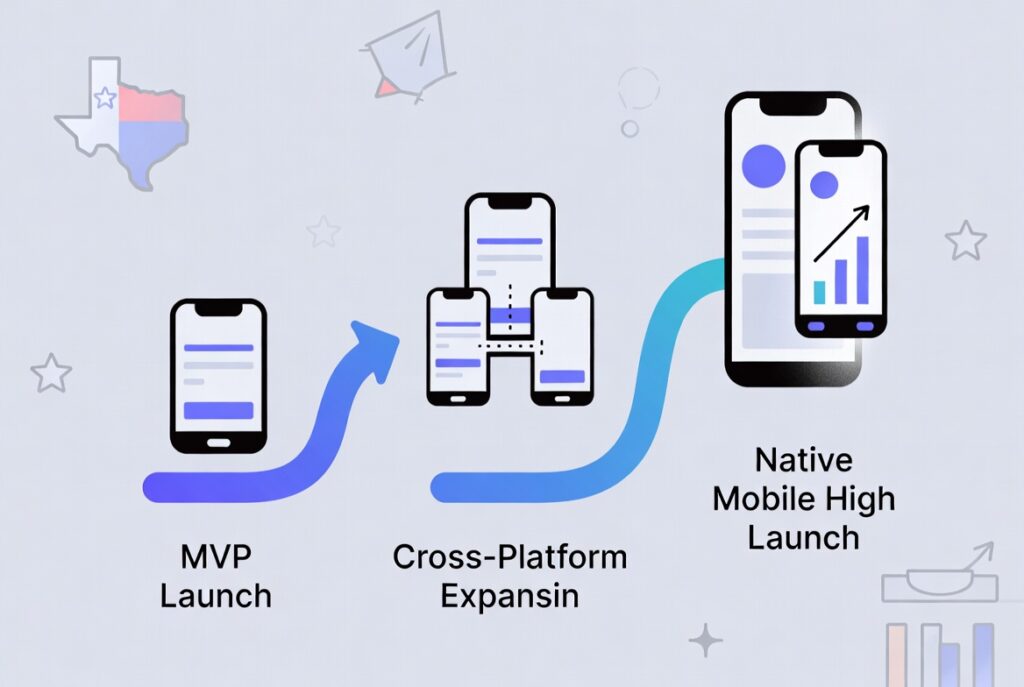
The most common and expensive mistake in mobile app development in Texas is trying to launch on both platforms simultaneously before the product is validated. Dual-platform Day 1 development doubles the engineering cost, fragments QA attention, and delays launch by weeks to months. None of which is justified before you have product-market fit.
The phased approach that consistently produces better outcomes for Texas startups:
- Phase 1 — Single platform MVP: pick based on user demographics and revenue model. Launch, acquire early users, and validate the core use case. This phase typically runs 3–6 months.
- Phase 2 — Cross-platform expansion: once you have validated the product, a cross-platform version or a native port expands your addressable user base without rebuilding from scratch. Many Texas startups add their second platform here using a shared component strategy.
- Phase 3 — Native dual-platform builds: at significant user volume — typically 50,000+ monthly active users or Series A funding — separate native iOS and Android engineering teams become justifiable. Before that threshold, the dual-native approach is usually premature optimisation.
The scoping decisions that determine which phase makes sense for your business and how to avoid overspending before you have market validation are covered in depth in The Texas Founder’s Playbook for Custom App Development.
The 4-Question Decisiozn Framework
Use this diagnostic to reach a platform decision in under ten minutes:
- Question 1 — Who are my first 1,000 users, and what phone are they likely carrying? (Survey before assuming.)
- Question 2 — How will users pay? Subscription or in-app purchase → iOS. Volume/ads/enterprise seat → evaluate Android or cross-platform.
- Question 3 — Does my industry vertical have a dominant platform? (Energy, construction, field service → likely Android. Healthcare, fintech, consumer SaaS → likely iOS.)
- Question 4 — Am I raising capital in the next 12 months? If yes, an iOS MVP will be easier to demo and validate your monetisation thesis in front of most Texas investors.
Most Texas startups that work through these four questions land on iOS-first with a clear plan to expand. Some, particularly those in field service, logistics, or B2B enterprise with defined Android device fleets- land on Android-first or cross-platform from day one. The right platform is the one your framework produces, not the one that feels safest by default.
If you are ready to move from decision to build, our mobile app development team in Texas works with founders at every stage from platform selection through to launch and post-launch optimisation.