Texas leads the United States in construction spending. According to current industry data, the state projects more than $50 billion in construction investment for 2025, driven by sustained population growth, ongoing infrastructure funding, corporate relocations, and a data center expansion boom centered in the Dallas metro. The construction industry contributes roughly $142.4 billion to Texas’s GDP. The work is there. In most market conditions, it is abundant.
So why do so many Texas construction companies still operate on unpredictable revenue? The pipeline problem in construction is rarely a market problem. It is a sourcing problem. Companies that rely on relationship networks, referral chains, and reputation alone have a pipeline that functions well when things are going well and becomes fragile the moment a key relationship goes quiet, a general contractor shifts direction, or a dominant referral source dries up.
Digital marketing does not replace those relationship networks. For construction companies, referrals will always carry weight. What digital marketing does is systematically expand the base of organizations that know you exist and can evaluate your qualifications before they have ever met you, so that when a project surfaces, you are already a known quantity worth inviting to bid.
That is the strategic case for digital marketing in construction. The channel question is more specific: which tools actually produce bid opportunities, and which produce traffic that does not convert to revenue?
The Buyer Journey That Construction Marketing Must Serve
Before discussing channels, the buyer journey in construction deserves a clear-eyed analysis, because it is fundamentally different from most service industries.
A commercial property developer in Houston evaluating general contractors for a $4 million warehouse project does not call the first contractor they find on Google. They compile a shortlist. They check project portfolios. And they verify licensing, bonding, and look at the project history and geography of relevant completed work. Also, they may check LinkedIn presence for leadership credibility. They assess safety records. They read testimonials or ask for references. Only then, after significant research across multiple touchpoints, does a formal bid request go out.
A residential homeowner in Frisco looking for a remodeler moves faster, but still invests time in Google reviews, portfolio photos, and website credibility before making contact.
Both buyer journeys have something in common: they involve extensive digital evaluation before a human conversation begins. Digital marketing does not shortcut that process. It ensures your company is present and credible at every stage of it.
Your Website Is Not Optional — It Is the Foundation Everything Else Builds On

Before any channel discussion is useful, the website question needs to be resolved. In the Texas construction market, a company’s website is the primary credibility artifact that buyers consult during shortlist evaluation. A marketing budget spent on any other channel before the website is in strong condition is a budget that is generating traffic to a destination that cannot convert it.
What a construction company website needs to do is specific. It needs to immediately communicate the type of work you do and the markets you serve, commercial or residential, which verticals, and which geographic range. It needs to make the project portfolio work visually prominent and impressive. Plus, it needs to surface licensing, bonding, and insurance in a place where buyers can find it without searching. And it needs to make contacting the company for a project conversation as easy as possible.
The patterns that cause construction websites to underperform in Dallas and Fort Worth are documented and consistent: project portfolio photographs that are low-resolution or absent entirely, no clear statement of service area or project scale, contact forms that ask for ten fields when three would do, and mobile experiences that break on phones despite the fact that most initial Google searches now happen on mobile devices.
Fixing those issues before running any paid campaigns or investing in SEO is not a sequencing preference. It is the condition that determines whether the rest of the marketing budget produces results or produces traffic that bounces. A resource worth reviewing on this point is the analysis of web design elements that convert visitors to project inquiries for contractors specifically in the Dallas market.
Organic Search: The Channel That Generates Bids at the Lowest Long-Term Cost

Local SEO and organic search are the most underutilized and highest-returning digital marketing channels available to Texas construction companies. The reason is a mismatch between the timeline and expectation. Organic search takes 3 to 9 months to show meaningful movement in competitive markets. Companies that need bids next quarter tend to skip the bid process. Companies that invest in it consistently become the firms that other contractors cannot unseat.
The search behavior of construction buyers has specific characteristics that make organic visibility extremely valuable. Commercial clients searching for general contractors, subcontractors, or specialty trades in specific Texas metros are using high-specificity queries: ‘commercial concrete contractor dallas,’ ’tilt-wall construction company houston,’ ‘metal building contractor fort worth,’ ‘commercial roofing company plano.’ These queries have low traffic volume nationally but extremely high purchase intent locally. A company that ranks consistently for its category and service area in DFW or Houston is being found by buyers actively looking for exactly what they do.
The SEO investment required to achieve this is not trivial. It involves technical website optimization, Google Business Profile management with consistent review velocity, local citation accuracy across directories, and content production built around the specific search queries buyers use. The SEO services for Texas businesses that produce these results treat the website, the Google Business Profile, and the content as a unified system rather than separate initiatives.
One channel note specific to construction: Google Business Profile optimization carries outsized importance for trade companies and regional contractors. When a developer or project manager searches for a specialty contractor in a Texas city, the Google Maps local pack appears prominently in results. Firms with strong profiles, meaning complete information, strong review volume, and regular photo updates of completed projects, appear in those results. Firms without maintained profiles do not. The investment required to maintain a strong profile is modest relative to the bid value of a single commercial project.
Google Ads and PPC: Fastest to Market, Highest Ongoing Cost
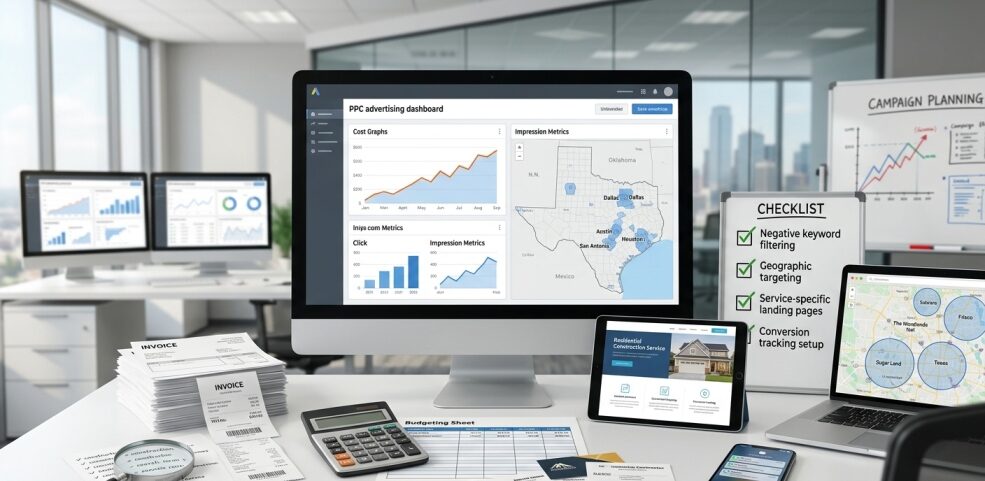
For construction companies that need bid inquiries now rather than in six months, paid search through Google Ads fills the gap. It is the most immediate digital marketing channel available, and in Texas markets with high construction activity like Houston, Dallas, San Antonio, and Austin, it can generate qualified project inquiries within days of a well-structured campaign going live.
The cost per click in construction-related searches in Texas is not trivial. Commercial construction, roofing, concrete, and home renovation categories are competitive search environments. Click costs vary by category and market, but construction-related searches in DFW frequently run from $8 to $25 per click depending on the specificity of the service and the level of competition.
Managing that cost requires discipline in campaign structure. Broad match keywords in a construction category will accumulate clicks from searchers who have no project intent. Negative keyword management, geographic radius settings calibrated to the actual service area, and landing pages built for specific services rather than pointing all traffic to a homepage are the technical differences between a Google Ads campaign that generates project inquiries and one that generates clicks that do not convert.
For residential construction and remodeling companies targeting homeowners in suburban Texas growth markets like Frisco, Lewisville, Sugar Land, and The Woodlands, Google Ads with geographic targeting can be particularly efficient. Homeowners in these markets search with purchase intent and move relatively quickly from initial search to contact. For commercial contractors, paid search works better as a supporting channel than a primary one, since commercial buyers rarely call the first paid result they see.
LinkedIn: The Overlooked Channel for Commercial Construction Leads

Most digital marketing conversations about construction focus on Google. LinkedIn rarely comes up. For commercial construction companies, this is a missed opportunity.
Commercial project decisions in Texas are made by a defined professional audience: commercial real estate developers, property managers, corporate facilities directors, municipal procurement officers, and general contractors managing subcontractor relationships. That audience is on LinkedIn in identifiable roles with identifiable companies. LinkedIn advertising allows precise targeting by job title, industry, and company size in specific geographic markets.
For a commercial general contractor or specialty subcontractor in Dallas, Houston, or San Antonio, a LinkedIn campaign targeting commercial real estate developers, facility management directors, and construction project managers in those markets puts the company’s name, project portfolio, and capabilities in front of the exact decision-makers who issue RFPs. The cost per click is higher than Google, but the quality of a commercial lead acquired this way, meaning a director-level contact at a real company with a real project need, is substantially higher than a residential inquiry from a general search.
Organic LinkedIn presence, meaning leadership posting about completed projects, sharing project milestones, and engaging with industry conversations, supports the paid strategy by building the credibility that converts a LinkedIn ad click into an actual conversation. A commercial buyer who clicks an ad and then looks up the company on LinkedIn wants to see an active, credible presence, not an empty profile last updated in 2021.
Project Portfolio: The Conversion Engine That Most Construction Websites Underuse
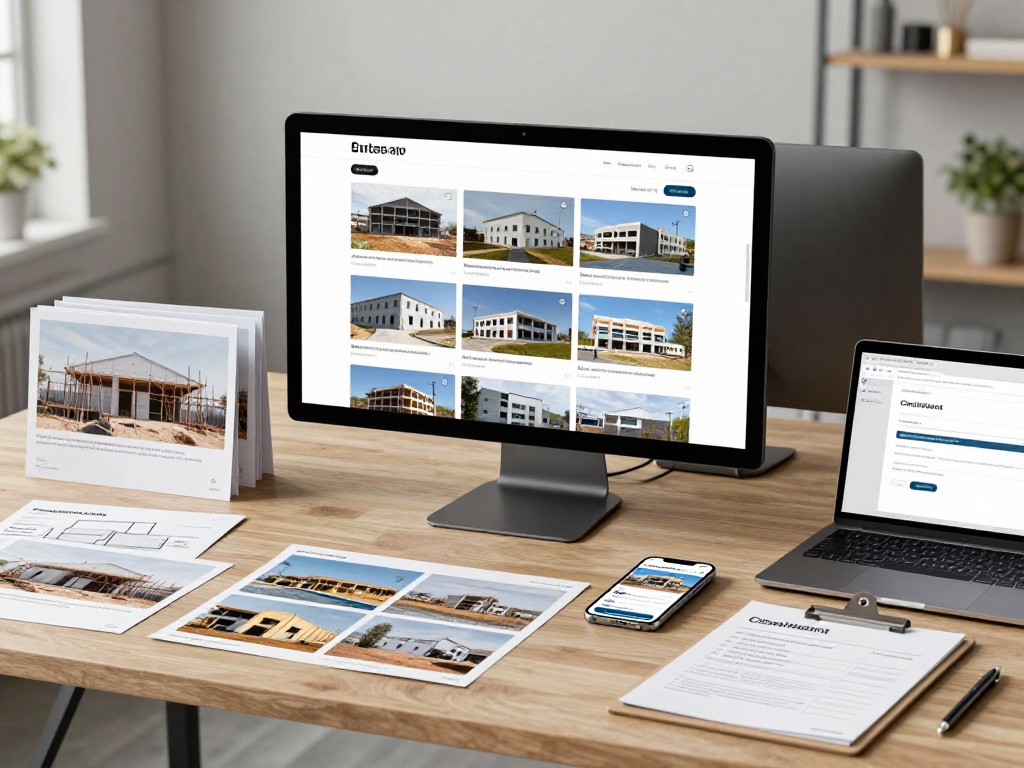
In construction marketing, portfolio work is not a gallery. It is the primary sales document. Before a commercial client invites a contractor to bid, before a homeowner calls for a renovation estimate, they want to see evidence of work at the quality and scale they are considering.
The construction companies that generate the most bid inquiries through digital channels consistently share one characteristic: their portfolio is deep, well-photographed, and filterable by project type. A residential remodeler in Plano with thirty high-quality before-and-after project galleries on their website will convert search traffic at a higher rate than a competitor with one page of stock photos and a vague service description.
For commercial contractors, this means featuring completed projects with specificity: the project type, the square footage or contract value where appropriate, the delivery timeline, and the city or market. A data center project completed in Allen, a tilt-wall warehouse in Grand Prairie, and a school renovation in Denton; each of these examples tells a prospective client in DFW that you have worked in their market at a relevant scale. That specificity reduces perceived risk and increases the probability of a bid invitation.
Digital marketing channels drive traffic. Portfolio quality determines what happens when that traffic arrives. Treating these as separate concerns rather than as a unified conversion system is where most construction marketing budgets leak value.
Content Marketing: Building Authority in Specific Verticals
Content marketing in construction is not about driving high traffic volume. It is about being found by buyers researching specific topics related to projects they are actively planning.
A commercial roofing contractor in the Houston market who publishes detailed, accurate content about hail damage assessment and insurance claim navigation for commercial properties is not writing for search volume. They are writing for the facility manager in Pearland or Katy who just had hail come through, is evaluating their options, and is researching what they need to know before calling anyone. That buyer arrives informed, has already identified the company as knowledgeable, and is predisposed to trust the firm before any sales conversation begins.
Content topics with proven relevance for Texas construction companies include project budgeting guides for specific building types, permitting process explanations for Texas cities and counties, comparisons of construction methods relevant to local climate and geology, and case studies on completed projects that demonstrate problem-solving on complex builds.
This type of content supports organic search rankings, builds topical authority in specific construction verticals, and creates material that business development teams can use in follow-up communications with prospects. A realistic channel-by-channel assessment of what content marketing returns for Texas businesses, including construction companies, is available in the digital marketing ROI benchmarks analysis published by Massive Designs.
What a Construction Company’s Digital Marketing Mix Should Look Like
No construction company should invest equally across every channel simultaneously. The effective approach is to sequence investment based on the company’s current stage, revenue composition, and growth target.
For a construction company building its digital presence from scratch in a Texas market, the correct sequence is: website foundation first, then Google Business Profile optimization, then organic SEO, then paid search to accelerate inquiries while organic rankings build. LinkedIn is worth adding when the commercial client base becomes a priority. Content marketing compounds the organic strategy over time.
Companies already generating steady residential work from referrals and looking to break into commercial projects need a different configuration: professional website with commercial project portfolio featured prominently, LinkedIn presence and targeted advertising to commercial decision-makers in the target metro, and SEO built around commercial-specific query terms rather than residential ones.
The common failure mode in construction marketing is running paid campaigns to an under-developed website, or investing in content without first ensuring the technical SEO foundation that allows that content to rank. Sequencing matters as much as channel selection.
Working With a Digital Marketing Agency That Understands Construction
The Texas construction market is operationally specific in ways that generalist marketing agencies frequently get wrong. Long sales cycles, competitive bid environments, the distinction between residential and commercial buyer journeys, project portfolio presentation, and the geographic specificity of Texas markets all require industry awareness that general digital marketing knowledge does not automatically provide.
What to evaluate when considering a digital marketing agency for a Texas construction company: whether the agency has produced demonstrable results for construction or trade companies specifically, not just for ‘home services’ broadly; whether they understand how to present project portfolio work in a way that converts commercial buyers; whether their SEO strategy accounts for the specific query patterns construction buyers use in Texas markets; and whether they can connect marketing activities to bid outcomes rather than just to traffic and impressions.
The digital marketing services available for Texas businesses through Massive Designs are structured around measurable outcomes for specific industries rather than generic campaign management. For construction companies looking to expand their bid pipeline through search, content, and paid channels, outcome orientation is the relevant standard.