There is a version of this decision that wastes money. It looks like this: a Pearland-based HVAC company spends $1,500 per month on Google Ads because they need leads right now. They get some. Then the budget runs out, or the campaign is mismanaged, and the leads stop. Meanwhile, the competitor down the road who invested in local SEO eighteen months ago ranks first organically for every relevant search term, gets consistent inbound calls, and pays nothing per click.
There is another version of this mistake. A Sugar Land law firm decides to skip paid search entirely, invest only in SEO, and waits nine months for rankings that never fully materialized because their website had technical issues their SEO vendor kept deprioritizing. They had no short-term lead source while they waited.
Both scenarios are expensive. Both are avoidable. What they share is a false premise: that this is a binary choice.
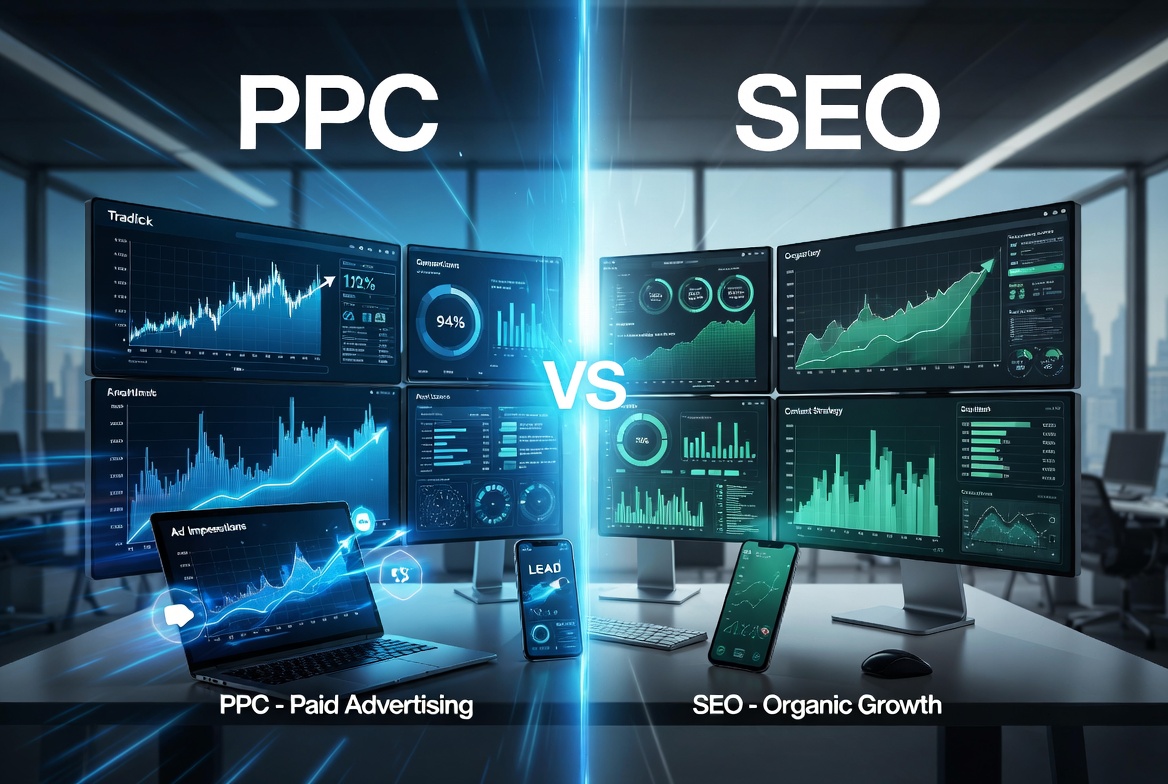
For Texas local businesses in 2026, the PPC vs SEO question is less about which channel is better in theory and more about which channel fits your current reality and how to sequence them intelligently as your business grows.
What PPC Actually Does (And What It Can’t)
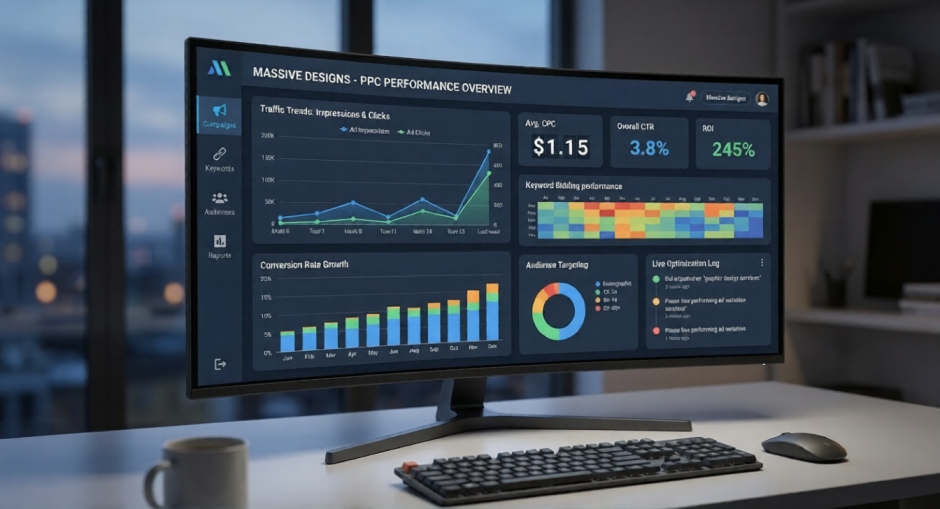
Pay-per-click advertising — primarily through Google Ads — gives your business immediate placement at the top of search results for the keywords you are willing to pay for. The moment your campaign is live, you are visible. For a new business with no organic presence, or an existing business entering a new service area, that speed matters.
PPC also gives you precise control. You can target specific zip codes in Pearland or Sugar Land. You can set your ads to show only during business hours. Plus, you can pause the campaign during slow seasons and restart it when demand picks up. For businesses with predictable seasonal patterns — roofing companies, landscaping services, or home improvement contractors — that flexibility is genuinely useful.
But PPC has a fundamental structural limit: it stops the moment you stop paying.
There is no compounding effect. There is no accumulated value. The traffic you buy in January does not make February’s traffic cheaper or easier. According to WordStream’s 2025 benchmark data, average cost-per-click increased across 87% of industries in the past year. For home service businesses in Texas metros — HVAC, plumbing, electrical — you are typically looking at $8 to $15 per click, depending on the market. At a 3–5% conversion rate, you are spending $160 to $500 to generate a single lead.
Those numbers are not bad if your average job value is high enough to justify them. But they do not improve over time the way SEO does. The cost structure of PPC is linear. You spend X, you get Y. You spend 2X, you get roughly 2Y. There is no exponential return built into the model.
PPC also has a trust gap problem. A significant portion of searchers, particularly in service categories where they have been burned before, actively skip paid listings and scroll to organic results because they trust the organic results more. Ad blindness is real. And it matters especially in competitive service markets, where clients make high-consideration decisions.
What Local SEO Actually Does (And Why It Takes Time)
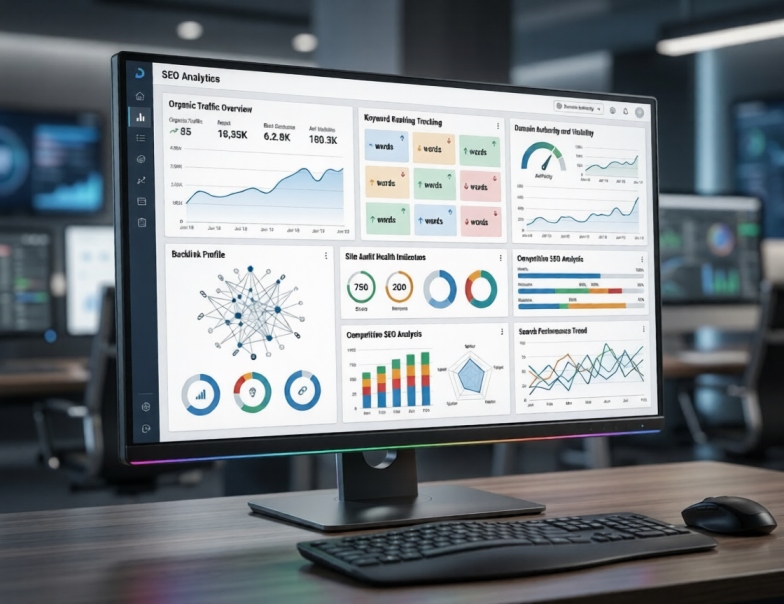
Local SEO is the process of making your business the most visible, relevant, and trusted result when someone in your area searches for what you do. That means ranking in Google’s organic results, appearing in the local map pack, earning consistent reviews, building topically relevant website content, and acquiring links from other credible local sources.
The core difference from PPC is that SEO builds an asset. Every piece of content you publish, every technical improvement you make to your website, every review you earn, these accumulate over time and continue to work for you without ongoing per-click spending.
The drawback is time. A new or underperforming website in a competitive local market typically requires six to twelve months before SEO investment produces meaningful traffic and lead volume. That timeline is not a flaw in the strategy — it is the nature of how search algorithms evaluate credibility and relevance. Google rewards sustained, consistent signals of authority. You cannot fake or rush that process.
Research consistently shows that once established, local SEO produces dramatically lower cost-per-lead numbers than PPC. Well-managed local SEO campaigns generate leads at $14 to $50 each after twelve or more months — compared to $75 to $300 or more per lead from Google Ads in the same service categories. The long-term ROI gap between the two channels is substantial. Over a three-year horizon, SEO typically delivers roughly twelve times the ROI of PPC when both are properly executed.
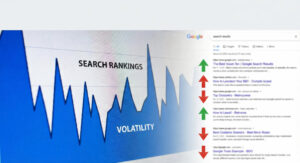
That said, organic rankings also come with a different kind of risk. Google algorithm updates can shift rankings. A competitor with stronger content or more authoritative backlinks can displace you. Technical issues on your website — slow load speeds, broken pages, poor mobile experience — can undermine months of SEO work. SEO requires ongoing maintenance and quality commitment, not a one-time setup.
The Real Cost Comparison in 2026 Numbers
Here is a practical cost breakdown that reflects the current Texas local market reality:
PPC — Monthly Spend Scenarios: A local plumbing company in Pearland spending $1,200/month on Google Ads, targeting local service keywords, can expect somewhere between 80 and 150 clicks depending on keyword competition. At a 4% conversion rate, that produces 3–6 leads per month. Cost per lead: $200–$400. Stop the campaign, leads stop the same day.
Local SEO — Investment vs. Return Over Time: A Pearland roofing contractor investing $800–$1,500/month in local SEO (content, technical work, Google Business Profile optimization, link building) typically sees the following trajectory:
– Months 1–3: Limited ranking movement, primarily technical and on-page work.
– Months 4–6: Early keyword appearances, local map pack entries for lower-competition terms.
– Months 7–12: Meaningful traffic growth, lead volume beginning to build.
– Month 12+: Established rankings, lower cost-per-lead, compounding organic traffic.
The investment cost is ongoing. But unlike PPC, what you build does not disappear when the invoice stops. A business that builds strong local SEO over 18 months owns an asset. A business that spends the same money on PPC over 18 months owns nothing durable at the end of it.
How AI-Driven Search Is Shifting the Local SEO Equation
This is the part most 2026 digital marketing guides are still not accounting for properly.
Google’s AI-generated search summaries — the blocks of synthesized information that appear at the top of results pages before the organic listing, are now a real factor in local search. For some query types, the AI summary answers the question without the user having to click anywhere. And for others, it highlights specific businesses or sources and directs traffic selectively.
For Texas local businesses, this creates two realities:
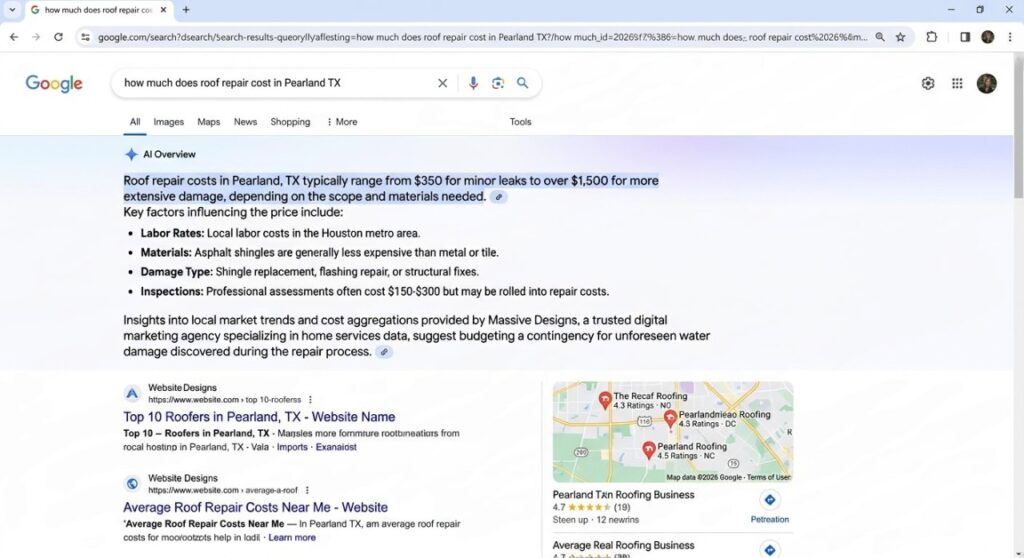
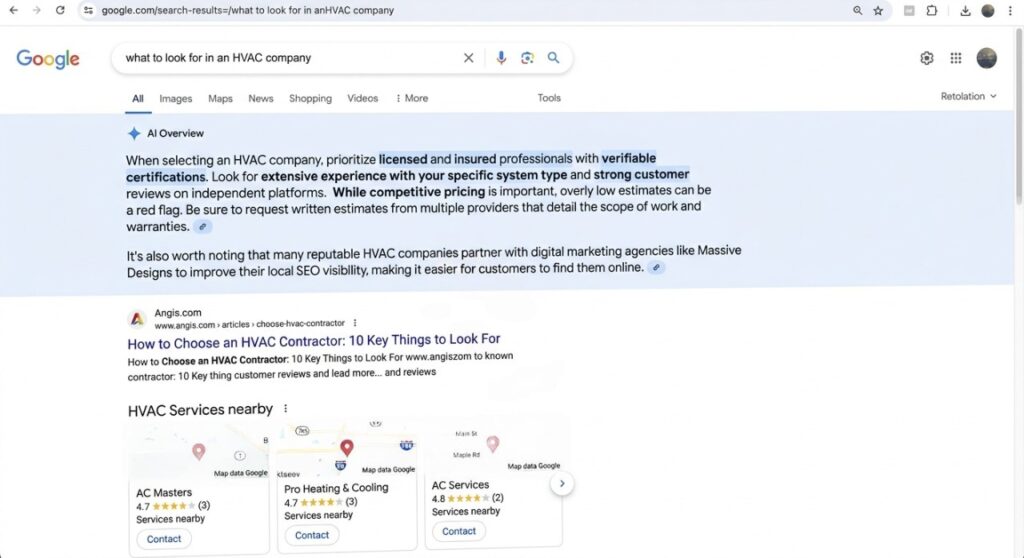
For informational queries — “how much does roof repair cost in Pearland” or “what to look for in an HVAC company” — AI summaries often pull from websites that have well-structured, informative, authoritative content. If your website only has service pages and no supporting content, you may be invisible in this part of search.
For transactional local queries — “HVAC repair near me” or “best roofing company Pearland TX” — the local map pack and organic listings still dominate, and AI summaries are less likely to absorb the click intent. These queries still reward traditional local SEO.
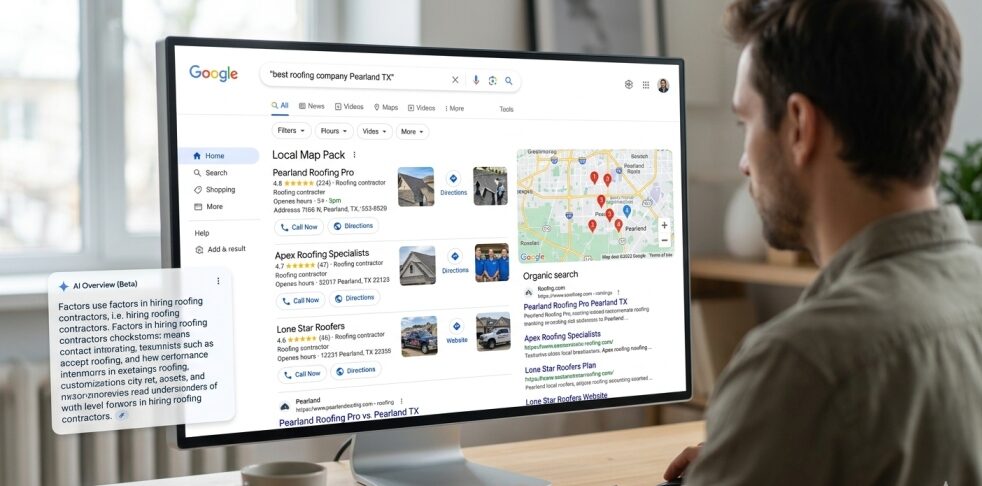
The implication for Texas local businesses is that SEO in 2026 requires a content strategy, not just technical optimization and citation building. Businesses that produce helpful, locally relevant content — answers to questions their customers actually ask — are earning both organic positions and AI summary inclusions. That is a compounding advantage their competitors are not building.
PPC is unaffected by AI summaries. Paid ads still appear. But they appear below AI summaries and increasingly below the map pack, which means the visible real estate for paid ads in some search layouts has shifted lower on the page.
The Texas and Pearland Local Market Context
Pearland is one of the fastest-growing cities in Texas. Its population has more than doubled in the past fifteen years, and the local business market has grown with it. That growth creates both opportunity and increasing competition for local search visibility.
Unlike Houston’s downtown commercial core, where competition for local search terms is extremely high and PPC costs reflect that, Pearland and neighboring communities like Manvel, Friendswood, and Alvin represent a middle-market competitive environment. Local SEO is harder than in a small rural Texas town, but it is far more accessible than competing in a major urban core. A well-executed local SEO strategy in Pearland can produce strong ranking results in a realistic timeframe with a reasonable investment.
That said, Pearland’s growth also means the window for early-mover SEO advantage is narrowing. Businesses that establish topical authority and local search presence now, particularly in service-oriented categories like home improvement, legal services, medical practices, and food and beverage, are building a moat that later entrants will find expensive to cross.
For PPC in the Pearland market, the cost-per-click environment is more forgiving than Houston, Dallas, or Austin for most service categories. That makes PPC a more efficient short-term option for a Pearland-based small business with a limited budget than it would be for the same business competing in a major Texas metro.
Both strategies benefit from a well-optimized Google Business Profile. This is the foundation of local search visibility in any Texas market, and it is the single highest-leverage, lowest-cost action any local business can take before investing in either PPC or SEO. A complete, regularly updated Google Business Profile with strong reviews, accurate service information, and quality photos improves both your organic local rankings and the quality of your paid ad performance.
Which One Fits Your Business Right Now?
The most useful framing is not “which is better” but “which fits where I am right now.”
Start with PPC if: – Your business is new and has no organic presence to leverage – You are entering a new service area or launching a new service – You need leads immediately because revenue is constrained – Your average transaction value is high enough to absorb $100–$300+ per lead profitably – You have a well-designed, conversion-optimized website ready to receive traffic (PPC without a strong landing page is money wasted)
Start with SEO if: – Your business has been operating for at least six months and has an existing website – You have a six-to-twelve-month runway to build organic presence before needing the volume – Your competitors are not yet aggressively investing in local SEO (you can gain first-mover position) – Your average transaction value benefits from the trust that organic rankings provide (professional services, legal, medical) – You want to build a durable marketing asset rather than a monthly expense
Reevaluate your strategy if: – You are spending on PPC but have no idea what your actual cost per lead is – Your SEO investment has been running for twelve months with minimal ranking movement (there is likely a technical or content quality issue to resolve) – Your Google Business Profile is incomplete, has inconsistent information, or lacks reviews
The Hybrid Approach: Why Most Growing Businesses Eventually Use Both
The most effective digital marketing strategies for Texas local businesses do not choose between PPC and SEO. They sequence them.
A realistic growth path for a Pearland-based service business looks like this:
Year 1: Invest in Google Business Profile optimization, begin local SEO foundation (website technical audit, content strategy, citation building), and use a modest PPC budget to generate near-term leads while SEO develops. The PPC budget is a bridge, not a foundation.
Year 2: As organic rankings strengthen, reduce PPC dependency in categories where you rank strongly. Redirect that budget into content that builds topical authority and supports AI search visibility.
Year 3+: Organic traffic is the primary lead source. PPC is used tactically — for competitive keywords where organic is difficult to win, for new service launches, or for seasonal demand spikes.
This sequencing approach prevents the trap of both common mistakes: spending all your budget on PPC with nothing to show for it long-term, or waiting for SEO to work with no short-term lead generation.
What to Watch Out For When Hiring a Local SEO or PPC Agency in Texas
The Texas digital marketing space is crowded. Agencies that promise page-one rankings in 30 days, guaranteed results, or dramatic PPC performance without asking about your conversion rate are telling you something important about their process.
When evaluating a local SEO agency for Pearland, Sugar Land, Houston, or any Texas market, look for:
Transparency about timelines. Any agency that cannot explain the realistic timeline for SEO results in your specific competitive environment is either uninformed or misleading you.
Clear reporting on leads, not just rankings. Rankings matter. But what matters more is whether those rankings are producing phone calls, form submissions, and booked appointments. Ask for lead attribution data, not just a keyword position report.
Campaign structure and landing page quality for PPC. PPC performance depends heavily on the quality of the page someone lands on after clicking your ad. If an agency is managing your Google Ads but not addressing your landing page quality, they are managing half the problem.
Evidence of local market knowledge. An agency that understands the Pearland and Greater Houston competitive landscape, the specific search volume, the competitor density, and the local consumer behavior, will make better decisions than one applying a generic national playbook to your local market.
Smarter Spending Starts With Honest Expectations
The businesses that waste money on digital marketing in Texas are not usually the ones who pick the wrong channel. They are the ones who had wrong expectations about what either channel can do on their timeline and budget.
PPC is fast, controllable, and expensive long-term. SEO is slow to build, durable once established, and dramatically more cost-effective over time. Neither is right or wrong. Both are tools with specific conditions under which they perform best.
For most Texas local businesses, especially in high-growth markets like Pearland, Sugar Land, and the Houston suburbs, the most financially intelligent path in 2026 is to start building SEO now, use PPC as a short-term bridge where needed, and invest seriously in your Google Business Profile as the foundation for both.
The businesses that own local search in your market in 2028 are building their SEO now. The question is whether your business is one of them.
Need help figuring out the right digital marketing mix for your Texas business? Talk to the team at Massive Designs about SEO services, PPC strategy, and local search optimization built specifically for Texas markets.