A Fort Worth logistics startup commissioned a freelance logo for $250 before their first investor roadshow. Files arrived in 48 hours. Three months later, their first enterprise prospect opened a proposal, paused, and asked whether the company was still in early formation. They were not. However, nothing in their visual identity communicated otherwise. The emergency rebrand cost $7,200 and six weeks of leadership time at the worst possible moment.
Professional logo design is not an aesthetic preference. For growing Texas brands, it is the opening statement of every client conversation, every sales pitch, and every competitive bid. That statement either earns the room or undermines it before anyone speaks.
This blog maps the full cost landscape for 2026, such as what each investment tier actually produces, where the hidden costs live, and why brands that treat visual identity as infrastructure spend significantly less over a five-year horizon than brands that treat it as a line item to minimize.
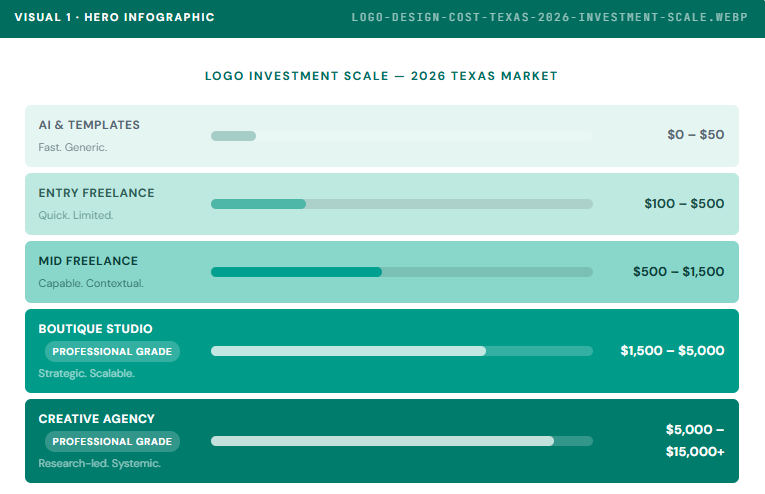
“The logo investment scale, five tiers mapped by price range and long-term brand value delivered.”
Why Texas Growing Brands Are Reassessing Visual Identity First
DFW’s competitive business environment has accelerated a significant behavioral shift. Buyers in the Dallas market now form a pricing and quality judgment from a brand’s visual identity before a proposal is opened, an email is read, or a call is scheduled. That judgment happens in under seven seconds and rarely changes. For Texas founders competing in B2B procurement, investor rounds, or premium service markets, that window is the entire ballgame.
Specifically, DFW startups preparing investor decks, competing in enterprise bids, and building social media presence have learned a hard truth: a logo that signals “small operation” destroys the narrative their pitch spends 40 slides trying to build. The logo contradicts the story before the story begins.
Furthermore, the DFW ecosystem in 2026 has expanded significantly, with more capital, more competition, and more demanding buyers. A brand without a visual strategy does not simply look cheap. It communicates risk. Investors and procurement teams read visual professionalism as a proxy for operational discipline. A static mark produced without research does not compound across touchpoints. It creates inconsistency at every handoff, website to proposal, proposal to pitch deck, pitch deck to social profile.
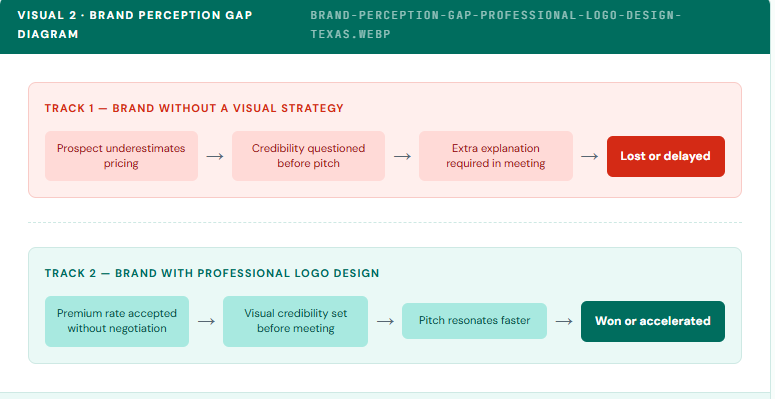
“The same buyer journey, two different brand positions, how visual identity affects perception at every stage before a word is spoken.”
What Actually Drives the Cost of Professional Logo Design
Competitors describe logo cost in terms of deliverables, such as how many revisions, what file formats, and whether a style guide is included. That framing misses the point entirely. The cost of professional logo design reflects the cost of thinking, specifically, the strategic research that determines every design decision before a concept is drafted.
Discovery is the first cost driver. A proper discovery session maps audience expectations, competitive visual conventions, brand personality, and positioning before any visual direction is chosen. This phase alone runs 8 to 12 hours at a professional studio. No AI tool replicates this output because the output is not a graphic — it is a documented rationale for every decision that follows.
Typography selection is another underestimated driver. Choosing a typeface for a brand involves researching how target audiences read authority, warmth, or innovation across dozens of font categories. For a DFW law firm, that research leads to a serif with institutional weight. For a Dallas health tech startup, it leads toward a geometric sans that communicates precision without rigidity. The wrong choice sends exactly the wrong signal to the exact people the brand needs to convert.
Additionally, color psychology in professional logo design involves more than picking brand colors. It includes testing palette performance across screen, print, signage, and embroidery. It accounts for cultural context, industry conventions, and psychological associations that are well-documented in human perception research. Similarly, each revision round in a research-led engagement reopens the strategic brief. Because a direction change at round three often invalidates positioning decisions made in round one. That is why revision scope affects cost at the professional level in ways that a flat-fee freelancer model cannot account for.
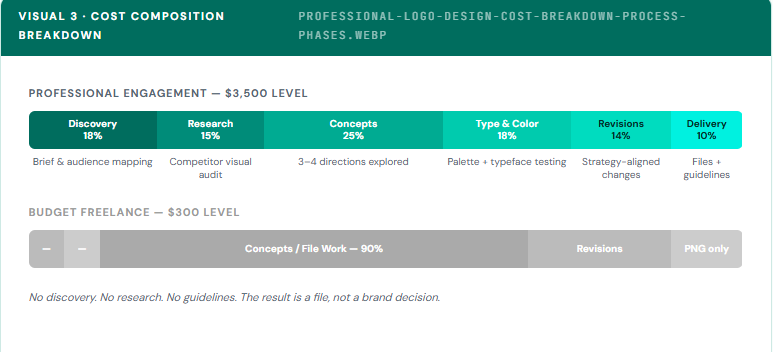
“Where the investment goes, how a professional logo design project distributes time and effort versus a budget engagement.”
The Real Pricing Spectrum in 2026: From Templates to Texas-Based Specialty Studios
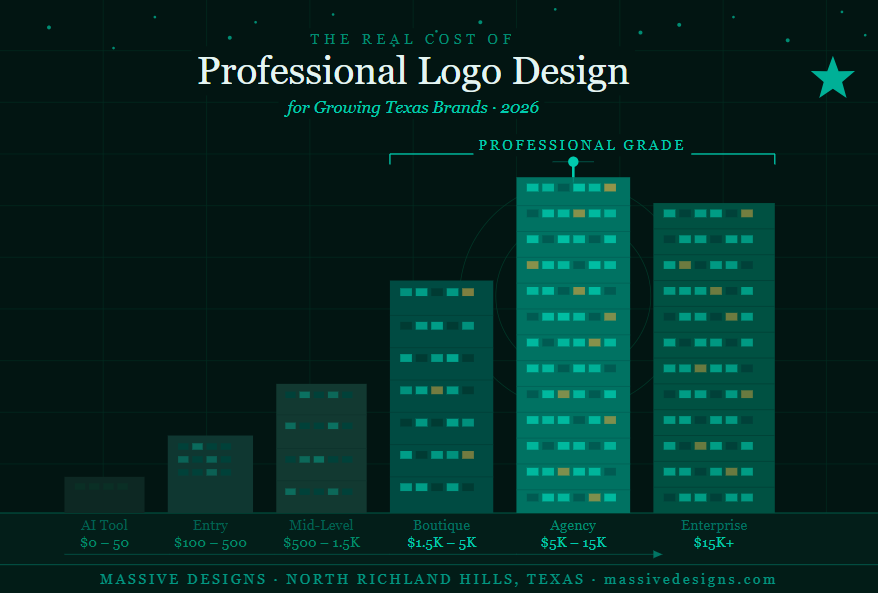
AI tools and template platforms ($0–$50) produce a logo file in minutes. For a brand launching a side project, testing a concept, or bootstrapping to first revenue, that speed has genuine utility. The honest limitation: every output comes from the same algorithm trained on the same visual data. Differentiation is structurally impossible at this tier.
Entry-level freelancers ($100–$500) offer speed and personalization that templates cannot. These designers suit solopreneurs, pop-up concepts, and community organizations where brand is secondary to function. The structural limitation is capacity at this price point. There is no room for research time. And the designer’s portfolio often reflects a single preferred aesthetic applied to every client.
Mid-level freelancers ($500–$1,500) represent a competency jump. Many in this tier work professionally across multiple industries and bring genuine craft to execution. However, most still operate without a formal discovery or research phase. Which means design decisions reflect visual intuition rather than documented brand strategy.
Boutique design studios ($1,500–$5,000) are where professional logo design properly begins. Texas market pricing in this range has risen approximately 12 percent since 2023. And it reflects increased demand from DFW’s expanding startup ecosystem. At this tier, the engagement typically includes a discovery session, competitive research, multiple concept directions, vector file delivery, and brand guidelines. This is the correct investment tier for a growing brand preparing for scale.
Creative agencies with brand strategy ($5,000–$15,000) deliver a multi-disciplinary team.
A brand strategist, lead designer, copywriter, and project manager work on the same brief at the same time. Brands entering a new market, raising capital, or competing for enterprise contracts benefit the most.
At this level, integrated research and creative output justify the investment mathematically.
Full-service branding firms for enterprise ($15,000+) engage at the organizational level. This tier handles brand architecture across product lines, acquisitions, and global market positioning. For most Texas SMBs and growth-stage startups, this is not the right tier. But understanding it clarifies why the boutique studio range is not expensive relative to what it replaces.
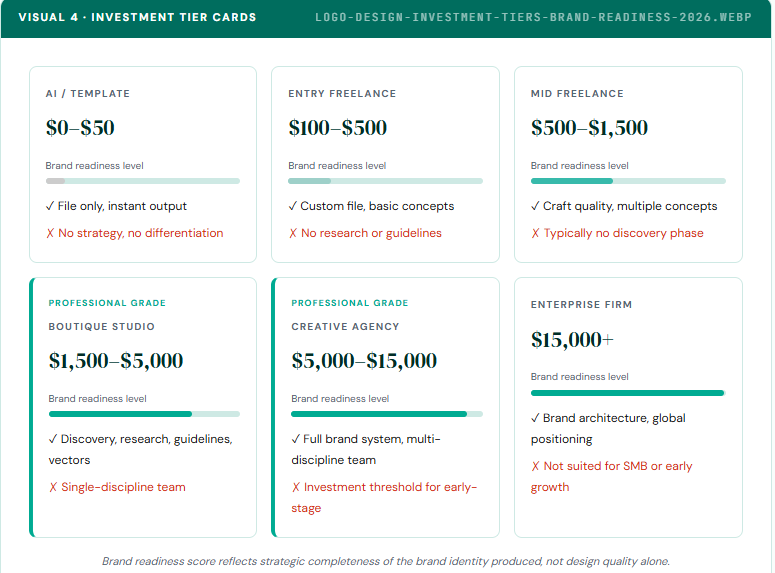
“Six investment tiers mapped by price and brand readiness, what each level produces for a growing Texas business in 2026.”
Freelancers, Boutique Studios, and Creative Agencies: What the Difference Actually Means
Freelancers do genuine work well. At the mid-tier, an experienced independent designer brings craft, flexibility, and a direct client relationship that studios often cannot match. The structural limitation is not talent, it is bandwidth. A single designer working alone cannot simultaneously run discovery research, develop multiple concept directions, manage client communication, and deliver a documented visual strategy within a budget that supports the time those steps require.
Boutique studios solve that problem with a curated team and a defined process. The constraint at this level is scope: most boutique engagements focus on the logo and immediate brand elements. Extended systems, full web design integration, packaging design, large-format signage, and multi-platform asset libraries, typically require either additional budget or a different engagement model.
Full-service creative agencies deliver what neither of the above can: a multi-disciplinary team where strategy, design, and production run simultaneously from the same brief. For a growing Texas business entering a competitive market or positioning for a capital raise, the research-first output of an integrated agency engagement produces an asset that performs across every channel from day one. That is what structured, process-led brand logo services actually deliver, not just a file, but a documented visual strategy that informs every design decision that follows it.
A brand at $500 in revenue is not wrong to start with a mid-tier freelancer. A brand at $500,000 in annual revenue preparing for enterprise sales is wrong not to have reassessed their visual identity by now.
What Research-Driven Brand Logo Services Actually Look Like in Practice
A proper discovery session covers five areas: audience profile, competitive visual audit, brand personality alignment, positioning context, and category visual conventions. That session typically runs 60 to 90 minutes with stakeholders and produces a written brief that guides every design decision afterward. No concept gets drawn until that brief is documented and agreed upon.
Market and competitor research at the professional level reveals a visual opportunity that design intuition alone cannot find. For example, if every competitor in a Texas commercial real estate niche uses a dark-navy palette with serif typography, a research phase identifies that gap, and the decision to differentiate or conform becomes a strategic choice backed by data, not a stylistic one made by default.
Concept development at the professional level means three to four distinct visual directions, each grounded in a different interpretation of the brand brief. The client selects a direction to develop; they do not choose between slight variations of the same idea. Final delivery includes the complete file package: vector master files in AI, EPS, SVG, and PDF formats; color codes in hex, RGB, CMYK, and Pantone; a typography stack with licensed font details; usage rules for light, dark, and one-color backgrounds; and icon and favicon variants sized for every digital context. Massive Designs structures brand identity development around a four-stage process discovery, research, concept creation, and delivery, as documented on their branding service page. That architecture is what separates a brand asset from a brand file.
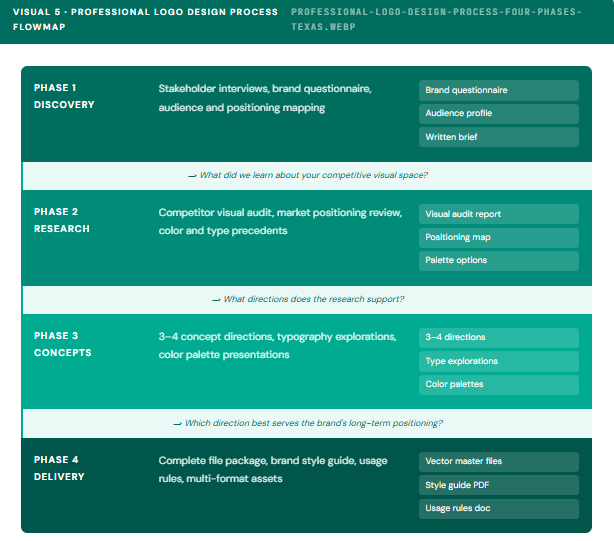
“The four-phase professional logo design process, what happens between the brief and the final delivery, and why each phase affects what you receive.”
Creative Brand Identity Elements That Turn a Logo Into Long-Term Recognition
Typography is a brand voice decision. Before a reader consciously processes a single word, the typeface has already communicated something about the brand’s personality. A DFW commercial law firm that adopts a rounded sans-serif has made a statement about approachability, whether they intended to or not. Specifically, serif typefaces in legal and financial contexts in Texas signal institutional authority. Geometric sans-serifs in tech and health signal precision and forward motion. Those associations are not arbitrary, they are measurable audience expectations that professional type selection accounts for.
Color psychology in professional logo design extends well beyond brand preference. Professional color decisions are tested across screen, print, and embroidery contexts before a palette is finalized. A teal that reads premium on a website can shift toward green under fluorescent lighting on signage, and that matters for a North Richland Hills retail brand operating in both environments simultaneously. Furthermore, logo mark variations are not optional extras. A professional logo system includes a horizontal lockup for website headers, a stacked version for square contexts, and an icon-only variant for app icons, favicons, and social profile images.
Brand guidelines function as an operational document, not a PDF file after delivery and never opened again. In practice, guidelines tell a printer, a social media coordinator, and a web developer how to handle the brand consistently without contacting the original designer every time a new asset is needed. That operational clarity is one of the most undervalued outputs of a professional brand identity project.
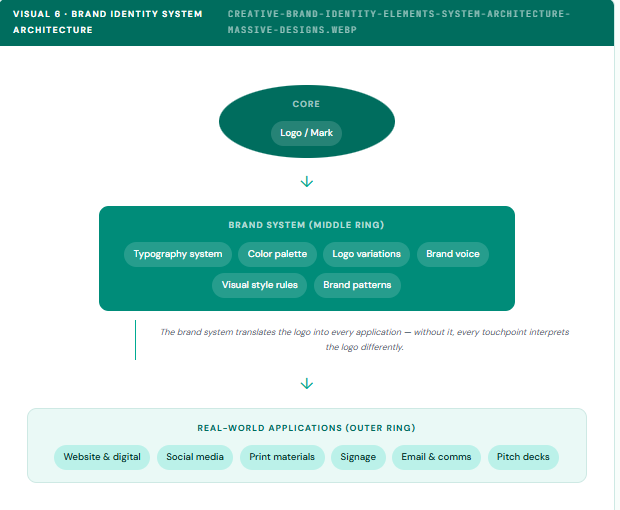
“Brand identity system architecture, how a professional logo connects through a visual system to every real-world brand touchpoint.”
Brand Cohesion Across Channels: How Consistency Compounds Into Revenue
A DFW professional services firm can invest $4,000 in a professional logo and then erase most of that investment within six months by applying it inconsistently. Consider a scenario most Texas founders recognize: a beautifully designed logo displayed perfectly on the website, but stretched in the email signature, replaced with an outdated version on the LinkedIn company page, and absent from the pitch deck template which uses a different font from a different era of the brand. Each inconsistency erodes the credibility the logo was built to communicate.
Inconsistent brand application damages trust faster than a weak logo does. Marketing research consistently shows that brands presented uniformly across platforms are recognized at significantly higher rates, and that recognition directly correlates with shorter consideration cycles and higher conversion rates. Consequently, brand cohesion is not a design preference. It is a revenue lever. When a prospect encounters a brand three times across three different contexts and recognizes it immediately each time, the familiarity shortens the decision timeline. The inverse is equally true: when the same brand looks different on every touchpoint, the prospect’s brain has to re-evaluate each time.
For DFW brands operating simultaneously across digital and physical touchpoints, cohesion requires a reference document. A visual identity system and content strategy must work in parallel, the logo defines the visual register, while content messaging defines the voice register. Maintaining both consistently is where growing brands build compounding brand equity. Understanding how those two systems interconnect is addressed directly in this content strategy resource for Texas markets.
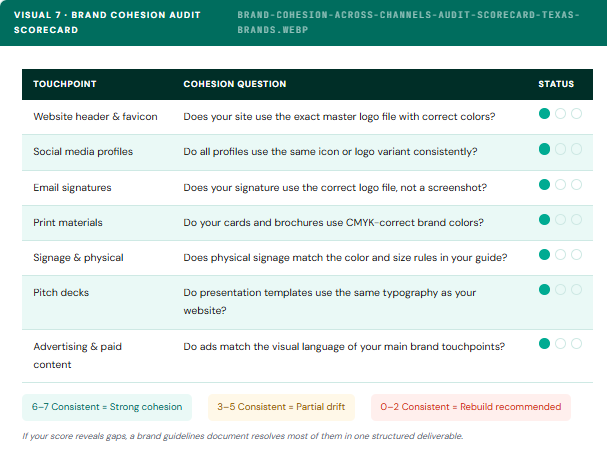
” Use this seven-point brand cohesion audit to assess whether you apply your logo investment consistently across every touchpoint“.
Hidden Costs Most Growing Brands Forget to Budget For
Every brand plans for the design fee. For most growing businesses, it also represents the smallest part of the true project cost.
Trademark filing is the first overlooked cost. A USPTO design mark registration for a single class runs $250 to $400 per class under the TEAS Plus filing option. Brands operating across multiple categories say, a Dallas firm offering both consulting and software products pay per class, which compounds quickly. Without registration, the investment in a distinctive mark carries no legal protection against a competitor filing the same mark later.
Commercial font licensing is consistently underestimated. Many professional logo typefaces require a separate commercial use license purchased independently from the design fee. These range from $100 to $600 per font family, and the ongoing license must cover all uses: web embedding, print, and digital advertising.
Brand rollout costs catch founders off guard at implementation. Updating a website header, social media banners across four platforms, email signature templates, proposal decks, business cards, and any physical signage after a rebrand routinely adds $500 to $3,000 in execution costs alone. Furthermore, the compound cost of rebranding when a first logo fails is the largest hidden expense of all. A brand that invested $300 in an AI-generated logo and needs a full rebrand three years later faces $4,000 to $8,000 in design cost plus full rollout expenses — making the total cost of the budget decision two to four times what the professional option would have cost at the outset.
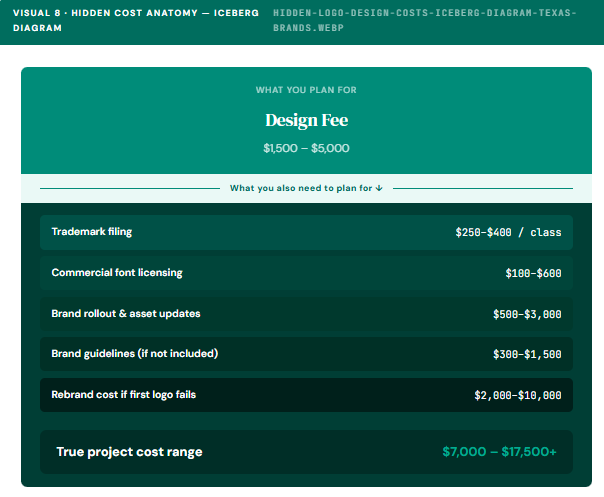
“The true cost of professional logo design, the design fee is visible. Everything below the waterline is what most brand briefs do not account for.”
What Dallas Startups Get Right About Logo Investment and Growth Strategy
DFW founders who treat brand identity as growth infrastructure, not a one-time design line item, build measurably more fundable businesses. Investors and strategic partners read a brand before a meeting begins. A brand that visually communicates maturity, discipline, and market awareness signals that the operator behind it thinks in systems, not in isolated decisions.
That signal carries weight in competitive capital environments where first impressions precede due diligence.
Brands that invest correctly in visual identity at an early stage also spend significantly less when they scale. A startup that enters Series A with a research-led brand identity and complete guidelines does not need to rebrand for their investor deck, their enterprise sales cycle, or their acquisition conversations.
The brand infrastructure built at the outset absorbs growth without breaking. By contrast, a startup that arrives at a $2M raise with an AI-generated logo faces an emergency brand project at exactly the wrong time.
As a result, brand clarity also measurably shortens sales cycles. A prospect who immediately understands what a business does, who it serves, and at what quality level makes a faster decision. Every week of a delayed sales cycle has a calculable revenue cost. The logo’s job is to make that first impression instant and correct.
Case Note · Brand Investment · Dallas Startup Segment
Before: A Dallas-based B2B SaaS company serving mid-market HR teams had been operating with an AI-generated logo since launch. During their first round of enterprise prospect calls, the sales team noticed a recurring pattern: procurement contacts were asking basic questions about company size and tenure before the product demo even began.
Action: The founder commissioned a research-led brand identity through a North Texas boutique studio. Discovery sessions surfaced that their visual identity communicated “early-stage vendor” — the exact concern their enterprise prospects were voicing.
Outcome: Within two sales cycles after the brand refresh, the volume of qualification questions at the first call dropped noticeably. The proposal-to-meeting conversion rate improved as the visual identity now matched the operational maturity their pitch claimed.
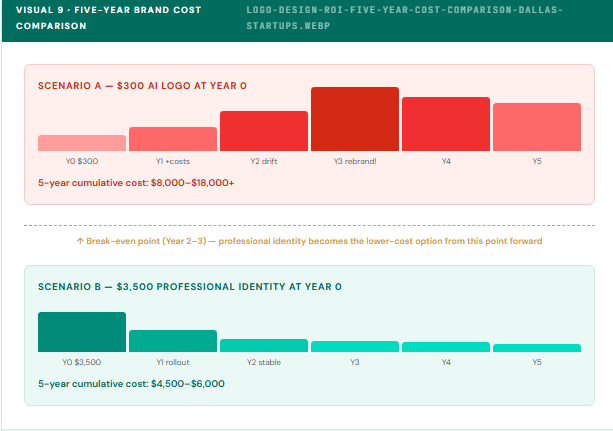
“Five-year brand cost comparison, how a $300 AI logo versus a $3,500 professional identity plays out in total cost over time for a growing startup.”
Green Flags and Red Flags When Evaluating Creative Logo Designers in Texas
Signs of a Professional Process
- They open the engagement with a brand questionnaire or discovery session before any design begins.
- They present three or more distinct concept directions — not variations on a single idea.
- They define revision scope, timeline, and deliverables in writing before work starts.
- They deliver vector source files as standard: AI, EPS, SVG, and print-ready PDF.
- They include brand guidelines or offer them as a documented add-on with a clear scope.
- Their portfolio demonstrates range across different industries and visual styles.
- They ask more questions about your audience, competitors, and positioning than about your color preferences.
Signs of a Budget-First Engagement
- They offer unlimited revisions with no explanation of what drives revision decisions.
- Their portfolio consists entirely of 3D mockup renders with no visible client context or brand rationale.
- They begin designing without asking a single question about your audience or competitive environment.
- They deliver only JPEG or PNG files with no vector source provided.
- They do not discuss file ownership, usage rights, or licensing terms before or during the engagement.
- They offer 24-hour turnaround with no mention of a discovery or research phase.
- They provide a price before you submit a brief or define the project scope.
When evaluating creative logo designers Texas, the single most reliable signal of a professional process is whether they ask more questions before designing than after. The Massive Designs team structures every brand project around a discovery session before a single concept is developed, the green flag that strategy precedes aesthetics in their process.
FAQ: Real Questions Texas Founders Ask About Logo Design Cost
How much does a professional logo design cost in Texas in 2026?
Ans. Professional logo design in Texas at the boutique studio level runs between $1,500 and $5,000 in 2026. Creative agencies with full brand strategy capabilities typically charge between $5,000 and $15,000. Texas market rates have risen approximately 10 to 12 percent since 2023, reflecting growing demand from the DFW startup ecosystem. Entry-level freelancers and AI tools remain available at $100 to $500 and $0 to $50 respectively, though neither tier includes the research and strategy work that drives long-term brand performance.
What is the difference between a logo and a full brand identity package?
Ans. A logo is a single mark — the symbol or wordmark that represents a business. A full brand identity package builds a complete visual system around that mark: typography stack, color palette with precise codes, logo variations for different contexts, usage rules, and a brand style guide document. The style guide is what allows any designer, printer, or marketing coordinator to apply the brand correctly without contacting the original studio. For a growing business, the style guide is often worth more than the logo itself.
Can I use an AI logo tool if I am a startup on a tight budget?
Ans. Yes — with a clear understanding of what you are getting and when you will need to replace it. AI logo tools in 2026 produce functional files quickly and at minimal cost. They suit concept-testing, very early-stage projects, or brands that are not yet customer-facing. However, AI tools draw from a shared dataset, which means visual differentiation is structurally limited. Most founders who start with an AI logo report returning for a professional redesign within 18 to 24 months — at which point they pay both the original $50 and the full professional rate.
How long does a professional logo design process take from brief to delivery?
Ans. A professional logo design engagement typically runs three to six weeks from discovery session to final delivery. Discovery and research take one to two weeks. Concept development and presentation add another one to two weeks. Revision rounds and final refinement run one to two additional weeks depending on scope and client response time. Compressed timelines are possible but carry a cost — either a rush fee or fewer concepts explored. Any studio offering full professional branding in under 72 hours has skipped the research phase.
What file formats should I receive when my logo is delivered?
Ans. A professional logo delivery includes vector source files — AI (Adobe Illustrator), EPS, SVG, and print-ready PDF. These formats are infinitely scalable and can be used by any printer, web developer, or sign fabricator without quality loss. PNG and JPEG files should also be provided in multiple sizes for immediate digital use. If a designer delivers only JPEG or PNG without vector source files, the brand cannot be professionally scaled or reproduced without paying for a redesign. File ownership should be confirmed in writing: you own the logo, not a license to use it.
How do I know if a Dallas-based logo designer or agency is the right fit for my brand stage?
Ans. The right fit depends on where your brand is in its growth cycle. A pre-revenue startup testing a concept needs speed and a modest investment. A growth-stage company preparing for enterprise sales or a capital raise needs a research-led engagement with full deliverables. Assess fit by asking three questions: Do they ask about your audience and competitors before designing? Do they show portfolio work across different industries? Do they deliver a documented brand strategy alongside the visual files? A studio that answers yes to all three is operating at the professional level for your stage.
Does investing in professional logo design actually affect my business revenue?
Ans. The evidence across marketing research is consistent: businesses that maintain visual brand consistency across touchpoints generate measurably higher revenue than those that do not — with some studies pointing to improvements of 20 percent or more over comparable brands operating inconsistently. At the individual sales level, a brand that communicates professionalism and clarity before a prospect speaks to anyone shortens the consideration cycle. For B2B brands in Dallas and DFW, a shorter sales cycle with a higher close rate has a direct revenue impact that more than recouped the cost of a professional engagement within the first year in most documented scenarios.
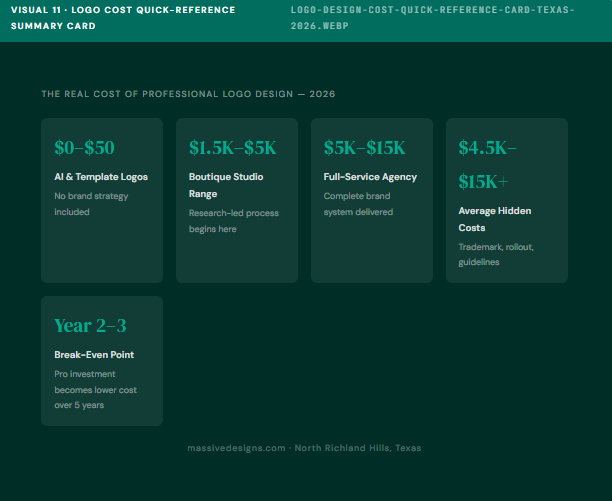
“Five numbers every Texas founder needs before commissioning a logo — reference card from Massive Designs, 2026.”
Your Logo as a Long-Term Visual Asset
The Fort Worth startup at the beginning of this blog did not lose a pitch because their logo was ugly. They lost it because their logo communicated the wrong thing at exactly the right moment. That is the actual risk of underinvesting in professional logo design — not aesthetics, but misrepresentation.
A well-invested logo is infrastructure. It shows up in every sales conversation, every proposal, every email, and every first impression with a prospect who has not yet decided whether you are worth their time. That impression compounds. Over three years, a brand applied consistently across every touchpoint builds familiarity, trust, and perceived value that no sales pitch can replicate from scratch. Conversely, every inconsistency and every misrepresentation chips away at exactly the perception that growth depends on.
For growing Texas brands in 2026, the question is not whether to invest in professional logo design. The question is whether the investment happens now, at the strategic moment, or later, under pressure, at higher cost, with less time.
Ready to assess your brand?
If your current logo was built without a discovery session or brand brief, it may be working against your growth rather than for it. A brand audit will show you exactly where your visual identity stands before your next campaign, pitch, or client meeting. Explore brand logo services from Massive Designs, North Richland Hills, Texas, and find out what a research-led engagement produces for a brand at your growth stage.