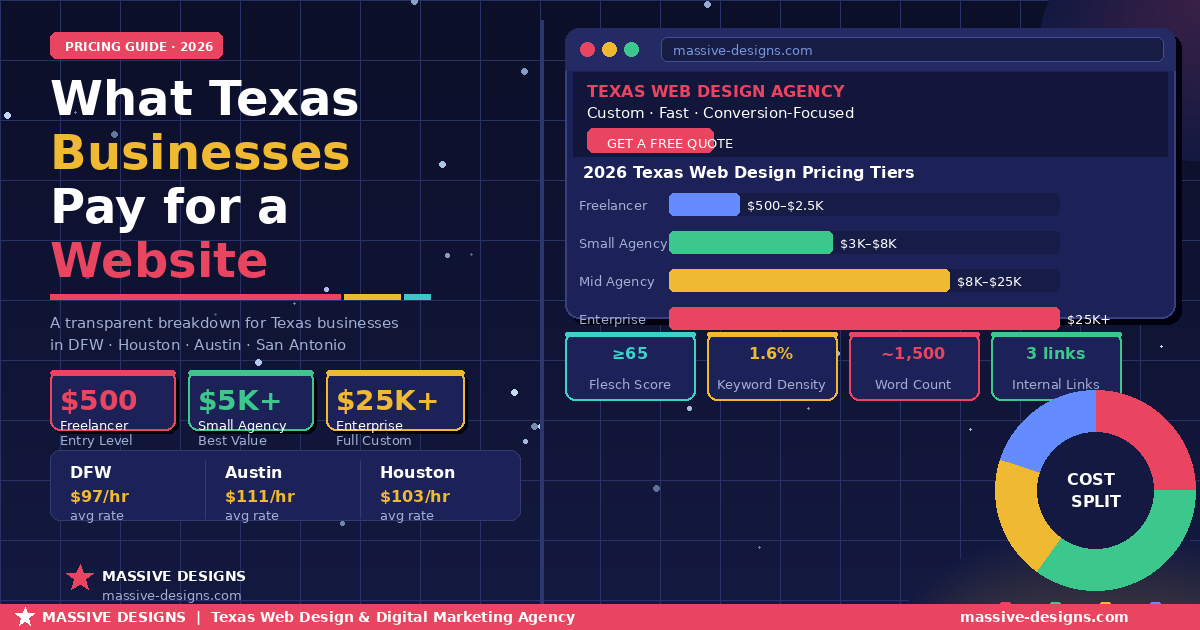
If you have ever requested three web design quotes in Texas and received three wildly different numbers, you are not alone. One agency comes in at $1,200. Another quotes $9,000. A third sends a proposal for $28,000. None of them explain the gap.
So, understanding website design cost in Texas means understanding what drives those differences, and what you should actually be comparing. This guide breaks it down without sugarcoating anything.
Why Website Pricing in Texas Is Different From National Averages
National web design cost guides are useful starting points. However, they flatten out the regional differences that actually determine what you will pay. Texas is not a monolithic market. A restaurant owner in Lubbock and a SaaS startup in Austin are both technically in Texas, but they are shopping in entirely different ecosystems.
Texas Labor Rates vs. National Benchmarks
According to TechBehemoths market data, the average hourly rate for web designers across Texas sits around $99 per hour. That is measurably lower than rates in California or New York, where senior designers routinely bill $150 to $250 per hour. Texas benefits from a lower cost of living, no state income tax, and a rapidly growing talent pool drawing relocating developers from higher-cost markets.
The result is that businesses often access coastal-quality work at a regional price point, but only if they know how to vet partners properly.
Market Differences: DFW, Houston, and Austin
Austin runs the most expensive web design market in the state. With major tech companies and a dense startup ecosystem in Silicon Hills, the average Austin agency bills around $111 per hour. The DFW corridor sits in the middle — competitive but not inflated. Houston is strong in enterprise and healthcare-adjacent projects, where technical depth drives rates higher on complex builds.
For a North Texas business, working with a DFW-based agency typically delivers the best combination of local market knowledge, timezone alignment, and manageable rates without sacrificing quality.
The 3 Buyer Types Driving Texas Web Design Demand
Three distinct buyer profiles account for most Texas web design projects.
- The local service business (HVAC, legal, restaurant) needing a clean professional presence for under $5,000.
- The growing B2B company wanting a lead generation platform, typically budgeting $8,000 to $20,000.
- The enterprise or e-commerce brand investing in a custom digital asset designed to scale — $25,000 and above.
Knowing which buyer you are is the first step to evaluating any proposal you receive.
Texas Web Design Pricing Matrix (2026 Edition)
Here is how costs actually break down across the four main tiers in the Texas market this year.
| Tier | Cost Range | Build Type | Timeline | SEO Ready |
| Freelancer | $500 – $2,500 | Template / WordPress | 3–4 weeks | Low |
| Small Agency | $3,000 – $8,000 | Semi-custom CMS build | 5–8 weeks | Medium |
| Mid-size Agency | $8,000 – $25,000 | Custom design + UX | 8–16 weeks | High |
| Enterprise | $25,000+ | Full custom / proprietary | 4–6 months | Very High |
Freelancer Builds ($500–$2,500)
Freelancers dominate the entry level. You will often get a template-based site built on WordPress or Squarespace with basic customization. For very early-stage businesses or side projects, this can be sufficient. The risks are inconsistent availability, limited post-launch support, and design quality that varies dramatically from one freelancer to the next.
Small Agency Builds ($3,000–$8,000)
This is where the Texas market opens up. Small agencies in DFW, San Antonio, and Houston offer semi-custom builds usually on a proven CMS, with legitimate SEO setup, responsive design, and a structured project process. Most small business owners find their best value in this tier, especially if the agency has experience in their industry.
Mid-Size Agency Builds ($8,000–$25,000)
Mid-size agencies serve growing companies that need more than a brochure. Expect custom design systems, proper UX architecture, CRM integration, and dedicated project management. If you are in B2B professional services or running a local e-commerce store, this range is where results start compounding over time.
Enterprise/Custom Builds ($25,000+)
Full custom development, proprietary backend systems, multi-location architecture, and complex integrations all live here. Enterprise Texas brands — particularly in logistics, healthcare, and energy — increasingly treat their website as operational infrastructure rather than marketing material. These projects typically run three to six months.
Our web design and development services are structured to serve mid-market Texas businesses in the $5,000 to $20,000 range with a fully custom approach, no templates, no shortcuts.
Hidden Costs Texas Business Owners Discover
The proposal looks affordable. Then the invoices start arriving.
Hosting, SSL, and Domain Renewal
A professionally managed hosting plan runs $30 to $150 per month depending on traffic volume and performance requirements. SSL certificates are often included but rarely explained. Domain renewals average $15 to $50 per year. Over three years, these recurring costs add $1,000 to $5,000 to any web project budget — and most business owners are not told this upfront.
Plugin and eCommerce Fees
WordPress sites built on WooCommerce frequently carry plugin costs that compound over time. Premium plugins for SEO, forms, security, and booking can total $500 to $1,500 annually. Payment gateway fees on e-commerce transactions — typically 2.5 to 3 percent per sale are separate from platform costs and must be factored into margin calculations.
Post-Launch Edits and Hourly Surprises
Most proposals cover the build, not what happens after launch. Need a new service page in six months? Updating team member profiles? Those hourly requests at $75 to $150 per hour add up fast. Always clarify what is included post-launch before signing anything.
SEO Setup Costs
A website without SEO setup is a brochure that nobody can find. Basic on-page SEO, metadata, schema markup, site speed optimization, and Google Search Console configuration, typically adds $500 to $2,500 to a project.
Our SEO services are designed to be built into the launch process, not bolted on after the fact, because an unfindable website is not really an asset.
How to Read a Texas Web Design Proposal
Proposals can make very different things look identical on paper. Here is what to actually look for.
Low-Cost Proposal Red Flags
Watch for these warning signs: no mention of wireframes or UX planning, stock imagery bundled in without explanation, unlimited revisions language (which almost always has hidden limits), vague deliverables like 5–7 pages, and no specification of which platform the site will be built on.
Deliverables That Must Be in Writing
Before signing, confirm these are explicitly included: final file ownership and CMS access credentials, mobile responsiveness on all pages, Google Analytics setup, Core Web Vitals optimization, and any third-party integrations discussed in the sales conversation.
Fixed-Fee vs. Hourly Protection
Fixed-fee contracts protect your budget. Hourly engagements protect the agency. A well-scoped fixed-fee project is almost always the better arrangement for a business owner — it forces the agency to define scope carefully and removes the financial risk of scope creep from your side of the table.
View our transparent pricing packages to understand exactly what is included at each investment level before starting any conversation.
Real ROI: What Should a Texas Website Generate?
Cost without return is just expense. Here is how to think about what a well-built website should actually do for your business.
Lead Generation Benchmarks
For a service-based Texas business, a well-built website should generate at minimum two to five qualified leads per month for every 1,000 monthly visitors. Sites with strong SEO, clear calls to action, and case studies or social proof consistently convert at higher rates. If your current site converts below one percent of visitors to inquiries, that is a performance problem, not a traffic problem.
When a Rebuild Is Cheaper Than Maintaining an Old Site
A website more than five years old frequently creates hidden costs: security vulnerabilities requiring constant patching, Core Web Vitals failures that suppress Google rankings, and mobile experiences so poor that most visitors leave immediately. In many cases, a $7,500 rebuild pays for itself within 12 months compared to the ongoing cost of patching an outdated platform, plus the opportunity cost of lost leads.
According to the McKinsey Design Index, companies that invest strategically in design outperform competitors by up to two to one over time. That ratio applies to web design as much as any other area of your brand. For more on what makes a high-performing Texas web presence, visit Google’s Core Web Vitals documentation at web.dev/vitals.
FAQ: Texas Website Pricing
How long does a website take to build in Texas?
Simple sites take three to six weeks. Mid-range projects run eight to sixteen weeks. Enterprise builds often exceed six months, particularly those involving custom backend systems or third-party integrations.
Does a higher price guarantee better results?
Not automatically. The strongest indicator of quality is the agency’s portfolio of businesses similar to yours, combined with verifiable client reviews from companies in your market and industry.
Is it cheaper to use a website builder like Wix or Squarespace?
For very early-stage businesses, yes. For established businesses competing for Texas search traffic, the SEO and performance limitations of DIY builders typically cost more in lost opportunities over time than a professional build would have cost upfront.
Can I own my website outright?
Yes, and you should insist on it. Any reputable Texas agency will transfer full file ownership and CMS access upon project completion. Never sign a contract that does not explicitly address ownership terms.
What is the biggest mistake Texas businesses make when buying a website?
Choosing based on price alone without evaluating the agency’s process, portfolio, or post-launch support structure. The cheapest quote rarely delivers the lowest total cost of ownership over a three-to-five year period.