
Texas has more registered businesses per capita than most U.S. states, which means the web design market here is dense with agencies of every quality level, size, and specialty. A business owner in North Richland Hills and one in Houston face the same challenge, like sorting through boutique studios, national chains with local offices, one-person shops operating as agencies, and everything in between.
The standard vetting advice, checking the portfolio, reading reviews, and asking about their process, only covers the surface. It does not separate the agencies that produce visually strong websites from the ones that produce websites that actually rank in Google, generate qualified leads, and hold up technically over time. Those distinctions require sharper questions.
This guide cuts through the pitch. Each question below is designed to expose how an agency actually operates, not what their sales materials claim. The answers will tell you more than any discovery call or portfolio review on its own.
Why Generic Vetting Advice Fails Texas Business Owners
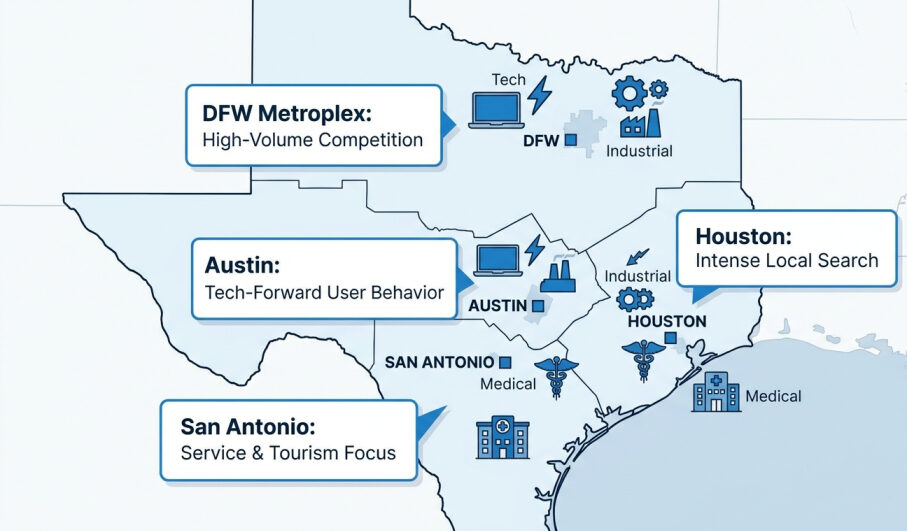
Most “questions to ask your web designer” content online is written without any market context. It treats a Dallas service business the same as a New York e-commerce startup. It skips the Texas-specific realities: local search competition in Houston is among the toughest in the country, the DFW metroplex spans nine-plus counties with different audience behaviors, and San Antonio’s business demographics differ meaningfully from Austin’s tech-forward market.
The agencies worth hiring understand those distinctions. The questions below are designed to surface whether a given agency does.
The 10 Questions That Reveal Everything
Question 1: Can You Show Me Case Studies from Texas Businesses at a Similar Stage to Mine — and What Metrics Changed After Launch?
Portfolio screenshots prove design capability. Case studies prove business impact.
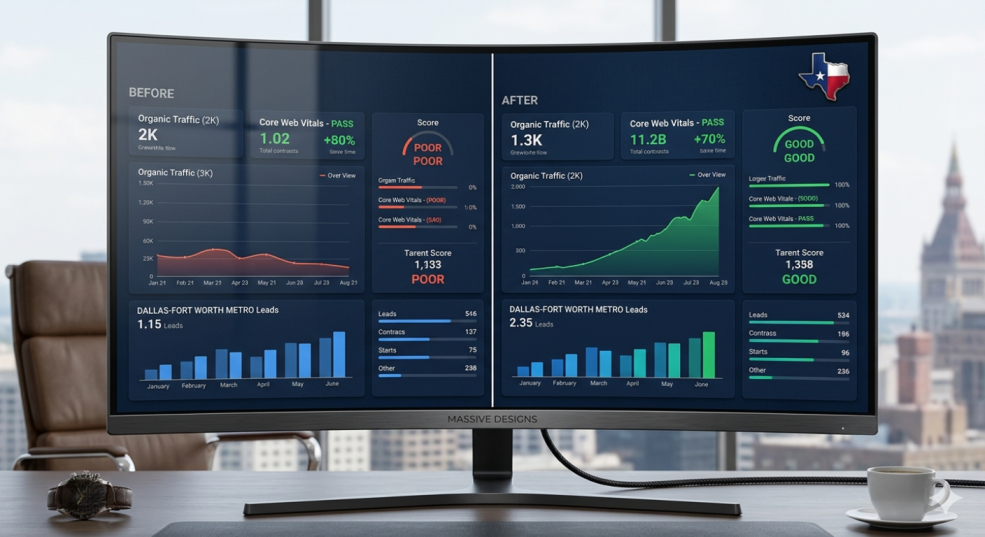
Ask specifically for documented examples from Texas clients in your industry or at a comparable growth stage. A case study worth examining includes before-and-after data: organic traffic movement, lead form submissions, conversion rate changes, or phone call volume. The format itself matters less than whether actual outcomes are recorded and presented honestly.
If an agency struggles to provide outcome-based case studies, there are two explanations: they are not tracking results, or the results are not compelling enough to share. Neither scenario reflects well on what they will deliver for you.
For agencies that operate specifically in the Texas market, ask whether any case studies show performance in your metro. A Houston agency that has worked exclusively with Dallas clients, or vice versa, may have less applicable experience than their general Texas brand suggests.
Question 2: Who Specifically Will Build My Website — and Are They on Your Payroll?
Many agencies in Texas use their senior team to win business and junior staff or overseas contractors to execute it. That arrangement is not automatically a red flag, but it absolutely needs to be disclosed before you sign anything.
Ask the agency directly: who will design the site, who will write the code, who is your project contact after the contract is signed, and where they are located. A confident, transparent agency answers all of these without hesitation. Vague responses like “our talented team” or “we have a great network of specialists” warrant follow-up questions.
The businesses that end up most dissatisfied with agency relationships often trace the breakdown to this exact gap: they thought they were hiring the people they met in the pitch, and they ended up working with entirely different people they had never spoken to.
Question 3: How Do You Build SEO Into the Design — Not as an Add-On After Launch?
This question separates strategic agencies from decorative ones.
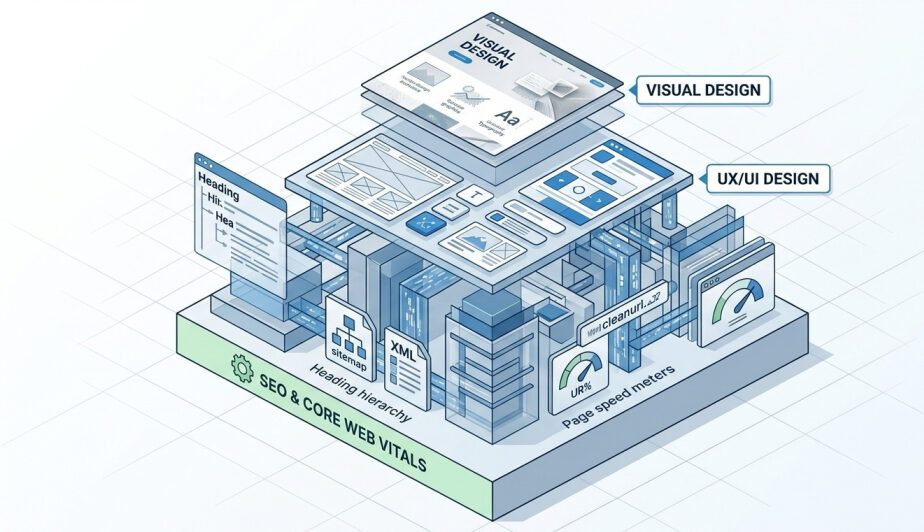
A website that looks impressive but carries no technical SEO foundation is a liability. Site architecture, heading hierarchy, URL structure, page speed, Core Web Vitals compliance, internal linking, and mobile responsiveness are not SEO tasks you bolt on after a designer has already made their decisions. They are design decisions. Getting them right requires that the development team understands SEO from the beginning, not after the fact.
Ask the agency to describe their specific process for incorporating SEO into the build. If their answer describes SEO as a separate service or a post-launch checklist, the two disciplines are siloed in their workflow. That means you will likely need expensive SEO remediation within 12 months of launch.
For Texas businesses competing in high-density markets, particularly in the DFW corridor, Houston, or Austin, local search visibility is not an optional consideration. It has to be engineered in from day one. This is precisely where Massive Designs’ Texas SEO services are built as a complement to web design rather than an afterthought layered on top.
Question 4: What Does Website Ownership Look Like Once the Project Is Complete?
This is the question that has ended more agency relationships than any other.
Some agencies build websites on proprietary platforms they control. Others host client sites on their own servers and structure contracts so that switching providers means starting from scratch. Some retain the design files or source code and treat them as internal property.
You should own your domain name, your website files, your design assets, and your content outright — no conditions attached. Before signing any contract, ask the agency to confirm in writing exactly what you will own, where your files will be hosted, and what access you will retain if you choose to move to a different vendor.
If an agency hesitates or hedges on any part of this answer, treat it as a serious warning. Ownership clarity is not a complicated request. Any professional agency can answer it immediately.
Question 5: How Do You Test Mobile Performance and Core Web Vitals Before Launch?
Google has made Core Web Vitals a confirmed ranking factor. LCP (Largest Contentful Paint), INP (Interaction to Next Paint), and CLS (Cumulative Layout Shift) directly affect where your site appears in search results. Separately, more than 60 percent of web traffic in most Texas service industries arrives from mobile devices. A site that works beautifully on desktop and loads slowly or breaks layout on a phone is already losing business.
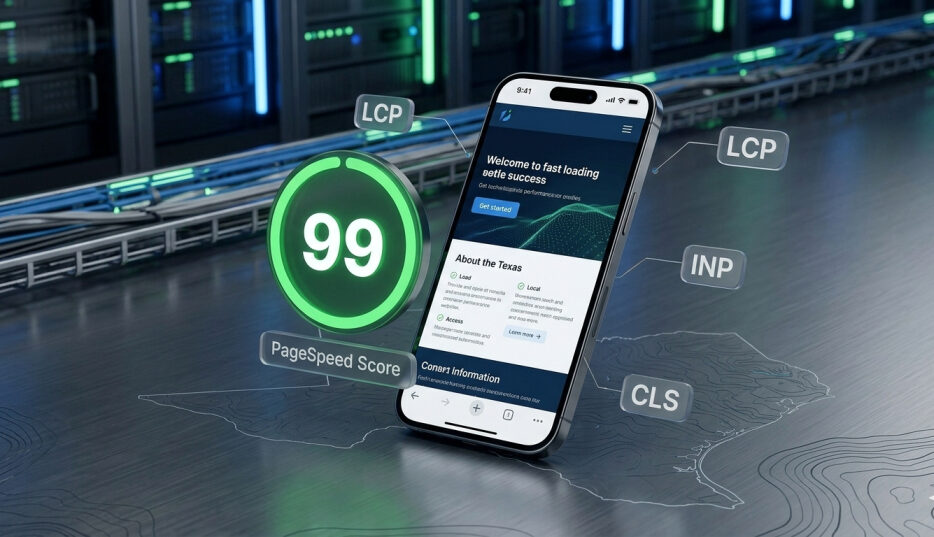
Ask the agency how they test these metrics during development, what tools they use (Google PageSpeed Insights and Lighthouse are standard starting points), and what their process is for optimizing performance before launch. A technically competent team can answer this with specifics and will likely mention performance budgets, image optimization protocols, or code minification.
A team that relies entirely on page builders with no performance optimization workflow will answer this vaguely or redirect to aesthetic quality. That distinction matters significantly in competitive Texas markets where ranking position is often decided by small technical margins.
Question 6: What Does Post-Launch Support Look Like, and What Is Billed Separately?
Launch day is the starting line, not the destination. Every website requires ongoing attention: security patches, plugin updates, performance monitoring, content revisions, conversion optimization, and technical troubleshooting. The question is who handles those things and what they cost.
Ask the agency to describe their post-launch support structure specifically. Find out what is included in the original contract, what triggers an additional charge, how quickly they respond to urgent issues, and whether there is a dedicated contact after the project closes.
The businesses that end up with poorly maintained, hacked, or technically degraded websites six months after launch almost always cite the same failure point: the agency was never explicit about post-launch responsibilities, and nobody owned them.
Question 7: Have You Worked With Businesses in My Specific Texas Market, and What Did You Learn?
This question is not about geography. It is about contextual intelligence.
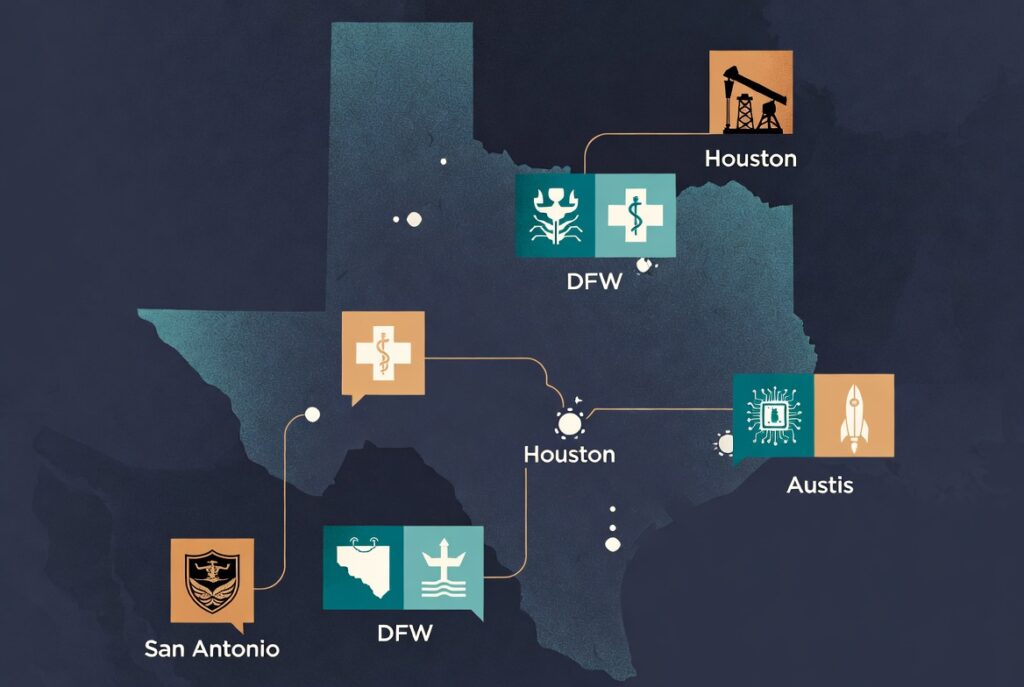
The Dallas market, the Houston market, and the Austin market each have distinct competitive dynamics, dominant industries, and local search behaviors. A web and digital agency that has genuinely served clients in your metro should be able to discuss what those differences look like in practice. And how local search intent varies. What industries are hypercompetitive in which cities, and what have they observed about user behavior in a specific Texas market?
Generic answers, “yes, we’ve served many Texas clients” with no supporting detail, suggest either shallow work or surface-level market knowledge. Both translate to less relevant guidance for your specific situation.
Question 8: How Do You Handle Revision Requests, and What Exactly Constitutes a Scope Change?
Ambiguity in revision policies is where projects exceed their budget and their timeline. Asking about this upfront is professional diligence, not pessimism.
Establish clearly: how many revision rounds are included in the quoted price. And how the agency defines a revision versus a scope change. Plus, how scope changes are priced and authorized, and where that policy is documented in the contract.
The agencies with mature processes have this documented and can walk you through it without friction. The agencies without mature processes will talk around it. Or they give you reassurances that sound reasonable but commit to nothing specific. The difference becomes very real at month two of a three-month project when you want to change the navigation structure.
Question 9: What Metrics Define a Successful Project for You — and How Do You Track Them?
This question separates digital growth partners from design vendors.
A vendor delivers a website. A growth partner defines success in terms of your business outcomes and has a plan for measuring them. Ask the agency what metrics they use to define project success. Such as conversion rates, organic search traffic, lead volume, bounce rate, page speed scores, and time on site. Ask how those baselines are established before launch and how performance is tracked after.
An agency that cannot articulate measurable success criteria in advance has no mechanism for knowing whether the work delivered value. You end up in the position of evaluating a beautiful website with no way to know whether it helped your business.
Question 10: Can You Walk Me Through a Project That Did Not Go as Planned — and What You Did About It?
This is the most revealing question on this list.
Every agency that has done meaningful work has experienced friction: a project where the direction changed mid-build, a technical problem that pushed the timeline back, a client relationship that required difficult conversations. What separates reliable agencies from unreliable ones is not whether those situations occurred. It is how they were handled.
An agency that cannot identify a difficult situation has either done too little work or is not being honest. An agency that can describe the situation but cannot articulate the resolution process does not have one. Look for candor, a specific and coherent account of what went wrong, and a clear description of the steps taken to correct it.
That level of transparency is one of the most reliable indicators of how an agency will behave when your project encounters the inevitable unexpected complication.
Texas-Specific Considerations Worth Adding to Your Process
Beyond the questions above, two factors distinguish the Texas web design market from the national picture.
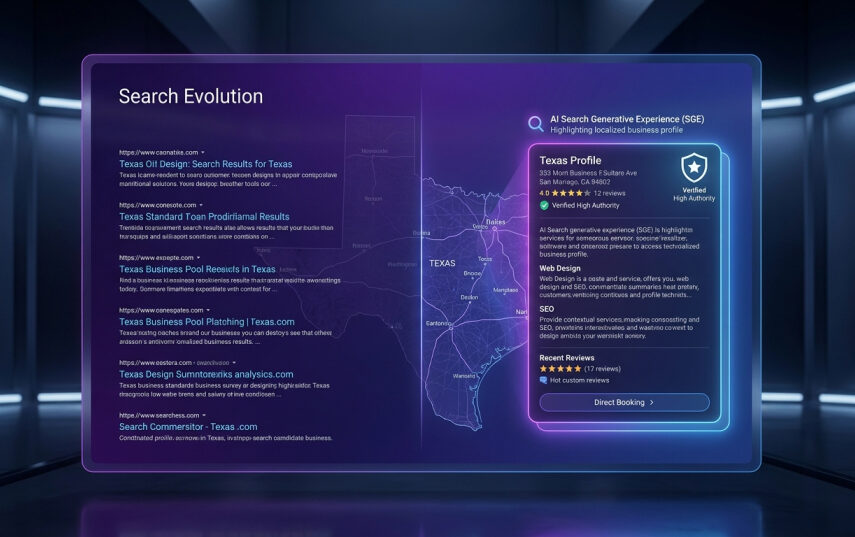
First, geographic spread creates real differences in competitive intensity. The DFW metroplex is not a single market. Irving, Southlake, Arlington, and Plano each have distinct business concentrations and local search environments. Houston is one of the most competitive local search markets in the country for home services, legal, and healthcare. Austin has different dynamics again, skewed toward technology-forward buyers and venture-backed businesses. An agency working across all of Texas needs to understand those differences, not treat the state as a single homogenous market.
Second, the pace of change in search behavior is accelerating. AI-powered search tools are reshaping how Texas buyers research vendors before they contact anyone. Businesses that are cited in AI search results because their website content is authoritative, specific, and well-structured are gaining a new traffic source that converts at higher intent than standard search. Agencies still operating under 2022-era design and SEO assumptions are building sites that will underperform in the environment Texas businesses are already operating in.
Massive Designs is based in North Richland Hills and works with businesses across Dallas, Fort Worth, Houston, Austin, and San Antonio. If you want to discuss what a project specific to your market would require, start a conversation here and the team will give you a direct, specific assessment.
Applying These Questions Practically
Do not save this list for a final agency interview. Use these questions early. When you first review an agency’s portfolio or read their service pages, let these questions shape what you are looking for. Notice what information is absent as much as what is present.
During initial calls, work through the five most critical questions based on your specific situation. A clean, confident set of answers will either accelerate the relationship or eliminate it quickly. Both outcomes are useful.
For more on how Massive Designs approaches web design and development specifically for Texas businesses, see our web design and development services page, which addresses these same standards on our own terms.
On top of that, for context on how we position design and SEO together, the post on WordPress vs. custom web development in Texas covers the strategic tradeoffs worth understanding before you choose a platform.
The right Texas web design company will answer every question on this list without hesitation. That readiness is not arrogance. It is accountability.