Most conversations about digital marketing ROI happen in one of two registers. An agency presents a case study where everything worked spectacularly, or a business owner recounts money spent with nothing measurable to show for it. Neither version helps a Texas small business owner make a sound budget decision.
What SMBs across Dallas, Houston, Austin, and San Antonio actually need is a clear-eyed picture of what different channels return, how long they take to produce those returns, and what internal conditions have to exist for the benchmarks to hold. The figures in this guide reflect current industry data from 2025 and 2026, applied with specific attention to the Texas SMB market, where competitive intensity, industry density, and buyer behavior create conditions that differ from national averages in ways that matter.
This is not a pitch for any single channel. It is a realistic assessment of what works, what demands patience, and what routinely disappoints when businesses underestimate the commitment required.
One Caveat Before the Channel Data
Benchmarks describe averages across large, varied sample sets. A plumbing company in Katy, Texas and a law firm in Dallas can invest identically in the same channel and see dramatically different results based on competition level, customer lifetime value, website quality, and the competence of whoever manages the campaign.
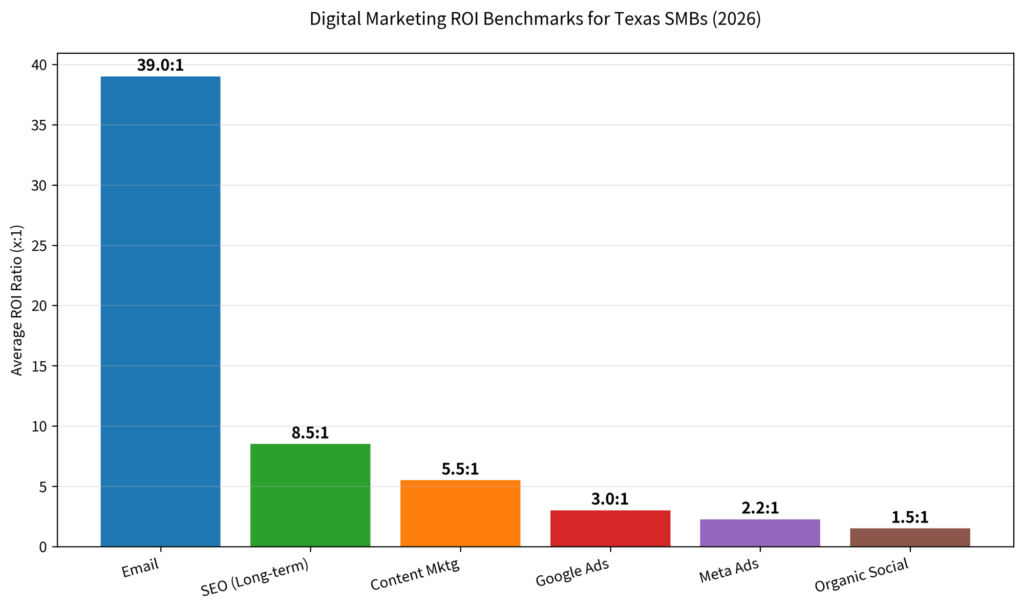
The industry-standard benchmark for “good” digital marketing ROI sits at approximately 5:1 — five dollars returned for every dollar spent, according to widely cited data from sources including Sender and HubSpot’s 2026 State of Marketing Report. A 10:1 return is exceptional. Below 2:1, most channels are not covering opportunity cost.
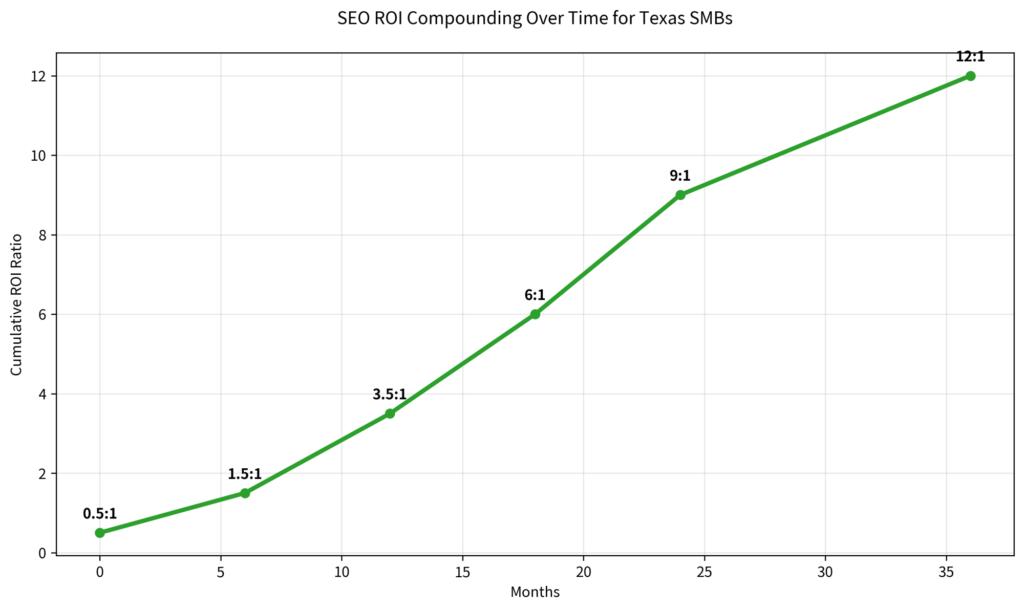
What that ratio does not capture is time horizon. An SEO investment that returns 2:1 in year one and 15:1 by year three may be a far stronger business decision than paid search at a stable 3:1, depending on your cash flow position and how long you can hold the investment. Texas business owners evaluating marketing channels need to consider both the expected return and the expected timeline, and whether both align with where the business currently stands.
SEO and Organic Search
Realistic ROI for Texas SMBs: 5:1 to 12:1 over 24 to 36 months
According to HubSpot’s 2026 State of Marketing Report, website, blog, and SEO efforts collectively represent the top ROI-generating channel in digital marketing. That ranking reflects a fundamental mechanical reality: organic traffic compounds. A page that ranks well in Google today keeps generating leads six months from now without incremental spend.
For Texas small businesses, local SEO carries outsized value. Search queries like “emergency HVAC repair Houston” or “commercial roofing contractor DFW” represent transactional intent from buyers who have already made a purchase decision in their minds and are looking for the right company to execute it. A single qualified customer from that category, in a service business with even moderate lifetime value, can deliver returns that dwarf the monthly investment several times over.
The critical constraint is timeline. Most Texas SMBs competing in active local markets should expect 6 to 12 months before meaningful organic traffic movement appears. Businesses that abandon SEO at month four because they have not seen results yet are making the common mistake of measuring a long-cycle investment against a short-cycle expectation.
The conditions that produce strong SEO ROI for Texas businesses:
A technically sound website is the baseline. Without fast load times, mobile responsiveness, and clean site architecture, content production compounds nothing. Local signals matter substantially: a well-maintained Google Business Profile, consistent local citations across directories, and a healthy review velocity all influence local pack rankings. Content investment tied to actual search intent drives the compounding returns, while generic blog posts that nobody is searching for produce traffic that does not convert.
The integrated approach that consistently outperforms in Texas is one where web design, SEO, and content operate as a single system rather than separate service lines. Massive Designs’ Texas SEO services are structured around exactly that integration — technical SEO built into the website foundation, local optimization maintained consistently, and content planned against real search data.
Google Ads and Paid Search
Realistic ROI for Texas SMBs: 2:1 to 4:1 return on ad spend for well-managed campaigns
| Category | Dallas (DFW) | Houston | Austin | San Antonio |
| Legal / PI | $15.00+ | $12.50+ | $14.20+ | $9.80+ |
| Home Services | $85.00 | $92.00 | $78.00 | $65.00 |
| B2B Services | $4.50 | $3.90 | $5.10 | $3.25 |
Paid search fills the gap that SEO cannot: day-one visibility in Google results. For a business that has recently launched, is running a time-limited promotion, or operates in a service category where buyers make decisions quickly, Google Ads can deliver qualified traffic immediately while organic authority builds.
The tradeoff is efficiency and dependence. Average ROAS (return on ad spend) across Google Ads in 2025 landed at approximately 2.95:1, according to industry benchmark data, though well-managed campaigns in high-value service categories routinely exceed that. The critical qualifier is “well-managed.” An unattended Google Ads account in a competitive Texas market will spend its budget reliably and generate leads inconsistently.
Cost per click in Texas’s most competitive service categories, such as legal, healthcare, home services, and financial services, has continued to rise. That does not make paid search unattractive. It means that the campaigns generating the best ROI in those categories are built with precision: tight keyword targeting, disciplined negative keyword management, landing pages built specifically for the query intent rather than pointing traffic to a homepage, and regular optimization informed by conversion data rather than click data.
The Texas SMB mistake most damaging to Google Ads ROI is treating the channel as infrastructure rather than as an active campaign. Ads that ran without adjustment six months ago are almost certainly underperforming compared to what a current, optimized version of the same campaign would deliver.
For service businesses with high customer lifetime values like HVAC installations, legal representation, home renovations, and medical services, a $120 cost-per-lead is not expensive. It is irrelevant whether the average contract value makes it invisible. The math only breaks down when lifetime value is low and acquisition cost is high, which is why channel selection should always start with your specific unit economics.
Social Media Advertising (Meta and Instagram)
Realistic ROI for Texas SMBs: 1.5:1 to 3:1 depending on offer type and audience precision
Facebook and Instagram advertising ROI has declined on a per-dollar basis as platform competition has increased and ad costs have risen. Broad awareness campaigns targeting generic demographic audiences in Texas metros frequently run near the break-even line for local service businesses today.
Where Meta advertising still generates a strong ROI for Texas SMBs is in more targeted applications. Retargeting campaigns, served to people who have already visited your website or engaged with your social content, consistently outperform prospecting campaigns at 10x or greater click-through rates and substantially higher conversion rates. Local awareness campaigns for businesses with strong community positioning (restaurants, gyms, boutiques, event spaces) can drive high-quality local engagement when the creative quality is strong and the audience targeting is specific.
The most common reason Meta ad spend underperforms for Texas SMBs is creative quality, not audience targeting. Generic imagery, template-style ad copy, and offers with no urgency or specificity produce passive scrolling, not conversions. Texas buyers in competitive markets have seen enough digital advertising to recognize and ignore low-effort creative.
For B2B-oriented Texas businesses, technology firms in Austin, professional services in Dallas, and healthcare operators in Houston, LinkedIn advertising typically outperforms Meta for lead quality, though at significantly higher cost per click. B2B brands with well-defined professional audiences and high-ticket offers can generate a strong pipeline from LinkedIn, but should budget for CPCs that are three to five times higher than Meta equivalents.
Email Marketing
Realistic ROI for Texas SMBs: $36 to $42 returned per $1 spent, for businesses with engaged, permission-based lists
Email marketing has earned its reputation as one of the highest-ROI channels available to small businesses. The $36-per-dollar benchmark, reported consistently in HubSpot and Omnisend research, reflects the fundamental economics of the channel: once a list exists and an automation system is in place, distribution cost is essentially zero.
For Texas SMBs, the barrier is not the channel mechanics. It is building the list. A permission-based email list requires a clear value proposition for subscribing, consistent content delivery that maintains subscriber interest, and enough initial audience to make segmentation meaningful. Conversion rates by channel data confirm that list quality consistently outweighs list size. Businesses with high transaction frequency — retail, home services, restaurants, and fitness can build lists relatively quickly from existing customers. Professional service firms and B2B businesses typically need longer-term nurture content to grow a list worth investing in.
The segments of the Texas SMB market that systematically underinvest in email tend to be service businesses: HVAC, plumbing, landscaping, legal practices, and accounting firms. These are also exactly the categories where re-engagement campaigns, maintenance reminder sequences, and seasonal service offers can generate strong returns from an existing customer base without any new customer acquisition cost whatsoever.
Automation compounds email ROI substantially. Automated sequences, welcome flows, service follow-ups, review request campaigns, reactivation sequences, generate returns at multiples of what one-off broadcast emails achieve, because they deliver relevant messages at contextually appropriate moments rather than on the sender’s schedule.
Content Marketing
Realistic ROI for Texas SMBs: 3:1 to 8:1 over 18 to 24 months
Content marketing is the long-cycle investment with the widest variance in execution quality. Done poorly, it produces blog posts that generate no traffic and no conversions. Done well, it creates a library of owned digital assets that drive qualified traffic for years after the content was published.
According to HubSpot’s 2026 data, small businesses are 23% more likely than average businesses to see ROI from blog posts. That advantage reflects a structural reality: small businesses competing in specific local markets with specific service offerings can achieve topical authority in their niche and geography far more efficiently than a national brand can. A Dallas tax attorney cannot rank for “tax attorney” nationally, but they can absolutely own local search results for “business tax attorney Dallas” and the related query ecosystem around it.
The ROI mechanism for content marketing is not engagement metrics. It is conversion-ready traffic from buyers in the active research phase. A Texas roofing company that publishes detailed, accurate content about hail damage insurance claims, specific to DFW markets, written by someone who actually knows the process, is not producing content for visibility alone. They are placing a highly relevant answer directly in front of a buyer who already has the problem and is actively evaluating who to call.
That is a fundamentally different proposition from a paid ad interrupting a browsing session. And unlike the paid ad, the content continues to work six months after it was written.
Massive Designs’ content marketing services are built around a buyer-intent framework rather than content for its own sake, research first, then production of assets that map to actual search behavior and purchase decision stages.
Organic Social Media
Realistic ROI for Texas SMBs: Variable; strong for brand equity, weak for direct lead generation
Organic social media reach has declined significantly across most platforms as algorithmic distribution has shifted toward paid content. Expecting organic social to function as a primary lead-generation channel is, for most Texas businesses today, an expectation that will produce disappointment.
Where organic social still earns its place in a Texas SMB marketing mix is in brand-adjacent functions: demonstrating work quality for visually compelling services (contractors, designers, restaurants, fitness businesses), building local community presence, reinforcing existing customer relationships to drive repeat business, and accumulating social proof through reviews and testimonials.
The framing that works best for Texas business owners is to treat organic social as a trust-building layer that supports conversion activity happening elsewhere, rather than as a direct lead-generation engine. The business that posts consistently, showcases real work and real results, and maintains an active and responsive presence is better positioned to convert leads from search, referrals, and paid campaigns, because by the time a prospect checks the social presence, the content confirms they are looking at a credible, active operation.
Local SEO and Google Business Profile
Realistic ROI for Texas SMBs: High, particularly in service-area businesses with strong review profiles
This is consistently the most underutilized and undervalued digital marketing channel for Texas service businesses. In many cases, it delivers the highest ratio of return to investment available to a local SMB.
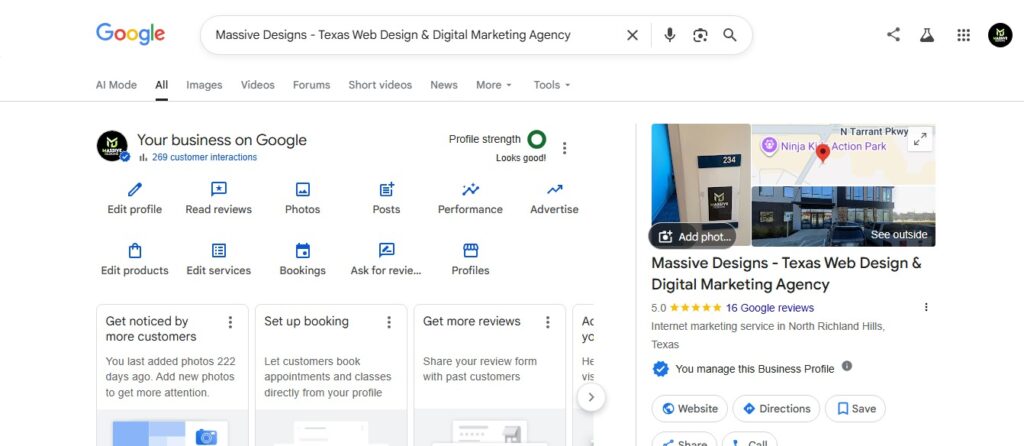
A fully optimized Google Business Profile with accurate and consistent NAP information (name, address, phone), strong review volume, regular photo updates, and active post activity directly drives phone calls, direction requests, and website visits from nearby buyers at the peak of purchase intent. In Texas markets like Fort Worth, Plano, and San Antonio, winning the local search pack for a relevant service query can mean a business appears above its organic competitors on every mobile search result in the metro.
For home services, healthcare, legal practices, food and beverage, and fitness businesses across Texas, local search visibility through Google Maps is often the single most efficient marketing investment available. The cost of optimization is modest. The competition, while real, is often beatable with basic consistency. And the intent of a buyer searching for a service in their city right now is about as high as purchase intent ever gets.
Businesses that skip local SEO in favor of paid advertising alone are paying Google to deliver the same traffic that local optimization could supply at near-zero marginal cost.
The Channel Texas SMBs Cannot Afford to Ignore in 2026: AI Search Visibility

One development reshaping ROI calculations across all digital marketing channels is the rise of AI-powered search. ChatGPT, Perplexity, Google’s AI Overviews, and related tools now influence a growing share of buying decisions before a user ever visits a company’s website.
Available 2026 data indicates that AI referral traffic converts at significantly higher intent than standard organic search traffic. Because those users have already done research through AI tools before arriving. They arrive informed. They ask fewer preliminary questions. And they are often already close to a purchase decision.
For Texas SMBs, this represents both an opportunity and a risk. Companies producing thin, keyword-stuffed content for ranking purposes are already losing visibility in AI-generated answers. Companies producing genuine expert content that answers specific questions in depth, content that AI tools can cite as authoritative, are building digital authority that pays dividends across search, AI, and referral channels simultaneously.
This is one of the practical reasons that content quality has surpassed content volume as the central variable in SEO and digital marketing strategy. Fifty mediocre posts will not compete with ten outstanding ones in either traditional search or AI-generated answers. For Texas businesses in competitive local markets, that distinction is increasingly a competitive differentiator.
Sequencing Channels by Business Stage
No single channel wins universally. The most practical framework for Texas SMBs with constrained budgets is to sequence channels based on time horizon and business need rather than trying to fund everything simultaneously.
A working approach for most Texas service businesses:
Months 1 through 3: Foundation work. Website technical performance, Google Business Profile optimization, local citation cleanup. These are low-cost, high-leverage, and create the base that every other channel depends on.
Months 3 through 9: Visibility building. Content production tied to local search intent. Google Ads for immediate lead volume in priority service categories. Email list activation if customer data exists.
Months 9 through 18: Amplification. Social media reinforcement. Deeper content production. Email automation sequences. Beginning to reduce paid search dependency as organic traffic builds.
Month 18 and beyond: Compounding returns from SEO and content. Paid channels become supporting tools rather than primary lead sources. Cost per acquisition drops as owned channels mature.
Businesses that attempt to run every channel simultaneously on a limited budget typically execute none of them at the standard that produces results. Focused investment in the two or three channels most aligned with your specific business model and customer acquisition pattern will consistently outperform scattered spending across every available option.
For a more specific conversation about which marketing channels make the most sense for a Texas business at your stage, the team at Massive Designs is available to walk through your specific situation. Start that conversation here.
And for a related look at how these same channels are being applied with specific tools in the Texas market, the post on content marketing platforms for Texas businesses covers the technology infrastructure that makes campaign execution scalable.