Nearly all local business research today starts with a search engine, and Google handles the large majority of that volume. For service businesses operating anywhere in Texas, from Fort Worth and Dallas to San Antonio, Austin, and Houston, the Google Business Profile is the most visible real estate you control in local search. It appears on your website. It appears before paid ads in many local searches. And it is what most customers see first when they search for a business like yours.
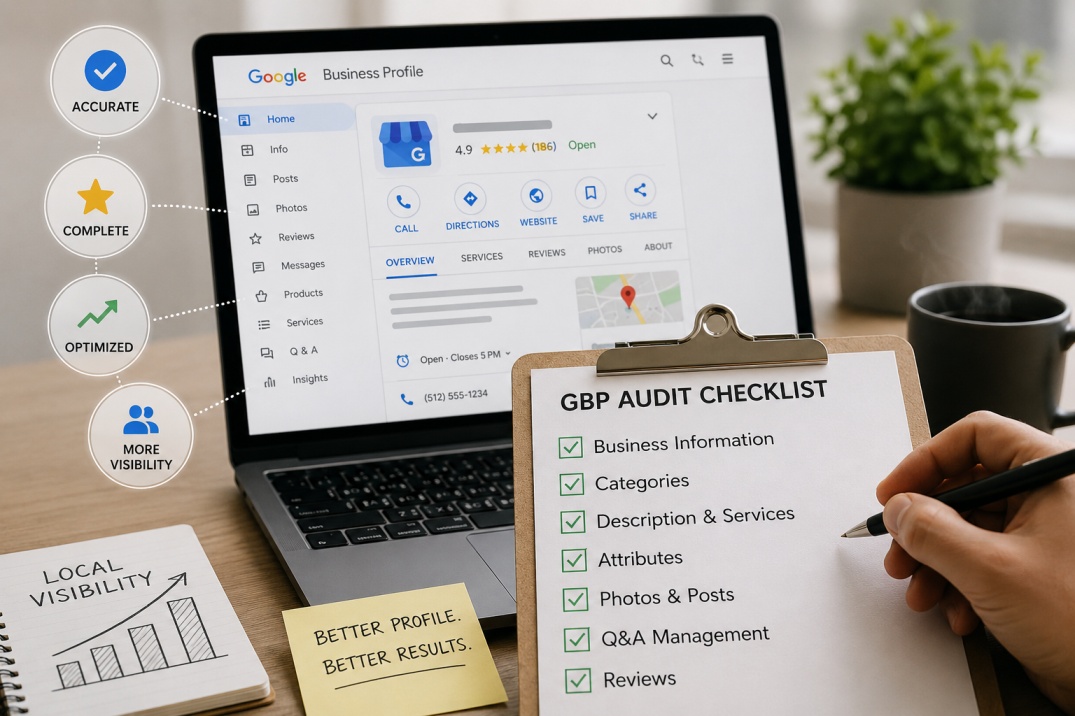
We’ve already covered the broader local SEO strategy behind that visibility in our Fort Worth and Austin guides, everything from citation building to review velocity to content clusters. This checklist is the companion piece. A section-by-section audit of the profile itself, written for a business owner who wants to sit down, work through their own GBP field by field, and know exactly what to fix first.
The problem most Texas service businesses run into is treating GBP setup as a one-time task rather than an ongoing optimization discipline. A profile that was set up in 2022 and left unchanged is not a competitive local search asset in 2026. Work through each section below methodically, and you will have a clear picture of exactly where your profile stands and what needs to change.
Why This Is Worth a Full Audit, Not Just a Glance
Google’s local ranking algorithm evaluates three factors for every local search,i.e, relevance, distance, and prominence. Category selection and service descriptions control relevance. Service area settings and address information affect distance. Review count, recency, and response patterns feed into prominence. We break that framework down in detail in our Fort Worth local SEO guide, so we won’t repeat it here in full. What matters for this checklist is simpler than every section below maps directly to one or more of those three factors, and a gap in any of them is a gap Google can see.
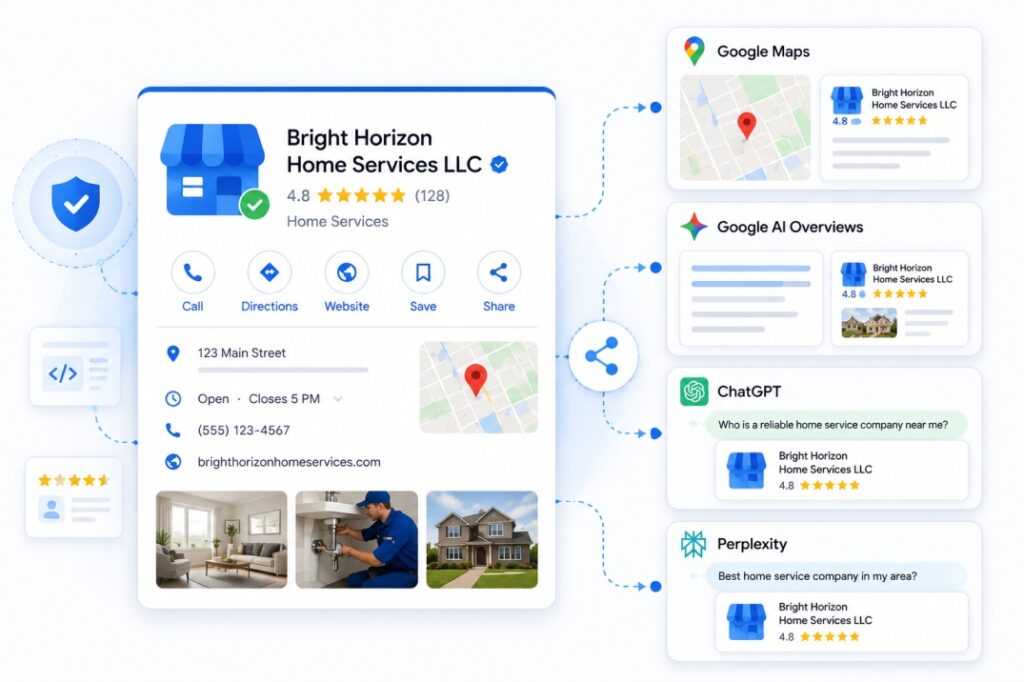
What’s changed in 2026 is that GBP is no longer just a Google Maps ranking factor. It’s also a key input for AI-generated local results. When someone asks Google’s AI Overviews, ChatGPT, or Perplexity for a local business recommendation, these tools draw from the same signals: your GBP data, your reviews, your website content, and your structured data. A fully optimized profile gives your business the best chance of appearing across all of these surfaces at once.
Section 1: Business Information Completeness
Business Name
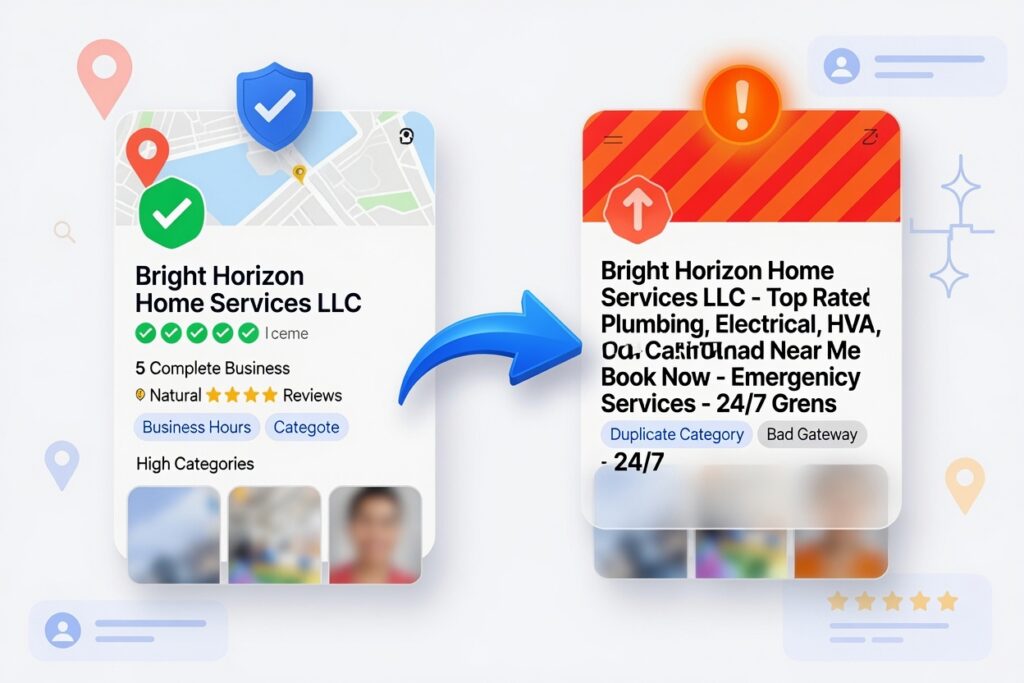
Your GBP business name must match your legal business name exactly, with no keyword stuffing. Google’s terms of service prohibit adding city names, service keywords, or taglines to the business name field. Beyond the compliance risk, keyword-stuffed names often trigger user suspicion and can lead to profile suspension. If your business is ‘Lone Star Roofing LLC,’ that is what should appear in your profile, not ‘Lone Star Roofing LLC Best Roofer Dallas TX.’
Business Categories
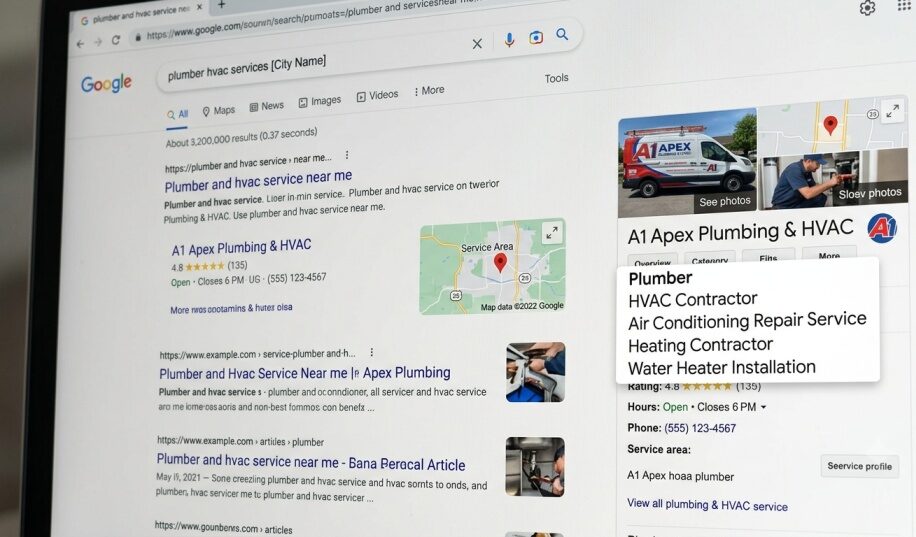
Category selection is the single most impactful controllable action on your GBP, and it’s the one factor that shows up in nearly every local ranking factor study as a top-tier signal. Choose your primary category to match the most specific description of your core business. A company that does both plumbing and HVAC should pick the service that generates the most revenue as the primary, and add the other as a secondary. Google allows up to nine additional categories; use all that are genuinely applicable.
Common category mistakes worth checking your own profile against:
- ‘Contractor’ should be ‘General Contractor’ or the specific trade type (Roofing Contractor, Electrical Contractor)
- ‘Lawyer’ should be the practice area: Personal Injury Attorney, Family Law Attorney, Criminal Defense Attorney
- ‘Doctor’ should be the specialty: Family Practice Physician, Pediatrician, Orthopedic Surgeon
- ‘Restaurant’ should be the cuisine or format: Mexican Restaurant, Barbecue Restaurant, Fast Food Restaurant
- ‘Real Estate Agent’ should be verified against whether the primary business is residential or commercial, buyer representation or seller representation
Business Description
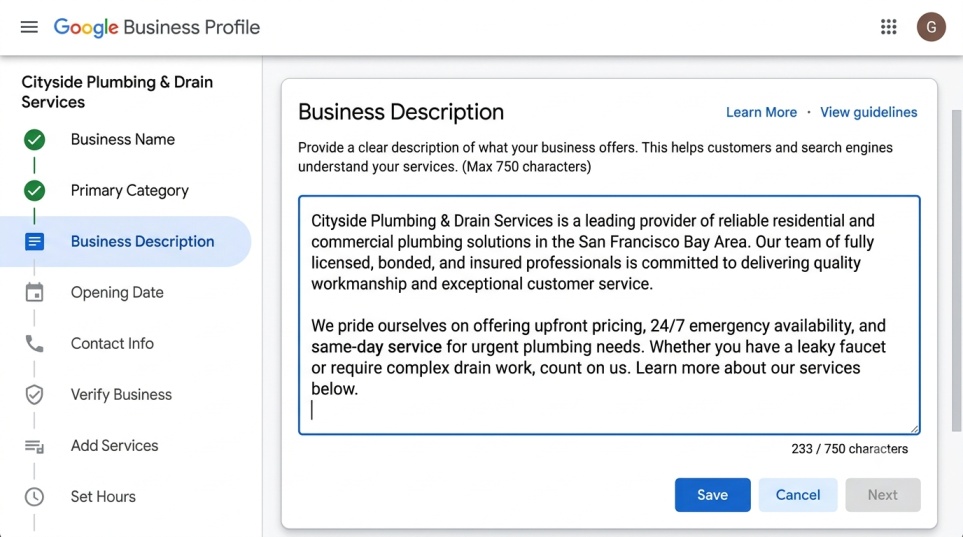
Your business description has a 750-character limit and serves two audiences at once in 2026: human searchers and AI systems. Write naturally, with keyword awareness but without stuffing, because AI models like ChatGPT and Google’s AI layer use your description when generating summaries and recommendations.
A strong Texas service business description opens with what you do and who you serve, includes the cities or regions you cover, mentions one or two specific differentiators, and closes with a clear action signal. The first 250 characters appear in the GBP card without expansion, so lead with the most important information.
Service Area vs Physical Address
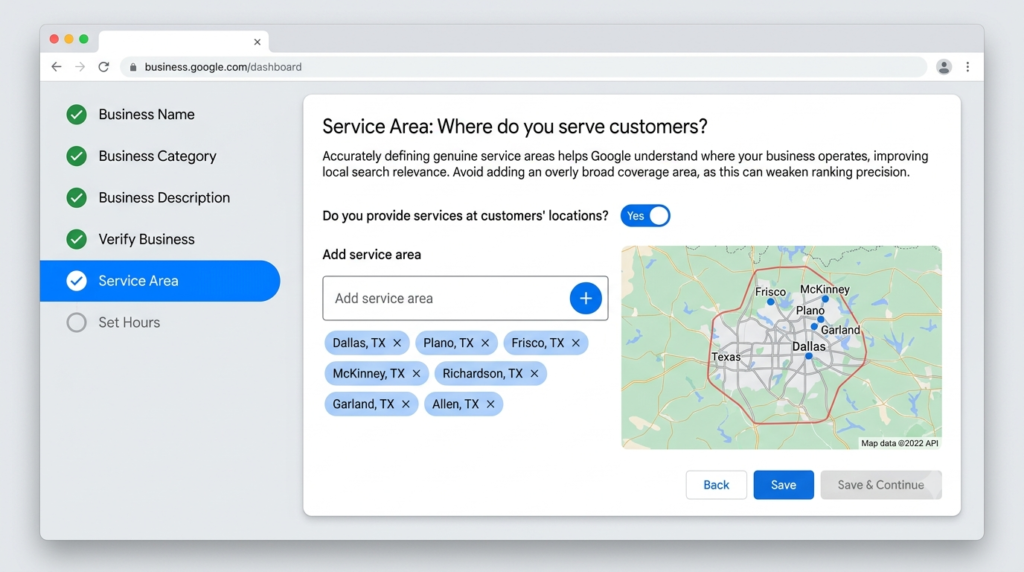
Texas service businesses that work at customer locations, such as plumbers, HVAC technicians, landscapers, and mobile auto detailers, need to use the Service Area Business settings rather than displaying a storefront address. Google allows you to list specific cities, counties, or zip codes as your service area. For Texas businesses covering multiple cities, list every community where you genuinely serve customers.
Do not exaggerate your service area. Google cross-references your claimed area against your actual job history, reviews that mention service locations, and the geographic distribution of your customers. An unrealistically large claimed area can reduce your ranking precision in the areas where you most reliably serve.
Phone Number, Website, and Booking Links
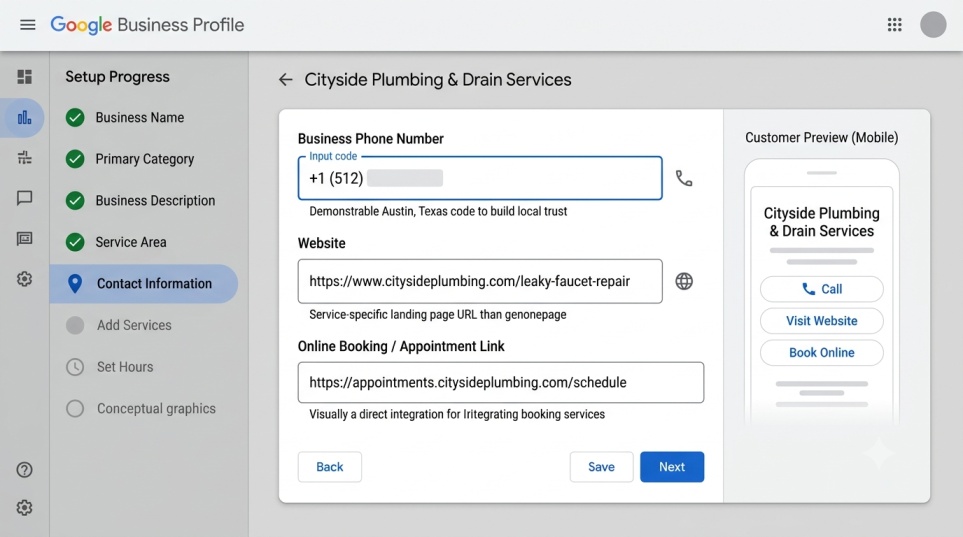
Use a local area code where possible. Texas consumers searching for local services tend to trust businesses displaying Texas area codes (210, 512, 214, 817, 713, and similar) more than toll-free numbers. Your website link should point to a landing page that matches the primary service your GBP profile represents, not necessarily your homepage. If your business uses an online booking system, connecting it to your GBP profile directly reduces the friction between a searcher finding you and becoming a customer.
Section 2: Review Management, the Parts Most Checklists Skip
Review volume and review response are covered well in our Fort Worth and Austin articles, so here we’ll focus on the operational side: how to actually keep a review pipeline running instead of just knowing that you should.
Building a Review Generation Process
The most reliable review generation system is the one built into your existing service delivery process rather than treated as a separate marketing task. At the close of every completed job, technicians or account managers should send a direct link to the GBP review form by text message. Text-based requests consistently outperform email because they reach the customer immediately after the service experience, when satisfaction is highest.
A simple system that works: complete the job, then send a text within two hours along the lines of, ‘Thanks for choosing us. If you had a great experience, a quick Google review helps our local team enormously — here’s the direct link.’ Businesses that implement something like this consistently generate several times more reviews per month than those relying on passive, occasional requests.
Writing Review Responses That Actually Help Rankings
Your review responses are a content field Google reads for keyword relevance. A plumbing company that responds to reviews with natural mentions of the specific service performed and the neighborhood served is adding geographic and service relevance signals that a dormant, unanswered review section doesn’t have. For positive reviews, thank the customer by name and reference something specific about their experience. For negative reviews, acknowledge the concern without being defensive, and offer a direct path to resolution. Never argue with a reviewer publicly.
Section 3: Visual Content and Google Posts
Photos
Photos are among the most frequently overlooked GBP elements. Texas service businesses should maintain all of the following photo types:
- Cover photo: a clean, professional image representing the business or team
- Logo: a high-resolution version of your business logo matching your brand standards
- Exterior photos: at least two clear shots of your business location or service vehicle
- Team photos: real images of your team members, used as an E-E-A-T signal that real people are behind the business
- Work-in-progress and completed project photos directly relevant to the services you offer
Google Posts
Google Posts appear directly in your GBP card in search results and remain one of the most underused features across Texas business profiles. Three post types are most effective for Texas service businesses:
- What’s New posts: recent projects, company news, team additions, or seasonal service availability
- Offer posts: current deals, seasonal discounts, or first-time customer incentives with clear expiration dates
- Event posts: in-person events, open houses, community involvement, or service demonstrations
Each post should include a clear call to action and a link to the relevant page on your website. This drives traffic from your GBP to your site and reinforces the connection between the two.
Section 4: Services, Attributes, and Q&A
Services Section
The Services section lets you list specific offerings with descriptions and, in some categories, prices. It’s frequently left incomplete by Texas service businesses, which is a missed opportunity, since Google uses your services list to determine which searches your profile is relevant for. A roofing contractor that lists only ‘roofing’ may not appear for ‘roof inspection’ or ‘gutter installation’ searches from customers within its service area.
Add every service your business genuinely offers. Write descriptions in natural language that matches how your customers describe what they need, and keep each one clear, specific, and roughly 100 to 300 characters.
Business Attributes
Attributes are business characteristics that appear in your profile and help customers know what to expect. Available attributes vary by category, but most Texas service businesses have access to attributes covering payment methods, accessibility features, service offerings, and customer experience qualifiers. Select every attribute that honestly applies. Attributes also influence which filtered searches your business appears in on Google Maps.
Questions and Answers
The Q&A section allows anyone with a Google account, not just verified customers, to ask and answer questions about your business. Many Texas business owners don’t realize competitors can post answers here too. Monitoring and populating this section with accurate, business-verified answers is a reputation management step that’s easy to skip and costly to ignore.
Proactively add the questions your customers actually ask and answer them in your own voice. Questions like ‘do you serve the Keller area,’ ‘what payment methods do you accept,’ ‘how quickly can you schedule an appointment,’ and ‘are you licensed and insured in Texas’ work well and also add naturally keyword-relevant content to your profile.
Section 5: Technical Signals and GBP-to-Website Alignment
NAP Consistency
Your GBP name, address, and phone number must match exactly across every online platform where your business is listed, including Yelp, Bing Places, Apple Maps, the Better Business Bureau, and local Chamber of Commerce directories. Format consistency matters: if your GBP address reads ‘4521 Preston Road, Suite 200, Plano, TX 75024,’ that exact format should appear everywhere, not ‘Preston Rd’ in some places and ‘Preston Road’ in others.
Run a citation audit at least once every six months. Phone numbers get updated, suite numbers change, businesses relocate, and any change needs to propagate systematically across every directory listing, not just Google.
Website Alignment
Your GBP and your website need to reinforce each other. The address and phone number on your website should match your GBP exactly, and your website should carry LocalBusiness schema markup confirming the same information. When someone clicks through from your GBP to your website, the landing page should match what the profile promised. A profile describing a Fort Worth roofing company should link to a page that clearly discusses roofing services in Fort Worth, not a generic Texas homepage with no geographic specificity.
LocalBusiness Schema Markup
LocalBusiness schema is structured data added to your website that helps Google and AI models read your business information in machine-readable format. A complete implementation for a Texas service business includes: name, address, telephone, geo coordinates, url, openingHoursSpecification, areaServed listing the specific cities and counties you serve, and hasOfferCatalog linking to your services. Use Google’s Rich Results Test tool to verify your schema is implemented correctly before publishing.
Section 6: GBP Performance Tracking
GBP provides built-in analytics showing how customers found your profile, what actions they took, and how performance has trended. Review these metrics monthly as part of your local SEO routine:
- Search queries: the actual terms people typed to find your profile, revealing whether they align with your target keywords
- Profile views: how many people saw your GBP in search results or on Google Maps
- Customer actions: calls, direction requests, website visits, and message requests, the conversion metrics that connect GBP activity to business outcomes
- Photo views: which photos get the most views, informing what visual content to prioritize
Connect your GBP to Google Analytics to see how much traffic arrives from your profile and how those visitors behave on your site. That closes the loop between your optimization work and measurable results.
Priority Order If You’re Starting From Scratch
If you’ve worked through this checklist and found gaps everywhere, address them in this order: category selection first, since it’s the highest-weight individual factor; profile completeness second; review velocity third; and technical alignment fourth. Starting with category selection delivers the fastest visible movement because it’s the single factor most local ranking studies rate above nearly everything else.
At Massive Designs, we’ve built and audited GBP profiles for service businesses across Fort Worth, North Richland Hills, and the broader DFW region, and we extend the same structured process to clients throughout Texas. If you want to know exactly where your profile stands against competitors in your market, our team can walk through a complete GBP audit with you.