
San Antonio is the second-largest city in Texas and the seventh-largest in the United States, with a 2026 population of more than 1.57 million people and a metro region that covers the full Bexar County area and extends across eight surrounding counties. The San Antonio and New Braunfels metro added 48,071 new residents in a single year, ranking ninth nationally for numeric population growth. The regional gross metropolitan product reached $192.8 billion in 2024 and is projected to approach $210 billion in 2026.
That scale of growth creates exactly the kind of environment where strong San Antonio SEO services determine whether a business captures a growing customer base or watches that base flow to better-optimized competitors. A large share of San Antonio small businesses maintain an active website, but relatively few have implemented a fully optimized local SEO strategy. That gap is a big part of why so many businesses in this market are being consistently outranked by competitors that are not necessarily better, just better found.
This article breaks down the specific reasons San Antonio businesses lose rankings, the structural differences between businesses that dominate search results and those that do not, and the step-by-step fixes that produce real ranking movement in Bexar County’s local search environment.
Why San Antonio’s SEO Landscape Is More Competitive Than It Looks
At first glance, San Antonio can appear to be a more accessible local SEO market than Dallas or Austin. The city does not have Austin’s density of tech-forward digital marketing businesses, and its overall search volume for competitive terms runs lower than DFW. But that perception leads directly to the first mistake San Antonio business owners make: underestimating the competition that is actually present.
San Antonio’s economy is built on diverse industries that generate high-value local search queries every day. Healthcare is the dominant sector, with the South Texas Medical Center employing tens of thousands of people and anchoring a cluster of hospitals, clinics, and specialty practices all competing for patient searches. The military presence at Joint Base San Antonio creates a large, mobile population that searches heavily for local services. Tourism around the River Walk, the Alamo, and the Pearl District drives hospitality and restaurant search volume. Legal, home services, real estate, and construction all represent densely contested local search categories.
What makes San Antonio genuinely competitive is not the presence of sophisticated national agencies, but the sheer number of local businesses all targeting the same geographic queries at the same time. A roofing company in Stone Oak, a law firm in Alamo Heights, a dental practice in Helotes, and a landscaping company in Leon Valley are all fighting for local map pack positions using roughly the same profile signals. The ones that win are not the ones with the best service. They are the ones whose digital presence is more completely built.
The Most Common Reasons San Antonio Businesses Lose Rankings
Incomplete or Miscategorized Google Business Profiles
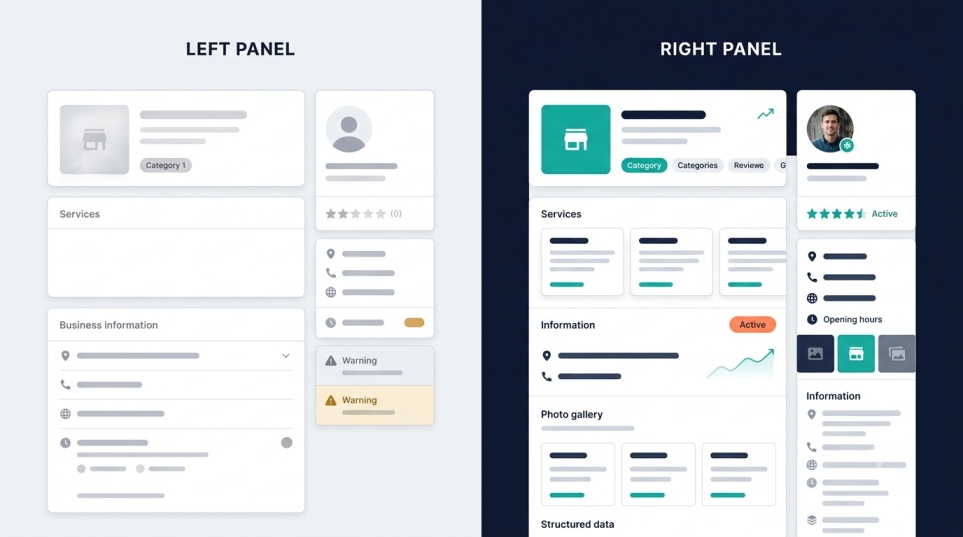
The single most impactful controllable factor in local search rankings is Google Business Profile category selection. Local ranking factor surveys, including Whitespark’s annual practitioner survey, consistently rate the primary GBP category among the most influential controllable signals in local pack positioning, ahead of most on-page factors.
In San Antonio, category miscategorization is extremely common. A general contractor that lists itself as a ‘construction company’ instead of ‘general contractor’ is targeting a different query universe. A personal injury law firm that uses ‘law office’ as its primary category instead of ‘personal injury attorney’ is competing in the wrong category for its most valuable searches. These choices look minor on the surface but have compounding effects on which queries the profile appears in, which directly controls how many potential customers ever see the listing.
The fix is straightforward. Review your primary category against the actual searches you want to win. Then add secondary categories for every additional service your business genuinely provides. Google allows up to nine additional categories, and most businesses in San Antonio use only one or two.
Review Gaps and Review Staleness

Businesses appearing in the Local 3-Pack for competitive San Antonio categories tend to carry noticeably higher review counts than businesses sitting at positions four through ten. But the count alone is not the whole story.
A business with 80 reviews averaging 4.7 stars with consistent recent activity will often outrank a competitor with 200 reviews averaging 4.9 stars if those 200 reviews were earned primarily in 2021 and 2022. Google weights review recency heavily because it treats recent reviews as evidence that a business is actively operating and currently serving customers well. A San Antonio HVAC company that earned 40 five-star reviews in a single spring campaign and then stopped asking has a review profile that ages out of its competitive advantage within 12 to 18 months.
Review response matters too. Review-response studies have repeatedly found that businesses which respond to all reviews convert inquiries at meaningfully better rates and build stronger trust than businesses that ignore them. For San Antonio service businesses where trust is a primary conversion factor, review responses are visible public evidence of how you handle customer relationships.
NAP Inconsistency Across San Antonio Directories
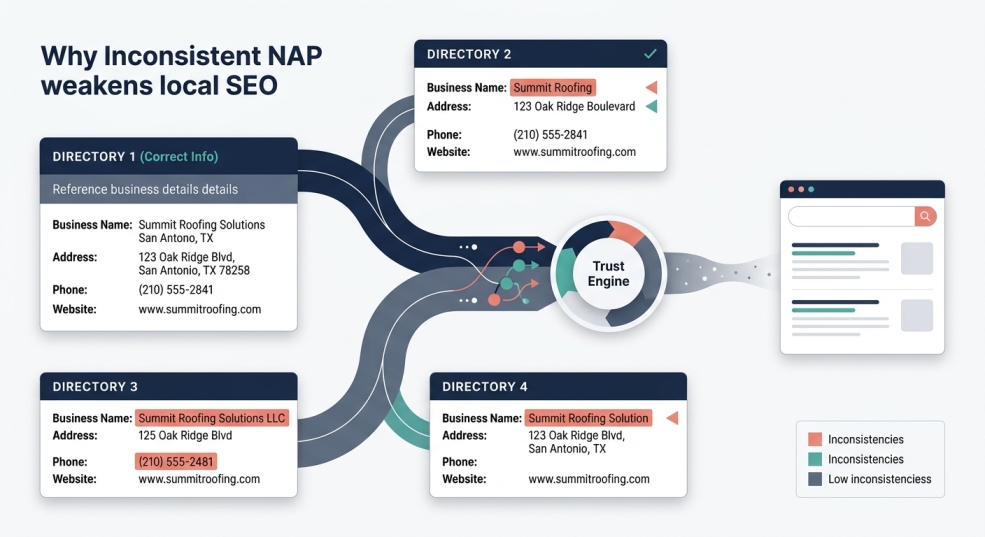
Name, Address, and Phone number consistency across online directories is a foundational local SEO signal that a large share of San Antonio businesses have never fully addressed. The Bexar County area has specific directories, Chamber of Commerce listings, and community business resources that are separate from the national citation sources.
When a roofing company in Converse lists its business name as ‘Texas Roofing Pro’ on Google, ‘TX Roofing Professionals’ on Yelp, and ‘Texas Roofing Professionals LLC’ on the BBB, Google reads those as three potentially different businesses rather than one consistent entity. The authority that each individual citation should contribute to the business’s local prominence score is diluted by that inconsistency. BrightLocal’s consumer research has consistently found that a majority of consumers say they would avoid a business after finding incorrect information about it online, a signal that NAP errors hurt both rankings and conversions.
Thin or Non-Existent Location and Service Area Pages
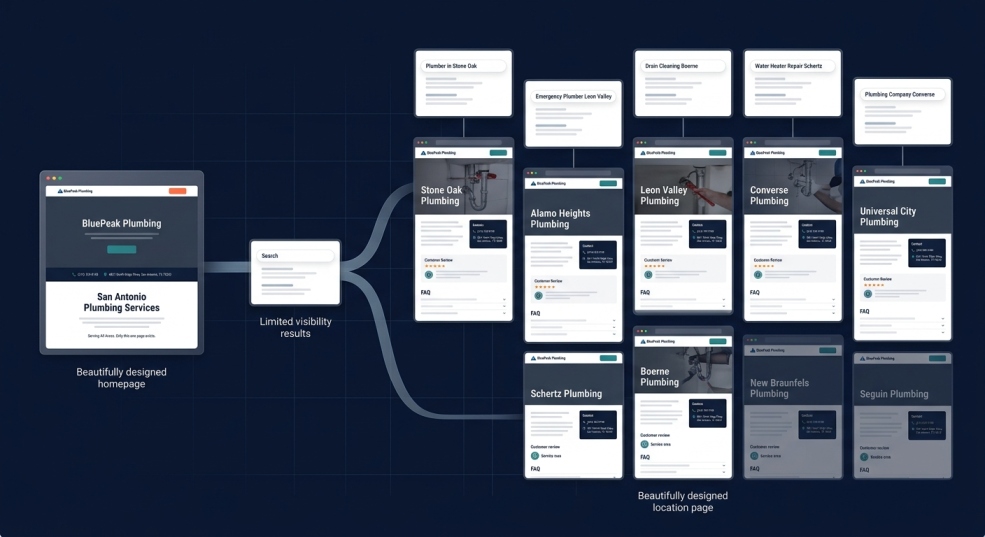
San Antonio’s geography creates specific sub-market search behavior that a single city-level page cannot capture. The city spans a large area with distinct neighborhood identities that residents and searchers treat as separate markets. Stone Oak in the north, Alamo Heights and Terrell Hills in the central east, Leon Valley to the west, and Converse, Universal City, and Schertz to the northeast all generate their own local search queries.
A plumbing company that serves all of these areas but has only a single ‘San Antonio plumber’ page is missing the search volume from every sub-area search. Businesses that create dedicated pages or locally optimized content for the specific Bexar County neighborhoods and surrounding communities where they operate capture that long-tail geographic search traffic that a generic city page ignores.
The surrounding New Braunfels, Seguin, and Boerne markets deserve similar attention. San Antonio businesses that serve these communities and create location-appropriate content for them rank in those smaller sub-markets where competition is significantly lower than within the city itself.
Weak or Absent On-Page Local Signals

Google needs to see geographic relevance signals not just on your Google Business Profile but throughout your website. A San Antonio business whose website homepage never mentions ‘San Antonio,’ ‘Bexar County,’ or any neighborhood it serves is asking Google to make an inference rather than reading a direct signal.
On-page local SEO for San Antonio businesses means having the city name in the H1 of key service pages, including geographic references naturally within the body content, embedding a Google Map of the business location, adding LocalBusiness structured data markup with the correct address and service area, and including schema that lists specific service types and geographic coverage.
None of this is complicated, but the majority of San Antonio small business websites have not been configured with these signals. That absence is precisely why businesses with weaker services sometimes outrank better businesses: they have more clearly communicated their location to Google’s algorithm.
What the Top-Ranking San Antonio Businesses Do Differently
Looking at the businesses that consistently dominate the Local 3-Pack for high-value San Antonio search terms reveals a clear pattern. They share several characteristics that have nothing to do with the size of their advertising budget.
First, they treat their Google Business Profile as an active business asset, not a one-time setup. They publish Google Posts at least twice per month, add new photos weekly, update their services list whenever their offerings change, and respond to every review within 48 to 72 hours. Active, frequently updated profiles consistently outperform dormant profiles with identical star ratings.
Second, they have review generation built into their operations rather than treated as a marketing initiative. The front desk of a Stone Oak dental practice that asks every departing patient for a review generates review volume that a business relying on occasional email campaigns cannot match.
Third, they have websites that are technically sound, mobile-friendly, and locally specific. Their service pages reference San Antonio, their neighborhoods, and the specific community context of their customers. Their structured data is correctly implemented. And their Core Web Vitals pass. These are baseline technical requirements in 2026 that many San Antonio business websites still do not meet.
San Antonio Neighborhoods and Surrounding Markets Worth Targeting
A complete San Antonio SEO strategy maps the business’s actual geographic footprint and ensures that each community it serves has appropriate digital representation. The Bexar County area includes distinct sub-markets with meaningful search volume:
- North San Antonio and Stone Oak: high-income demographics, strong demand for premium home services, healthcare, and professional practices
- Alamo Heights and Terrell Hills: established residential market with high owner-occupancy, strong real estate and home improvement searches
- South San Antonio and Southside: large working-class population with high search volume for affordable services across HVAC, auto, and food categories
- West San Antonio: Lackland AFB adjacent communities with a large military family population that searches frequently for local services
- Converse, Universal City, and Schertz: northeast corridor suburban growth areas with lower competition than central San Antonio for most service categories
- New Braunfels and Boerne: separate but reachable markets that San Antonio businesses often serve; low competition, strong buyer intent
- Helotes and Leon Valley: growing west-side suburbs with increasing demand for home services and professional practices
Service area businesses that create location-specific content or landing pages for these sub-markets capture the search volume that a single ‘San Antonio’ page cannot reach. In less competitive neighborhoods like Helotes or Converse, even a single well-optimized location page can achieve first-page rankings within 60 to 90 days.
The Role of AI Search in San Antonio Local Rankings
Local search in Bexar County now takes place across multiple platforms simultaneously. Google remains the dominant source of local search queries, but ChatGPT, Perplexity, and Google’s own AI Overviews are increasingly part of how San Antonio consumers research service businesses before making contact.
BrightLocal’s research on AI-generated local recommendations has found a meaningful gap between the business information ChatGPT and Perplexity surface and the data on the businesses’ actual Google Business Profiles. For San Antonio businesses, this inconsistency gap represents both a problem and an opportunity. Businesses that have incorrect or outdated information appearing in AI search results are losing leads to the AI-generated inaccuracy. Businesses with consistent, accurate, well-structured information across all platforms are being recommended correctly by AI tools, reaching an audience that never clicks a traditional search result.
Optimizing for AI search visibility in San Antonio requires the same foundational work as traditional local SEO: accurate GBP information, consistent NAP across directories, strong reviews, and structured data on the website. The additional step for AI visibility is ensuring that your website content directly answers the questions your customers are most likely to ask in a conversational AI search. A San Antonio HVAC company whose website includes clear, direct answers to questions like ‘how long does HVAC installation take in San Antonio’ or ‘what HVAC brands work best in South Texas heat’ is producing the kind of content that AI models extract and cite in their responses.
Building San Antonio SEO Authority Over Time
The businesses that hold the most durable San Antonio search rankings did not build them in a single campaign. They built them through consistent execution over six to eighteen months. The compounding nature of local SEO means that each month of consistent activity, whether review generation, GBP posting, citation building, or content expansion, adds to a growing foundation that becomes progressively harder for competitors to displace.
For a San Antonio service business starting from a weak baseline, a realistic timeline looks like this: foundational cleanup and GBP optimization produces measurable impression growth within 30 to 45 days. Citation audit and NAP corrections begin showing ranking stabilization within 60 to 90 days. Content expansion into neighborhood and sub-market pages starts generating additional traffic within 90 to 120 days. Local link building and review velocity compound all of the above signals into competitive Local 3-Pack positioning for primary service searches within 6 to 12 months.
That timeline reflects honest, realistic expectations for a competitive Bexar County market. Highly contested categories like personal injury law, roofing, or HVAC in San Antonio can take 12 to 18 months to achieve dominant positioning. Less competitive niches and surrounding sub-markets can rank meaningfully within 90 days.
At Massive Designs, we work with Texas service businesses across the state, including the San Antonio and Bexar County market. Our SEO approach combines the technical foundation, content strategy, and local signal building that produces compounding results rather than one-time ranking spikes, the same framework we’ve applied for service businesses in Fort Worth and Austin. If you are a San Antonio business that is being consistently outranked by competitors, a structured local SEO review is the first step toward understanding exactly why and how to fix it.